
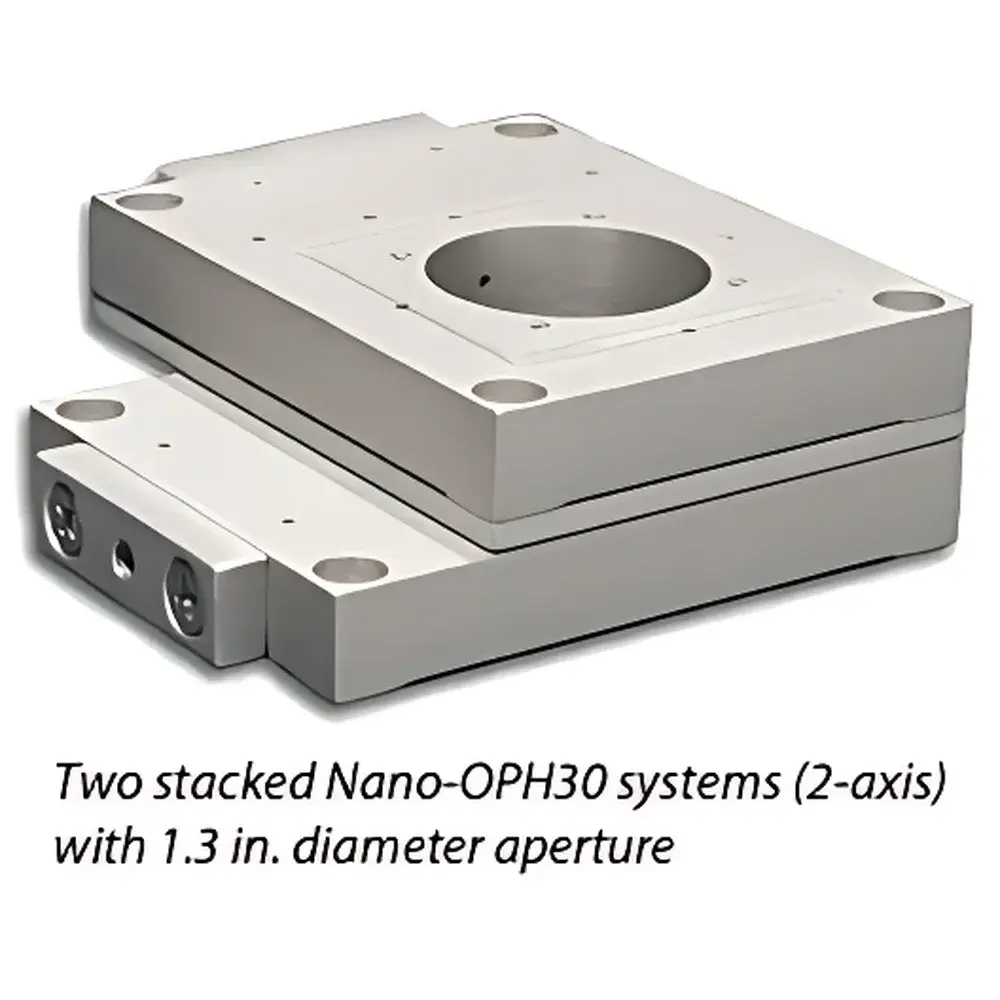
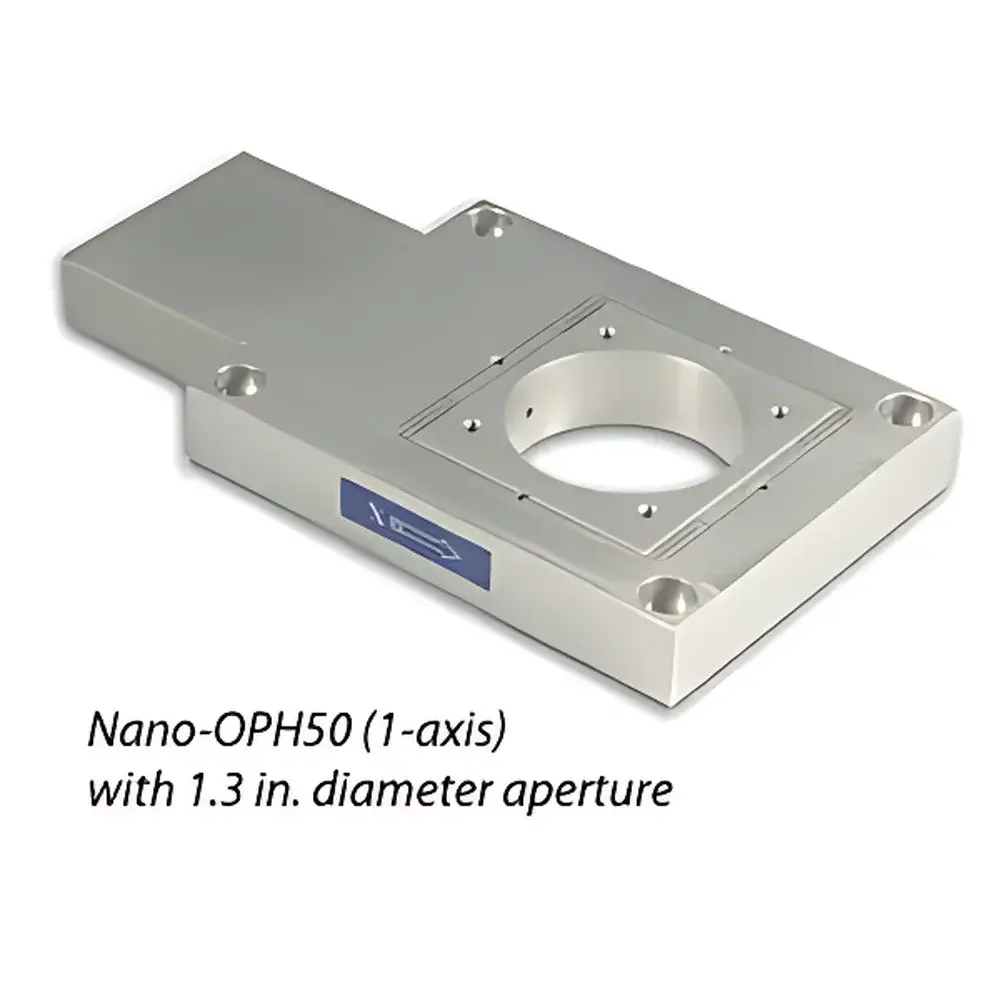
MCL Think Nano Nano-OPH Series Nanometer Linear Translation Stage
| Brand | MCL Think Nano |
|---|---|
| Origin | USA |
| Manufacturer Type | Authorized Distributor |
| Product Category | Imported |
| Model | Nano-OPH |
| Drive Type | Motorized (Piezo-Based Direct Drive) |
| Motion Range Options | 30 μm / 50 μm / 100 μm |
| Closed-Loop Resolution | 0.06 nm (OPH30) / 0.1 nm (OPH50) / 0.2 nm (OPH100) |
| Resonant Frequency | 3.5 kHz (unloaded) ±20% |
| Stiffness | 3.0 N/μm ±20% |
| Angular Errors (Roll/Pitch) | ≤1 μrad |
| (Yaw) | ≤2 μrad |
| Max Horizontal Load | 1.0 kg |
| Max Vertical Load | 0.5 kg |
| Body Materials | Aluminum, Invar, or Titanium |
| Position Sensing | Integrated PicoQ® Absolute Piezoresistive Sensor |
| Controller | Nano-Drive® Platform |
| Aperture Diameter | 1.3 in (33 mm) |
| Stackable Architecture | Yes, for XYZ, XYθ, or custom multi-axis configurations |
Overview
The MCL Think Nano Nano-OPH Series is a high-precision, aperture-integrated nanometer linear translation stage engineered for demanding optical and nanoscale positioning applications. Built upon a direct-drive piezoelectric actuation architecture with no mechanical transmission elements, the Nano-OPH eliminates backlash, hysteresis, and stick-slip artifacts common in lead-screw or stepper-motor-based stages. Its core measurement principle relies on proprietary PicoQ® piezoresistive sensing technology—embedded directly within the moving carriage—to deliver absolute, drift-free position feedback at true picometer-level resolution under closed-loop control. The defining mechanical feature is a centered 1.3-inch (33 mm) optical aperture, enabling unobstructed beam path integration in interferometric setups, near-field scanning optical microscopy (NSOM), fiber alignment rigs, and high-speed adaptive optics systems. Designed and manufactured in the United States, each Nano-OPH stage adheres to stringent dimensional stability and thermal coefficient specifications—particularly critical when constructed from low-expansion Invar or lightweight titanium for vacuum-compatible or ultra-low-vibration environments.
Key Features
- True aperture-through-stage design (33 mm clear bore) for co-aligned optical train integration without beam obstruction
- Closed-loop position resolution down to 0.06 nm (Nano-OPH30), validated via traceable metrology and compliant with ISO 230-2 motion accuracy standards
- High resonant frequency (up to 3.5 kHz unloaded) enables sub-millisecond step response and stable operation in dynamic focusing and active stabilization loops
- Modular stackability: Single-axis units are mechanically and kinematically compatible for repeatable XYZ, tip-tilt, or hybrid multi-degree-of-freedom assemblies
- Material-selectable construction (6061-T6 aluminum, Invar 36, or Grade 5 titanium) supporting application-specific requirements for thermal stability, weight, or UHV compatibility
- Integrated PicoQ® sensor provides absolute position encoding without homing—critical for GLP/GMP-aligned lab workflows requiring audit-trail integrity
Sample Compatibility & Compliance
The Nano-OPH Series is routinely deployed in Class 100 cleanrooms and ISO 17025-accredited calibration laboratories. Its non-magnetic, non-outgassing variants (Invar/titanium builds with gold-plated contacts) meet ASTM E595 requirements for total mass loss (TML) < 1.0% and collected volatile condensable materials (CVCM) < 0.10%. All models comply with CE electromagnetic compatibility directives (2014/30/EU) and RoHS 2011/65/EU material restrictions. When operated with the Nano-Drive® controller, the system supports configurable audit trails, user-access levels, and timestamped parameter logging—facilitating alignment with FDA 21 CFR Part 11 electronic record requirements for regulated R&D environments.
Software & Data Management
Native control is provided through the Nano-Drive® software suite (Windows/Linux), offering real-time position monitoring, waveform generation (sine, sawtooth, arbitrary), and scriptable motion sequences via Python SDK. Data export conforms to HDF5 and CSV formats, ensuring interoperability with MATLAB, LabVIEW, and Python-based analysis pipelines (e.g., SciPy, NumPy). The controller firmware implements deterministic USB 2.0 communication with sub-100 µs latency and supports hardware-triggered acquisition synchronization—essential for time-critical experiments such as pump-probe spectroscopy or lock-in amplified interferometry. Optional EtherCAT integration enables deterministic multi-axis coordination in industrial-grade automation frameworks.
Applications
- White-light and laser interferometry requiring sub-nanometer path-length stabilization
- Nanomanipulation in SEM/TEM sample holders with integrated optical access
- Active focus correction in confocal and multiphoton microscopes (e.g., objective lens z-scanning)
- Precision alignment of single-mode fibers, photonic integrated circuits (PICs), and free-space optical couplers
- Scanning probe microscopy enhancements—including NSOM probe rastering and tip-sample distance regulation
- Beam steering and wavefront correction in adaptive optics testbeds using deformable mirror coupling stages
FAQ
What distinguishes the Nano-OPH from the standard Nano-OP series?
The Nano-OPH incorporates a precision-machined central aperture (33 mm diameter), enabling direct optical beam passage—making it ideal for interferometry and collimated-path applications where mechanical obstruction must be eliminated.
Is vacuum compatibility available?
Yes. Invar and titanium configurations with vacuum-rated adhesives, dry-lubricated flexures, and bakeable cabling options support pressures down to 10⁻⁷ Torr. Full UHV qualification documentation is available upon request.
Can I operate multiple Nano-OPH stages synchronously?
Absolutely. The Nano-Drive® controller supports daisy-chained USB or EtherCAT topologies with hardware-synchronized triggers, enabling coordinated motion across up to 16 axes with sub-microsecond jitter.
Does closed-loop operation affect maximum scan speed?
No. Unlike traditional servo systems, the PicoQ® sensor’s bandwidth exceeds 10 kHz, allowing full-range motion at maximum rated velocity (e.g., 100 µm/s for OPH100) without closed-loop lag or positional overshoot.
How is calibration traceability maintained?
Each stage ships with a NIST-traceable calibration certificate documenting linearity error, bidirectional repeatability (< ±0.3 nm), and thermal drift performance over 15–35 °C—valid for 12 months under standard lab conditions.






