
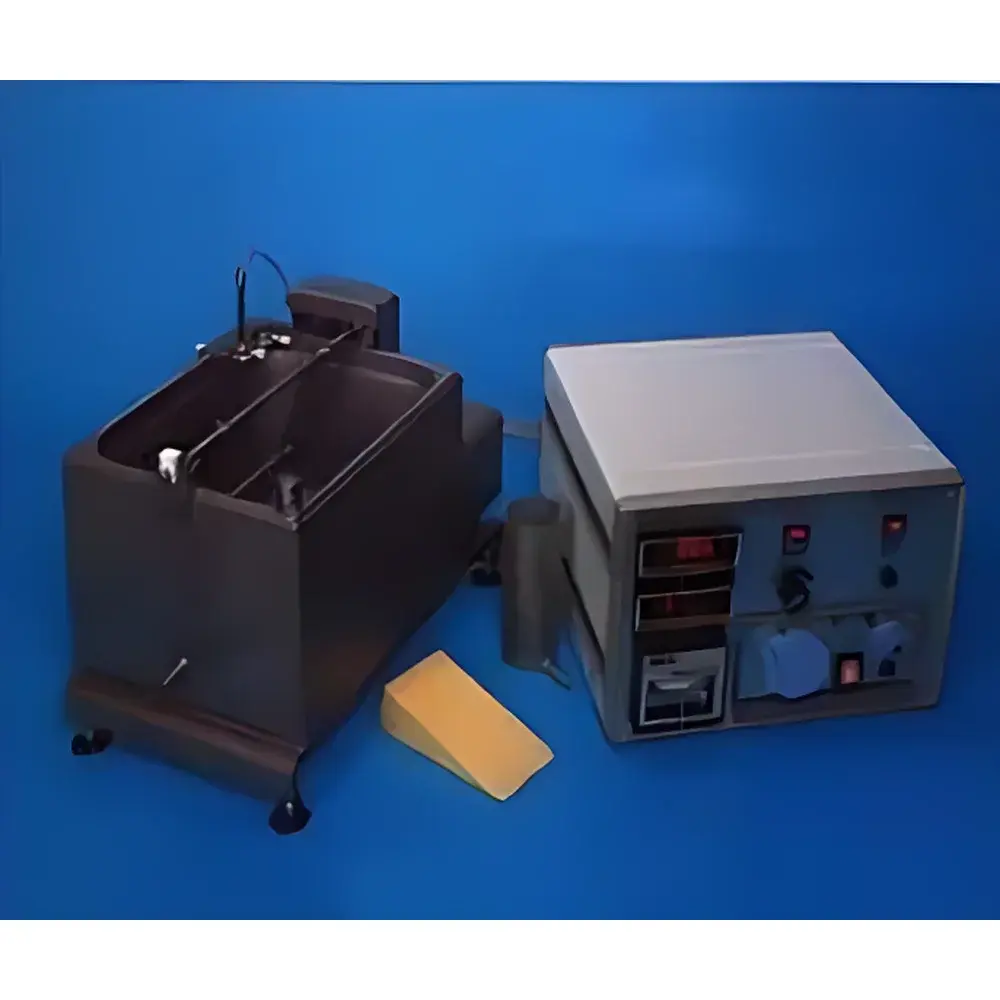
GL-20 Laboratory-Scale Cheese Vat System
| Origin | Shanghai, China |
|---|---|
| Manufacturer Type | Authorized Distributor |
| Origin Category | Domestic (China) |
| Model | GL-20 |
| Pricing | Available Upon Request |
Overview
The GL-20 Laboratory-Scale Cheese Vat System is an engineered platform for controlled, reproducible cheese-making process simulation in research laboratories, pilot plants, and quality assurance facilities. Designed around the fundamental unit operations of traditional and industrial cheesemaking—including standardized milk heating, acidification, coagulation, cutting, scalding, whey drainage, salting, and molding—the system implements a hygienic, thermally stable, and digitally monitored environment. Its core architecture follows the principles of batch thermal processing with precise kinetic control: milk is heated uniformly via jacketed circulation (driven by a magnetic-drive water pump), while mechanical agitation is delivered through a removable stainless-steel impeller with variable-speed torque transmission. The system operates on Couette-type mixing dynamics within a triple-walled vat—inner product chamber, middle thermal jacket, and outer insulation layer—ensuring minimal thermal lag and high spatial temperature homogeneity (±0.3 °C across 20 L volume). This design enables strict adherence to time–temperature–pH protocols required for starter culture activation, rennet kinetics, syneresis control, and curd maturation.
Key Features
- Triple-wall stainless-steel vat (AISI 316 inner surface) with fully drainable, sanitary geometry and sloped bottom for complete whey evacuation
- Adjustable-speed stirring mechanism: 0–60 rpm continuous rotation + 0–90 strokes/min oscillatory motion, driven by a 90 W brushless motor with IP54-rated enclosure
- Independent digital PID temperature control (ambient to 90 °C) with PT100 sensor feedback and jacketed water circulation (max. flow: 20 L/min)
- Integrated food-grade pH probe (0–14 range, ±0.02 pH accuracy) with automatic temperature compensation and real-time display
- Dual-purpose curd knife set: one horizontal stainless-steel blade (adjustable depth) and one vertical blade for uniform curd sizing
- Modular whey extraction system with fine-mesh stainless-steel filter plate and gravity-assisted drainage port
- Two standard cheese molds included: 0.5 kg and 1.0 kg capacity, both with perforated walls for controlled moisture egress
- RS-232/USB interface for connection to external PCs; compatible with time-stamped logging of temperature, pH, and stir status per ASTM E2500-22 guidelines
Sample Compatibility & Compliance
The GL-20 accommodates raw, pasteurized, or standardized bovine, caprine, or ovine milk, as well as plant-based dairy analogs (e.g., soy, almond, oat suspensions) when validated for curd formation behavior. All wetted parts comply with FDA 21 CFR §177.2400 (food-contact polymers) and EU Regulation (EC) No. 1935/2004. Surface finish meets ISO 20488:2017 (Ra ≤ 0.8 µm for interior surfaces). The system supports Good Manufacturing Practice (GMP) and Good Laboratory Practice (GLP) workflows, including full audit trails for parameter changes, calibration events, and data export—aligned with requirements for regulatory submissions under USP , ISO/IEC 17025, and EFSA guidance on dairy process validation.
Software & Data Management
The GL-20 includes embedded firmware supporting configurable logging intervals (1–60 s), user-defined alarm thresholds (e.g., pH drift >0.15 units/5 min), and password-protected operator levels (Supervisor, Technician, Trainee). Exported CSV files contain timestamped columns for T(°C), pH, stir speed (rpm), stroke count, and system status flags. Optional software modules provide trend visualization, statistical process control (SPC) charts (X-bar/R), and PDF report generation compliant with 21 CFR Part 11—supporting electronic signatures, change history, and data integrity verification. Raw logs are stored in non-volatile memory with battery-backed retention (>72 h power loss resilience).
Applications
- Strain selection and fermentation kinetics studies for mesophilic and thermophilic starters (e.g., Lactococcus lactis, Streptococcus thermophilus, Propionibacterium freudenreichii)
- Rennet activity profiling and coagulation time (RCT) optimization under varying Ca²⁺, pH, and temperature conditions
- Curd rheology assessment during syneresis, including compression testing post-molding and moisture migration modeling
- Process scale-up correlation between lab-scale (GL-20) and pilot (200–500 L) or production vats using dimensionless numbers (e.g., Reynolds, Péclet)
- Regulatory dossier preparation for novel cheese products, including challenge studies and shelf-life modeling
- Training of QC/QA personnel on standardized sensory–instrumental correlation protocols (e.g., texture profile analysis vs. curd firmness index)
FAQ
What is the minimum and maximum batch volume the GL-20 can handle?
The nominal working capacity is 20 L, with validated operation from 10 L (minimum fill level for thermal and mechanical uniformity) to 22 L (safe upper limit with 10% headspace). Custom configurations ranging from 5 L to 500 L are available upon engineering review.
Is the pH probe autoclavable?
No—the integrated probe is designed for immersion sterilization only (e.g., 70% ethanol wipe, 0.5% peracetic acid rinse). Autoclaving would damage the reference junction and ISFET membrane. A separate calibrated reference electrode is recommended for routine verification.
Can the system be integrated into a LIMS or MES environment?
Yes—via optional OPC UA server module (IEC 62541 compliant), enabling bidirectional communication with laboratory information management systems (LIMS) and manufacturing execution systems (MES) for automated metadata tagging and electronic batch record (EBR) population.
Does the GL-20 meet CE marking requirements for machinery safety?
Yes—the system conforms to Machinery Directive 2006/42/EC, Low Voltage Directive 2014/35/EU, and EMC Directive 2014/30/EU. Full Declaration of Conformity and risk assessment documentation are provided with each unit.






