
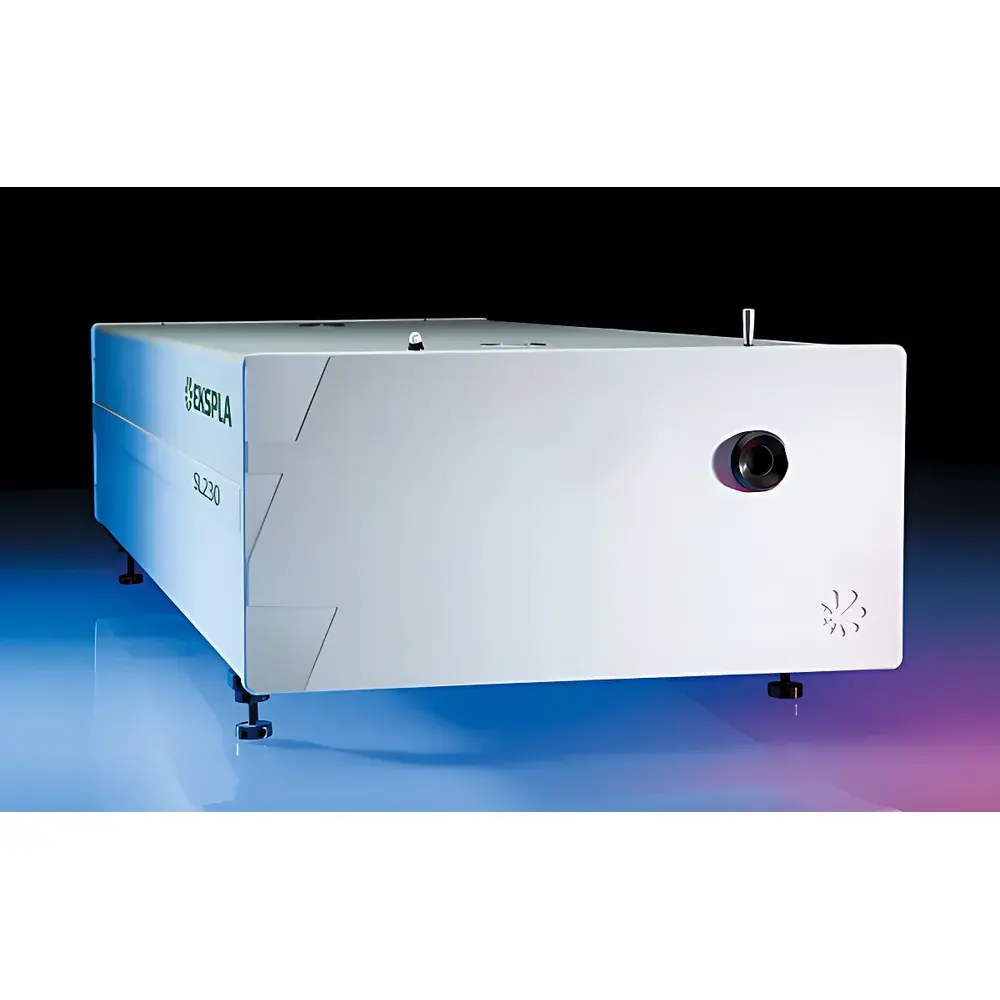
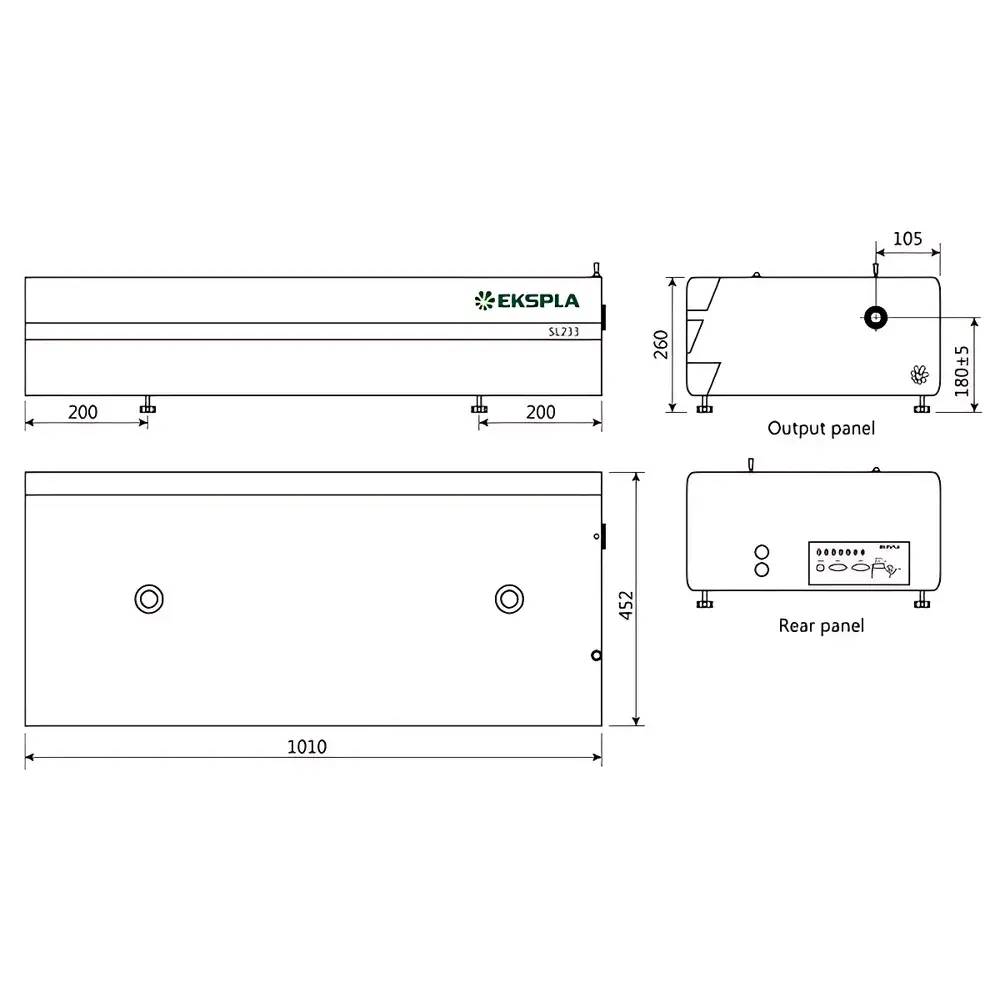
Ekspla SL230 SBS-Compressed Picosecond Laser System
| Brand | Ekspla |
|---|---|
| Origin | Lithuania |
| Manufacturer Type | Original Equipment Manufacturer (OEM) |
| Product Category | Imported High-Energy Picosecond Laser System |
| Model | SL230 |
| Pulse Duration | 100 ps |
| Central Wavelength | 1064 nm (fundamental), with optional 532 nm, 355 nm, and 266 nm harmonics |
| Maximum Pulse Energy | 250 mJ @ 1064 nm |
| Repetition Rate | Up to 50 Hz |
| Pulse-to-Pulse Jitter (External Trigger) | < 0.2 ns RMS |
| Sync Pulse Jitter (Pre-trigger) | < 100 ps RMS |
| Harmonic Generation | Thermo-stabilized KD*P/KDP crystal-based, angle-tuned, with wavelength-separated output ports |
| Cooling | Water/Water heat exchanger integrated in 19″ rack-mount unit |
| Control Interface | USB-connected Windows® PC application + backlit remote keypad |
Overview
The Ekspla SL230 is a high-energy, diode-pumped, Q-switched picosecond laser system engineered for scientific and industrial applications requiring precise temporal control, exceptional pulse stability, and scalable energy output. Unlike conventional mode-locked oscillators relying on Kerr-lens or saturable absorber mechanisms—where timing jitter typically exceeds tens of picoseconds—the SL230 employs backward stimulated Brillouin scattering (SBS) in carbon tetrachloride (CCl₄) to compress nanosecond-duration seed pulses into stable, transform-limited 100 ps optical pulses. This SBS compression technique delivers intrinsically low timing jitter (<0.2 ns RMS on external trigger; <100 ps RMS on pre-trigger sync signals), enabling synchronization-critical experiments such as pump-probe spectroscopy, time-resolved plasma diagnostics, and optical parametric chirped-pulse amplification (OPCPA) seeding. The system architecture integrates a single-longitudinal-mode (SLM) master oscillator, a multi-pass flashlamp-pumped Nd:YAG power amplifier, and thermo-stabilized harmonic generation modules—ensuring reproducible performance across extended operational periods.
Key Features
- Diode-pumped, electro-optically Q-switched SLM oscillator delivering nanosecond seed pulses with high spectral purity and amplitude stability
- Backward SBS pulse compression in CCl₄ liquid cell yielding consistent 100 ps FWHM pulse duration with minimal pedestal and high temporal contrast
- Flashlamp-pumped Nd:YAG power amplifier supporting up to 250 mJ pulse energy at 1064 nm, scalable to 50 Hz repetition rate
- Thermo-controlled harmonic generation using angle-tuned KD*P (second harmonic) and KDP (third/fourth harmonic) crystals, with independent output ports per wavelength (1064 nm, 532 nm, 355 nm, 266 nm)
- Integrated real-time pulse energy monitoring with analog/digital readout via remote keypad or PC interface
- Low-jitter synchronization architecture: external trigger input with <0.2 ns RMS jitter; programmable pre-trigger outputs with <100 ps RMS jitter relative to optical pulse onset
- Compact 19″ rack-mounted design incorporating water/water cooling unit, high-voltage power supply, and safety interlock circuitry compliant with IEC 60825-1 Class 4 requirements
Sample Compatibility & Compliance
The SL230 is designed for integration into vacuum-compatible, radiation-hardened, or atmospheric experimental chambers without modification. Its beam parameters—including M² 95% transmission at respective wavelengths. The system conforms to CE marking directives (2014/35/EU Low Voltage Directive, 2014/30/EU EMC Directive), meets laser safety standards per IEC 60825-1:2014 (Class 4), and supports audit-ready operation under GLP and ISO/IEC 17025 laboratory frameworks. Optional documentation packages include Factory Acceptance Test (FAT) reports, traceable calibration certificates for energy monitors, and full electrical safety certification files.
Software & Data Management
Control is executed via a dedicated Windows®-based application delivered on a supplied netbook PC, communicating over USB 2.0 with deterministic latency. The GUI enables real-time adjustment of Q-switch delay, amplifier flashlamp voltage, harmonic crystal angles (via stepper motor drivers), and pre-trigger offset—all logged with timestamps and metadata (operator ID, session ID, environmental temperature). Energy monitor data is streamed at 1 kHz and exportable in CSV or HDF5 format. Remote keypad functionality includes emergency stop, manual firing, and status display (pulse count, energy deviation %, coolant temperature, HV status), with backlighting optimized for use under laser safety goggles. Audit trails comply with FDA 21 CFR Part 11 requirements when operated in validated environments, supporting electronic signatures and user-access-level permissions.
Applications
- Plasma physics research: high-intensity laser–matter interaction studies, laser-induced breakdown spectroscopy (LIBS), and inertial confinement fusion (ICF) target irradiation
- Material processing: precision ablation of dielectrics, thin-film deposition via pulsed laser deposition (PLD), and microstructuring of transparent substrates
- Ultrafast science: OPCPA front-end pumping, time-resolved X-ray generation via laser-plasma acceleration, and femtosecond electron diffraction seeding
- Remote sensing: satellite laser ranging (SLR), atmospheric LIDAR with high peak-power discrimination, and long-path differential absorption measurements
- Holography & interferometry: pulsed digital holography requiring high coherence length and sub-nanosecond timing fidelity
- Nonlinear optics development: high-fluence testing of novel nonlinear crystals and phase-matching configurations under picosecond excitation
FAQ
What distinguishes SBS compression from other picosecond pulse generation methods?
SBS compression avoids the complexity and instability of mode-locking while achieving superior timing jitter performance and higher single-pulse energy scalability compared to fiber-based or Ti:sapphire oscillator-amplifier systems.
Can the SL230 be integrated into automated vacuum chamber systems?
Yes—its sealed optical path, rack-mount form factor, and RS-232/USB programmable interfaces support seamless integration with PLC-controlled vacuum and motion stages.
Is harmonic generation efficiency stable over extended operation?
Thermal stabilization of KD*P/KDP crystals maintains angular alignment within ±5 µrad over 8-hour continuous operation, ensuring harmonic conversion efficiency drift < ±1.5% (1σ) at 50 Hz.
Does the system support external synchronization with femtosecond lasers?
Yes—the pre-trigger output provides TTL-sync pulses with <100 ps RMS jitter referenced to the optical pulse leading edge, enabling sub-picosecond cross-correlation with fs oscillators.
What maintenance is required for the SBS cell?
CCl₄ is sealed in a hermetically closed, temperature-regulated cell with no scheduled replacement; periodic visual inspection for bubble formation or discoloration is recommended every 12 months.





