
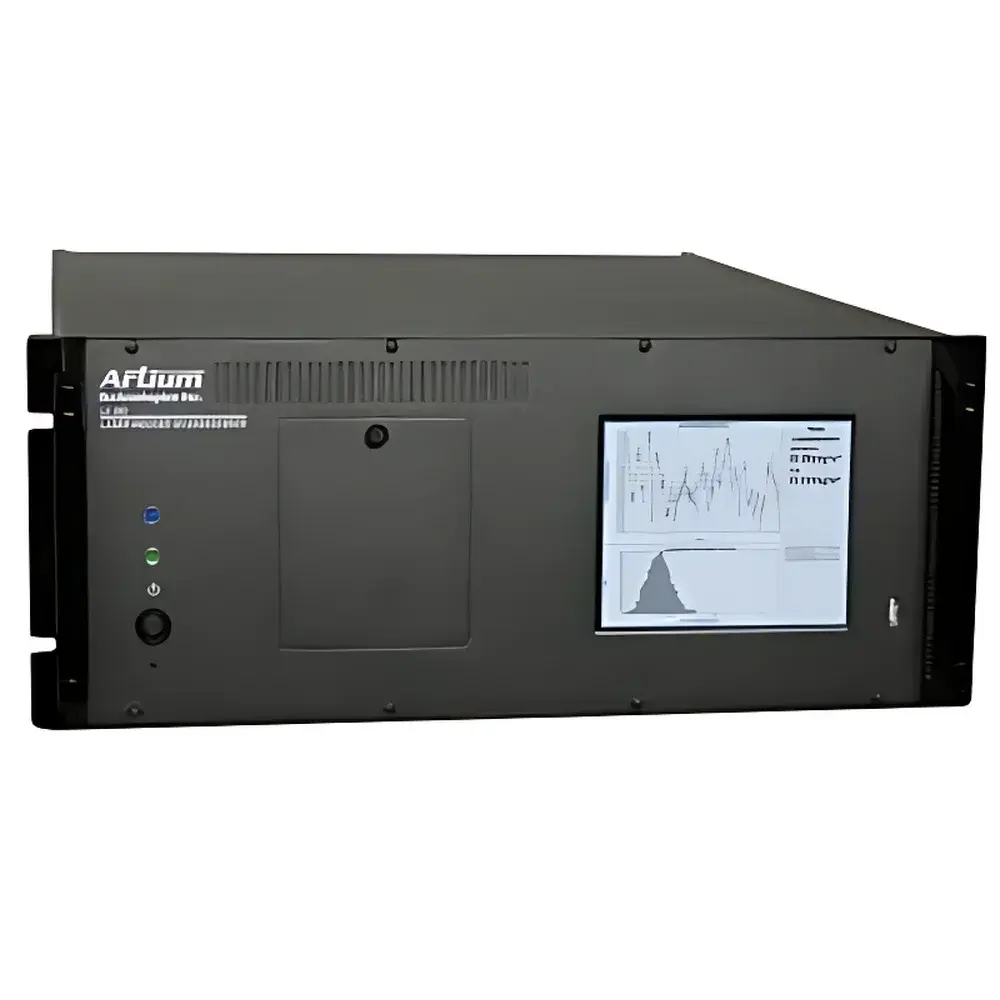
Artium LII 300 Laser-Induced Incandescence Soot Analyzer
| Brand | Artium |
|---|---|
| Origin | USA |
| Model | LII 300 |
| Measurement Principle | Laser-Induced Incandescence (LII) |
| Measured Parameter | Soot Mass Concentration, Primary Particle Diameter, Specific Surface Area |
| Detection Limit | <1.0 ppt (<2 µg/m³) |
| Upper Range | 10 ppm (20 g/m³) |
| Dynamic Range | >1,000,000:1 |
| Accuracy | ±2% of reading |
| Repeatability | ±2% |
| Stability | ±2% |
| Response Time | <100 ms |
| Soot Primary Particle Size Range | 10–100 nm |
| Specific Surface Area Resolution | Derived from LII signal ratio and calibration traceable to NIST standards |
| Compliance | Designed for ASTM D6551, ISO 8573-4, and EPA Method 9-compatible particulate characterization workflows |
| Software | Real-time acquisition with timestamped raw signal, background-subtracted incandescence decay, and dual-wavelength LII ratio processing |
Overview
The Artium LII 300 Laser-Induced Incandescence Soot Analyzer is a turnkey, research-grade instrument engineered for quantitative, time-resolved measurement of soot in high-temperature combustion exhaust streams and dilute atmospheric aerosols. It operates on the physical principle of laser-induced incandescence (LII), where nanosecond-pulsed laser radiation (typically 1064 nm) rapidly heats carbonaceous soot particles to incandescent temperatures (~4000 K). The resulting thermal radiation—emitted within microseconds—is spectrally filtered and detected with gated photomultiplier tubes or fast CMOS sensors. Unlike optical extinction or light scattering methods, LII is intrinsically insensitive to non-absorbing volatiles, ash, or condensed organics, delivering unambiguous soot-specific quantification without geometric assumptions about aggregate morphology. The system is optimized for integration into engine test cells, furnace exhaust ducts, and laboratory-scale flame reactors, supporting both in-situ and extractive sampling via heated transfer lines.
Key Features
- True non-intrusive, calibration-traceable soot mass concentration measurement across six orders of magnitude (1 ppt to 10 ppm)
- Simultaneous derivation of primary particle diameter (10–100 nm range) and specific surface area using dual-wavelength LII signal ratio analysis
- NIST-traceable calibration protocol employing certified soot reference materials and controlled laser fluence mapping
- Sub-millisecond temporal resolution enables cycle-resolved soot diagnostics in reciprocating engines and pulsating combustors
- No sample dilution required; compatible with raw exhaust, CVS-diluted exhaust, and laminar flame sampling configurations
- Robust opto-mechanical architecture with air-cooled Nd:YAG laser, thermally stabilized detection optics, and vibration-isolated optical bench
- Real-time background subtraction and laser pulse-to-pulse energy normalization ensure long-term measurement stability (±2% over 72 h)
Sample Compatibility & Compliance
The LII 300 interfaces directly with standard 1/2″ or 3/4″ stainless-steel sampling probes equipped with heated sheath air (up to 250 °C) to prevent thermophoretic deposition. It accepts gas matrices containing CO₂, H₂O, NOₓ, O₂, and unburnt hydrocarbons without signal interference. The analyzer meets functional requirements for ASTM D6551 (Standard Test Method for Determination of Soot Volume Fraction in Combustion Gases Using Laser-Induced Incandescence), supports ISO 8573-4 particulate classification frameworks, and provides audit-ready data logs compliant with GLP and 21 CFR Part 11 when paired with validated software configuration. All calibration certificates include uncertainty budgets per ISO/IEC 17025:2017.
Software & Data Management
Acquisition and analysis are managed through Artium’s LII-Studio v4.2 software suite, deployed on Windows 10 IoT Enterprise. The software performs real-time spectral deconvolution of incandescence decay curves, applies temperature-dependent Planck-law corrections, and computes soot volume fraction, mass concentration, and primary particle size using pre-loaded Mie-LII hybrid models. Data export formats include HDF5 (for MATLAB/Python post-processing), CSV (with full metadata headers), and XML (for LIMS integration). Audit trails record operator ID, calibration event timestamps, laser energy logs, and environmental sensor inputs (T, P, RH). Optional FDA 21 CFR Part 11 compliance package includes electronic signatures, role-based access control, and immutable data archiving.
Applications
- Engine development labs: Cycle-resolved soot mapping in diesel, gasoline direct injection (GDI), and alternative fuel (H₂, ammonia, biofuel) combustion systems
- Emissions certification testing: Validation of PN (particle number) and PM (particulate mass) limits under UN ECE R49, Euro VI, and U.S. EPA Tier 4 standards
- Combustion research: Quantifying soot inception, surface growth, and oxidation kinetics in laminar premixed and diffusion flames
- Incinerator and industrial boiler monitoring: Continuous soot load assessment for SCR/DPF regeneration control logic
- Aerosol science: Laboratory generation and aging studies of flame-synthesized nanoparticles under controlled oxidative atmospheres
FAQ
What combustion environments are compatible with the LII 300?
The system is validated for use in exhaust gases up to 600 °C (with appropriate probe cooling), including diesel, jet fuel, natural gas, hydrogen, and biomass-derived syngas. High-temperature operation requires optional water-cooled sampling interface.
Does the LII 300 require periodic recalibration?
Calibration is performed annually using NIST-traceable soot standards; field verification checks (laser energy, detector gain, background offset) are recommended before each major test campaign.
Can the LII 300 distinguish between soot and metal oxide nanoparticles?
Yes—LII signal amplitude and decay time constants differ fundamentally between refractory carbon (τ ≈ 1–10 µs) and transition-metal oxides (τ < 100 ns); spectral filtering and temporal gating enable selective detection.
Is the system suitable for mobile emissions testing?
The LII 300 has been integrated into PEMS (Portable Emissions Measurement Systems) configurations with shock-mounted optical enclosures and DC power conditioning for vehicle chassis dynamometer and on-road applications.
How is data synchronization handled with engine control units or DAQ systems?
The instrument provides TTL-compatible trigger I/O, IEEE-1588 PTP time synchronization, and CAN bus interface (SAE J1939) for phase-locked acquisition relative to crank angle or valve timing signals.
Related Products







