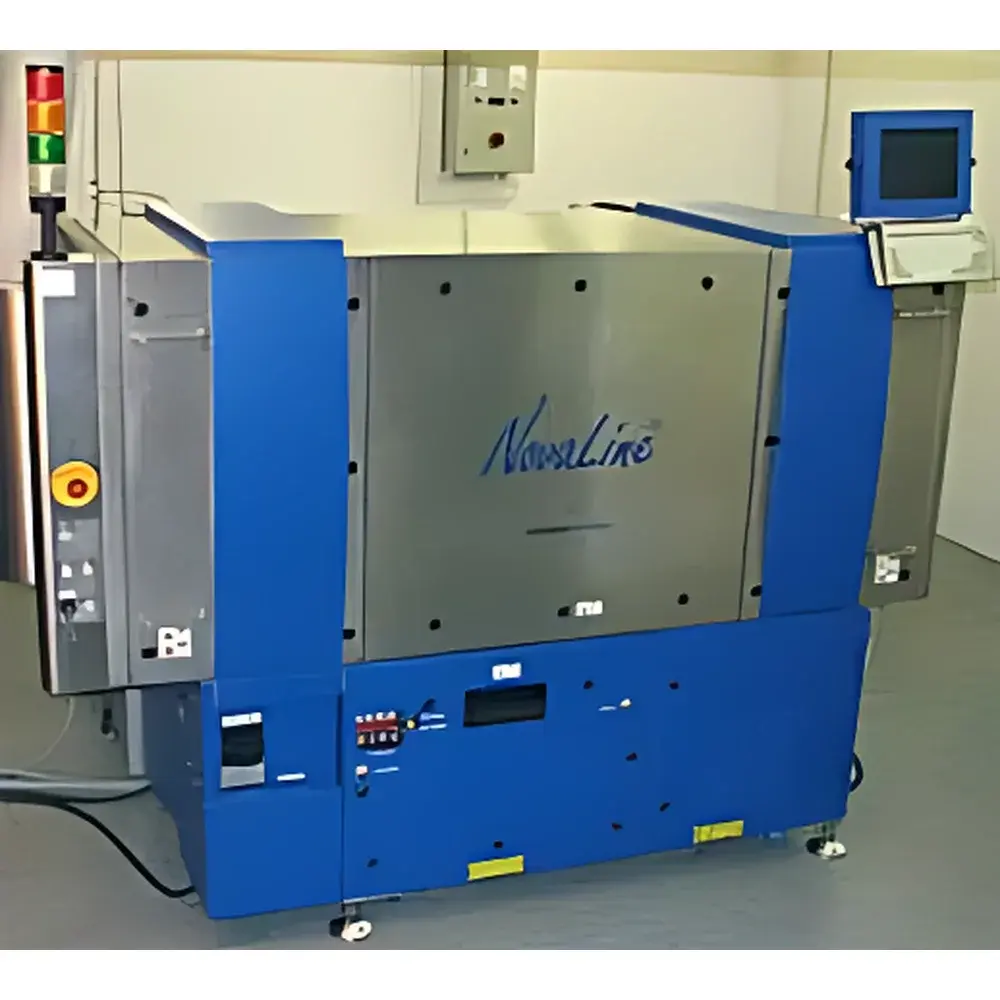
Göttingen Laser-Laboratorium PowerLine UV Femtosecond Laser Amplifier
| Brand | Göttingen Laser-Laboratorium Gottingen e.V. |
|---|---|
| Origin | Germany |
| Type | KrF-based UV laser amplifier |
| Model | PowerLine |
| Wavelength | 248 nm |
| Pulse Energy | 30 mJ (seed input > 50 µJ @ 248 nm) |
| Repetition Rate | 0–350 Hz |
| Average Power | >9 W |
| Pulse Width | <1 ps |
| Timing Jitter | ±2 ns (relative to external trigger) |
| Beam Size | 25 × 25 mm² |
| Beam Quality | M² ≈ 2 × diffraction-limited (input M² = 1) |
Overview
The Göttingen Laser-Laboratorium PowerLine UV Femtosecond Laser Amplifier is a high-repetition-rate, industrial-grade KrF excimer-based amplifier engineered for precision ultraviolet material processing and time-resolved scientific applications. Unlike conventional nanosecond KrF systems, the PowerLine integrates femtosecond seed injection and regenerative amplification architecture to deliver sub-picosecond pulses at 248 nm—enabling high peak intensity while maintaining exceptional temporal stability and spatial coherence. Its core design leverages the NovaLine industrial laser platform as the master oscillator and pre-amplifier stage, ensuring robust synchronization and scalability across demanding environments including cleanroom-integrated micromachining, ultrafast photoelectron spectroscopy, and laser-induced forward transfer (LIFT). The system operates in a sealed, gas-handled KrF gain medium with active thermal management, supporting continuous operation at up to 350 Hz—achieving an average output power exceeding 9 W, a critical threshold for throughput-sensitive industrial deployment.
Key Features
- UV wavelength output at 248 nm—optimal for high-resolution ablation of wide-bandgap materials (e.g., fused silica, sapphire, GaN) and photochemical activation without thermal damage
- Sub-1 ps pulse duration enables non-thermal interaction regimes, minimizing heat-affected zones and enabling sub-micron feature resolution
- Scalable repetition rate from single-shot to 350 Hz—programmable via TTL/RS-232 interface for process optimization and duty-cycle control
- High pulse energy stability (<±1.5% RMS over 8 hours) achieved through active discharge monitoring, gas replenishment feedback, and temperature-stabilized cavity alignment
- Beam homogeneity maintained across full aperture (25 × 25 mm²) with M² ≈ 2 × diffraction-limited performance—compatible with standard UV-grade beam expanders, scanners, and projection optics
- Low timing jitter (±2 ns relative to external trigger) supports pump-probe experiments and synchronized multi-laser architectures compliant with ISO 11554 and IEC 60825-1 safety standards
Sample Compatibility & Compliance
The PowerLine amplifier is compatible with a broad range of solid-state, thin-film, and semiconductor substrates—including SiO₂, CaF₂, SiC, LiNbO₃, and polymer-based photoresists—without requiring vacuum coupling or specialized coatings. Its 248 nm output falls within the spectral response window of commercial UV photodiodes, streak cameras, and CCD-based spectrometers, facilitating real-time pulse diagnostics per ISO 13695. The system conforms to EU Machinery Directive 2006/42/EC and carries CE marking for Class 4 laser product compliance. All optical enclosures meet EN 60825-1:2014 requirements for interlocked access control, beam containment, and emission labeling. For regulated manufacturing environments, optional audit-ready logging modules support 21 CFR Part 11-compliant electronic records and GLP/GMP traceability of operational parameters (pulse energy, repetition rate, gas pressure, coolant temperature).
Software & Data Management
Control and monitoring are executed via the proprietary PowerLine Control Suite (v3.2), a Windows-based application offering deterministic real-time parameter adjustment with ≤10 ms latency. The suite provides synchronized acquisition of pulse energy (via calibrated pyroelectric sensor), repetition rate, and external trigger phase—exportable in HDF5 and CSV formats for integration with MATLAB, Python (NumPy/Pandas), or LabVIEW environments. Firmware-level event logging captures all hardware state transitions (discharge voltage, gas flow rate, interlock status) with microsecond timestamp resolution. Optional remote API (REST/JSON over Ethernet) enables integration into factory automation systems (SECS/GEM, OPC UA) and centralized maintenance dashboards aligned with Industry 4.0 protocols.
Applications
- High-throughput UV laser micromachining of transparent dielectrics and ceramics in display and semiconductor packaging
- Pump-probe spectroscopy of carrier dynamics in 2D materials (e.g., MoS₂, WS₂) and perovskite photovoltaics
- Ultrafast surface texturing for anti-reflective and hydrophobic functionalization of medical implants
- Laser-induced breakdown spectroscopy (LIBS) with enhanced signal-to-noise ratio due to reduced plasma shielding at sub-ps durations
- Photoemission electron microscopy (PEEM) illumination source for time-resolved nanoscale imaging
- Calibration reference for UV radiometric standards laboratories (traceable to PTB via NIST-traceable transfer standards)
FAQ
What is the maximum achievable pulse energy at 100 Hz?
At 100 Hz, the PowerLine delivers ≥28 mJ/pulse with energy stability better than ±1.2% RMS, verified using NIST-traceable calorimetry.
Is the system compatible with third-party pulse compressors or chirped-pulse amplification (CPA) stages?
Yes—the 248 nm output is polarization-maintained and dispersion-compensated for direct coupling into off-the-shelf UV CPA compressors; full spectral phase characterization data is provided with each unit.
How often does the KrF gas mixture require replacement?
Under continuous operation at 350 Hz, the gas lifetime exceeds 1.2 × 10⁹ shots; automated gas replenishment triggers at 5% degradation threshold, logged in real time.
Does the amplifier support external cavity synchronization for multi-laser experiments?
Yes—dual TTL sync inputs (trigger-in and clock-in) enable master-slave configuration with sub-nanosecond phase locking capability across multiple PowerLine units.
What cooling infrastructure is required?
The system operates with closed-loop deionized water cooling at 18–22 °C and ≤0.5 bar pressure drop; chiller specifications (e.g., Huber Unistat) are supplied in the installation manual.