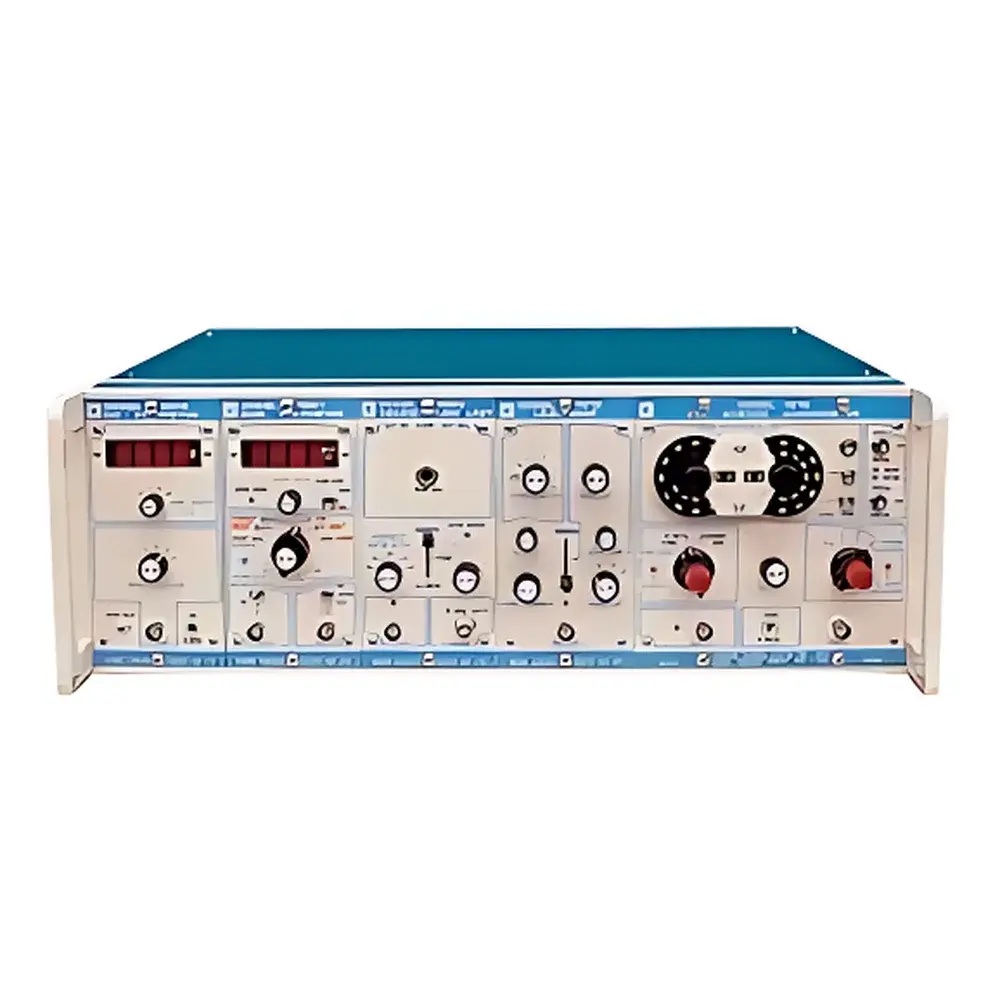
Kanomax 7000 Series Constant-Temperature Anemometer (CTA) / Hot-Wire Anemometer (HWA)
| Brand | Kanomax |
|---|---|
| Origin | Japan |
| Model | CTA/HWA 7000 |
| Sensor Type | Thermal (Constant-Temperature Anemometry) |
| Bridge Ratio Options | 1:1 (max. 500 mA) or 5:1 (max. 1.2 A) |
| Probe Current Limit | 500 mA (1:1 configuration) |
| Frequency Response | Up to 140 kHz (with 5 µm tungsten wire probe) |
| Power Supply | AC 100/115 V ±10%, 50/60 Hz |
| Enclosure Dimensions | 436 × 149 × 456 mm |
| Compliance | Designed for ISO/IEC 17025-aligned laboratory environments and ASTM D5467-compliant airflow characterization |
Overview
The Kanomax 7000 Series Constant-Temperature Anemometer (CTA) / Hot-Wire Anemometer (HWA) is a precision-grade thermal anemometry system engineered for high-fidelity, time-resolved velocity measurements in gaseous media. It operates on the fundamental principle of constant-temperature anemometry: a fine-wire sensor—typically fabricated from platinum or tungsten—is electrically heated and maintained at a fixed temperature differential above ambient via a feedback-controlled Wheatstone bridge circuit. As fluid flow impinges upon the wire, convective heat loss increases proportionally with local velocity magnitude. The control electronics dynamically adjust the heating current to preserve the set temperature, and this compensatory current serves as the primary output signal—linearly correlated to instantaneous flow velocity under calibrated conditions. With bandwidths extending up to 140 kHz (achievable using 5 µm diameter tungsten probes), the system supports turbulence spectral analysis, transient jet characterization, and unsteady boundary layer investigations. Its design prioritizes signal integrity, low noise floor, and thermal stability—critical for applications demanding sub-meter-per-second resolution and microsecond-scale temporal fidelity.
Key Features
- Wide dynamic velocity range—from 0.01 m/s to over 200 m/s—enabling both laminar boundary layer profiling and high-speed exhaust flow analysis.
- Modular architecture with interchangeable probe modules: straight-wire, X-wire, and inclined-wire configurations support multi-component velocity vector reconstruction and directional sensitivity optimization.
- High-frequency response capability (up to 140 kHz) validated per IEC 60770-1 for dynamic pressure and flow transducers, facilitating accurate power spectral density (PSD) computation in turbulent flows.
- Dual-bridge ratio support (1:1 and 5:1) allows flexible trade-offs between sensitivity and maximum measurable velocity—optimized for low-noise operation in cleanroom ventilation studies or high-power excitation in combustion chamber testing.
- Rugged aluminum enclosure (436 × 149 × 456 mm) with EMI-shielded internal layout ensures stable performance in electromagnetically noisy industrial environments.
- Integrated temperature compensation and linearization circuits minimize drift across ambient variations from 10 °C to 40 °C, meeting requirements for GLP-compliant data acquisition workflows.
Sample Compatibility & Compliance
The Kanomax 7000 Series is compatible with dry, non-corrosive, particle-free gas streams—including air, nitrogen, helium, and CO₂—within standard atmospheric pressure ranges (80–106 kPa). It is not rated for use with condensing vapors, abrasive particulates, or chemically aggressive gases without protective sheathing or custom probe coatings. The system conforms to electromagnetic compatibility standards IEC 61326-1 (industrial environment) and safety standard IEC 61010-1 (measurement category II). While not intrinsically safe, optional ATEX-compatible probe housings are available for Zone 2 classified areas. Data traceability supports audit-ready documentation per ISO/IEC 17025 Clause 7.7 and aligns with FDA 21 CFR Part 11 requirements when paired with compliant third-party data acquisition software featuring electronic signature and audit trail functionality.
Software & Data Management
The 7000 Series interfaces via analog voltage outputs (±5 V or 0–10 V) and optional digital RS-232/USB communication ports, enabling seamless integration with industry-standard DAQ platforms (e.g., National Instruments LabVIEW, MATLAB Data Acquisition Toolbox, or Dewesoft X). Kanomax provides calibration certificate templates compliant with ISO/IEC 17025 Annex A.3 and supports NIST-traceable calibration services through authorized regional metrology partners. Raw voltage signals are convertible to velocity using polynomial or piecewise-linear calibration curves stored in external configuration files—ensuring reproducibility across instrument deployments. Time-synchronized multi-channel acquisition (when used with matched probe sets) permits cross-correlation analysis and Reynolds stress tensor estimation in accordance with ISO 20785-2 for turbulent flow quantification.
Applications
- Aerodynamic testing in low-turbulence wind tunnels and open-jet facilities, including wake surveying behind airfoils and vehicle models.
- In-situ velocity mapping inside HVAC ducts, cleanroom supply diffusers, and fume hood face velocities per ASHRAE Standard 110.
- Combustion research: flame front tracking, swirl number validation, and exhaust gas recirculation (EGR) flow uniformity assessment.
- R&D of rotating machinery—fan inlet distortion analysis, turbine blade tip clearance flow measurement, and compressor surge onset detection.
- Academic fluid dynamics laboratories conducting DNS/LES validation experiments requiring point-wise, high-bandwidth velocity time series.
FAQ
What is the difference between CTA and HWA modes on the 7000 Series?
The system operates exclusively in Constant-Temperature Anemometry (CTA) mode; “HWA” denotes historical nomenclature referencing hot-wire sensing technology—not a separate operational mode. All measurements rely on active temperature regulation of the sensor wire.
Can the 7000 Series measure mass flow directly?
No—it measures local volumetric velocity. Mass flow calculation requires concurrent temperature and pressure measurement plus gas composition input for density correction.
Is probe recalibration required after each use?
No—recalibration is only necessary following mechanical damage, exposure to contaminants, or annually as part of preventive maintenance per ISO/IEC 17025 clause 7.6.2.
Does the system support real-time turbulence intensity calculation?
Yes—when integrated with compatible DAQ hardware and post-processing scripts, root-mean-square (RMS) fluctuation analysis of the velocity signal yields turbulence intensity (u’/U) per ISO 20785-1 Annex B.
Are replacement probes supplied with individual calibration certificates?
Yes—each probe is factory-calibrated and shipped with a NIST-traceable certificate listing sensitivity slope, offset, and frequency response envelope.