
Ekspla SFG PS Picosecond Scanning Sum Frequency Generation Vibrational Spectrometer
| Brand | Ekspla |
|---|---|
| Origin | Lithuania (EU) |
| Manufacturer Type | Original Equipment Manufacturer (OEM) |
| Import Status | Imported |
| Model | SFG PS |
| Price | Upon Request |
| Spectral Range | 625–4300 cm⁻¹ |
| Spectral Resolution | <6 cm⁻¹ (optional <2 cm⁻¹) |
| Pulse Duration | 29 ± 5 ps |
| Repetition Rate | 50 Hz |
| IR Tuning Range | 2.3–10 µm (optionally up to 16 µm) |
| VIS Wavelength | 532 nm (optional 1064 nm or tunable 420–680 nm) |
| Beam Geometry | Co-propagating, non-collinear (optional collinear) |
| Incidence Angles | Fixed (~60° VIS, ~55° IR |
| Polarization Control | Motorized s/p selection for IR, VIS, and SFG (purity > 1:100) |
| Detection | Time-gated photomultiplier tube (PMT) |
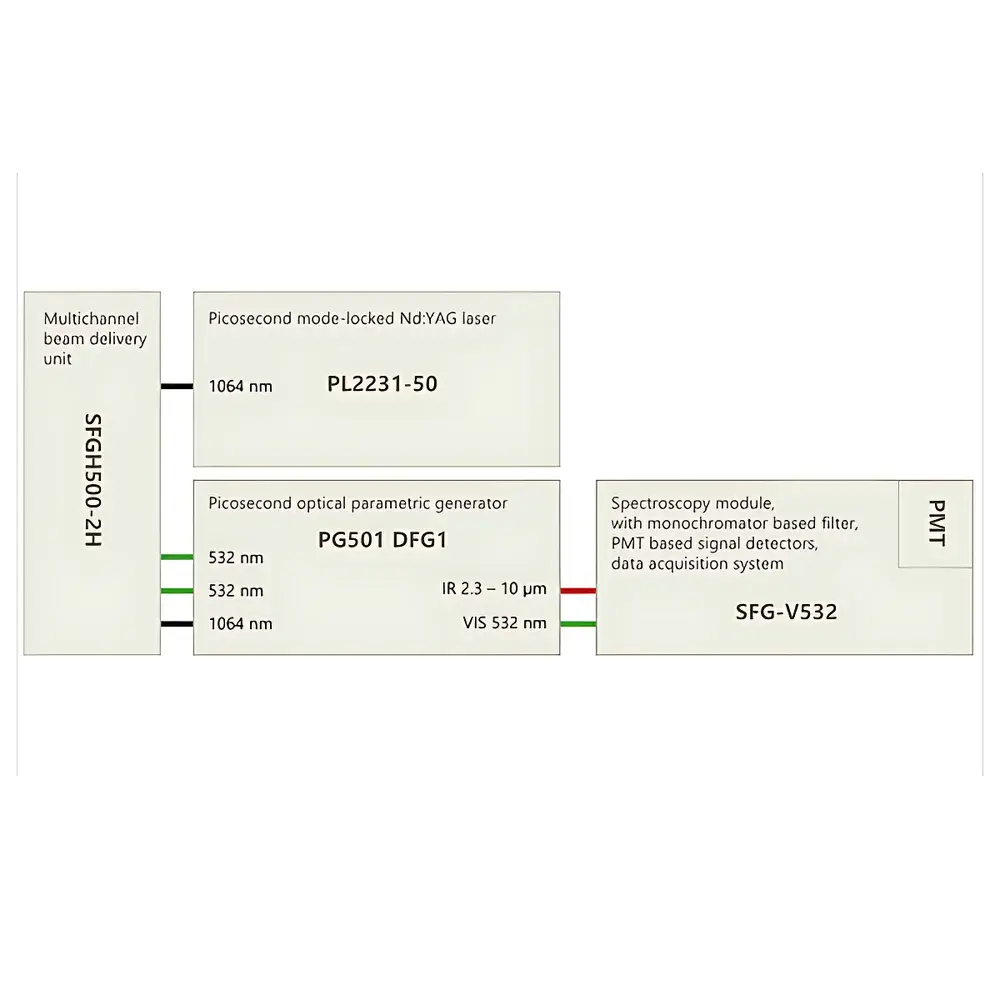
| Laser Source | Diode-pumped mode-locked Nd:YAG (PL2231 series) |
| OPG System | PG501-DFG (standard) or PG511-DFG (high-resolution) |
| Sample Compartment | Vertically oriented, customizable, compatible with Langmuir-Blodgett troughs, temperature/humidity cells, and in situ reaction chambers |
Overview
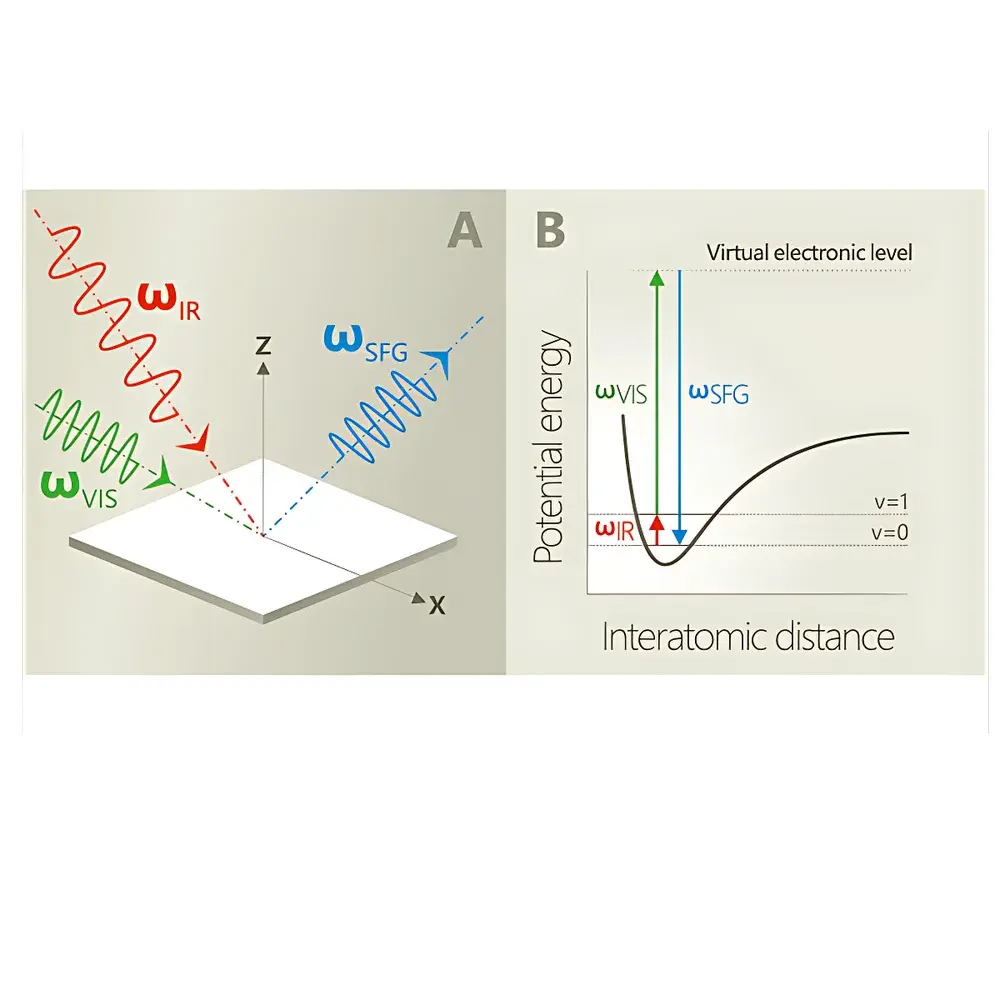
The Ekspla SFG PS Picosecond Scanning Sum Frequency Generation Vibrational Spectrometer is a high-precision, nonlinear optical instrument engineered for label-free, surface-specific molecular characterization at interfaces. Based on the second-order nonlinear optical process of sum frequency generation (SFG), this system exploits the intrinsic symmetry-breaking condition at surfaces and interfaces—where inversion symmetry is absent—to generate a spectroscopically resolvable signal exclusively from interfacial molecules. In operation, a tunable picosecond mid-infrared (IR) pulse (ωIR) and a fixed-frequency visible (VIS) pulse (ωVIS) are spatially and temporally overlapped on the sample surface, producing a coherent SFG output at ωSFG = ωIR + ωVIS. As the IR wavelength is scanned point-by-point across 625–4300 cm⁻¹, resonant enhancement occurs when ωIR matches vibrational transitions of interfacial species—yielding a vibrationally resolved spectrum that encodes chemical identity, conformation, orientation, and ordering. Unlike conventional bulk-sensitive techniques (e.g., FTIR or Raman), SFG-VS requires no labeling, causes no photodamage, and delivers sub-monolayer sensitivity without background interference.
Key Features
- Picosecond time resolution (29 ± 5 ps pulse duration) enables suppression of thermal artifacts and enhanced temporal discrimination in dynamic interfacial studies.
- High spectral resolution (<6 cm⁻¹ standard; <2 cm⁻¹ optional) achieved via narrowband IR generation using PG501-DFG or high-stability PG511-DFG optical parametric generators.
- Motorized polarization control for IR, VIS, and SFG beams (s/p selection, purity > 1:100) facilitates quantitative dipole orientation analysis through polarization-dependent spectral decomposition.
- Time-gated PMT detection with real-time pulse energy monitoring (IR and VIS) ensures shot-to-shot normalization, eliminating spectral distortion from laser fluctuations.
- Vertically oriented, modular sample compartment accommodates in situ accessories: Langmuir-Blodgett troughs, environmental cells (temperature/humidity control), electrochemical cells, and catalytic reactors.
- Diode-pumped Nd:YAG laser architecture (PL2231 series) provides long-term amplitude stability (>98% RMS over 8 h), minimal maintenance, and acoustic-noise-free operation.
- Computer-controlled beam alignment, spot size adjustment (150–600 µm), and automated geometry switching (top-side, bottom-side, top-bottom, total internal reflection) support rapid experimental reconfiguration.
Sample Compatibility & Compliance
The SFG PS spectrometer is applicable to all optically accessible solid–gas, solid–liquid, liquid–gas, and buried interfaces—including single-crystal surfaces, polymer films, lipid bilayers, catalytic nanoparticles, electrode/electrolyte junctions, and atmospheric aerosol proxies. Its nondestructive, ambient-pressure compatibility supports real-time monitoring of interfacial reactions under operational conditions (e.g., CO oxidation on Pt, water dissociation at TiO₂, protein adsorption on biomaterials). The system complies with IEC 60825-1:2014 (laser safety class 4), EN 61000-6-3 (EMC emission limits), and ISO 13406-2 (optical radiation hazard assessment). Enclosed beam paths, interlocked sample compartment shielding, and automatic polarization/attenuation sequencing enable routine use without manual beam exposure—meeting institutional laser safety officer (LSO) requirements for Class 4 operation in shared laboratory environments. All control firmware and data acquisition modules adhere to GLP-relevant traceability standards, including audit-log recording of instrument parameters, user actions, and calibration events.
Software & Data Management
Control and analysis are performed via a dedicated LabVIEW®-based software suite featuring intuitive graphical workflow design, real-time spectral preview, and automated sequence scripting. The platform supports full parameter logging (pulse energies, angles, polarizations, delay times) synchronized with each spectral acquisition point. Raw SFG intensities are normalized in post-processing using concurrently measured IR and VIS pulse energies—ensuring quantitative comparability across sessions and laboratories. Export formats include ASCII, HDF5, and MATLAB-compatible .mat files, enabling integration with third-party modeling tools (e.g., nonlinear susceptibility tensor fitting, density functional theory cross-validation). The software architecture is compatible with networked deployment and remote operation via secure VNC or SSH tunneling—facilitating multi-user access and unattended overnight measurements. Audit trails meet FDA 21 CFR Part 11 requirements for electronic records and signatures when configured with user authentication and role-based permissions.
Applications
- In situ characterization of catalyst surface intermediates during heterogeneous reactions under realistic gas-phase or liquid-phase conditions.
- Quantitative determination of molecular tilt angles and azimuthal order in self-assembled monolayers (SAMs) and Langmuir films via p- and s-polarized SFG ratio analysis.
- Probing hydration structure and ion-specific effects at aqueous electrolyte interfaces relevant to battery electrolytes and corrosion science.
- Monitoring conformational changes in membrane proteins and peptide insertion kinetics at model lipid bilayers.
- Tracking epitaxial growth dynamics and interfacial strain evolution in thin-film semiconductor heterostructures.
- Environmental surface science: identification of organic coatings on atmospheric particulates and ice-nucleating agents at air–ice interfaces.
FAQ
What distinguishes narrowband picosecond scanning SFG from broadband femtosecond SFG?
Narrowband scanning SFG (as implemented in the SFG PS) delivers superior spectral resolution (<2 cm⁻¹ achievable) and higher peak IR fluence—critical for probing weakly absorbing or low-concentration interfacial species. It avoids spectral congestion by exciting one vibrational mode at a time, enabling clean separation of coupled modes. Broadband SFG acquires full spectra simultaneously but trades resolution for speed and is more susceptible to water vapor absorption in the IR path.
Can the system operate under ambient atmospheric conditions?
Yes—the 532 nm VIS beam and picosecond IR pulses (2.3–10 µm) are transmitted effectively through dry air. For extended spectral coverage beyond 4000 cm⁻¹ (i.e., <2.5 µm), purging or vacuum operation is recommended to minimize H₂O/CO₂ absorption. Optional environmental enclosures support controlled humidity and gas composition.
Is polarization-resolved measurement automated?
Yes—motorized waveplates and precision linear polarizers allow fully programmable s/p selection for IR, VIS, and SFG channels without manual realignment. Polarization sequences are scriptable within the LabVIEW interface.
What sample environments are supported out-of-the-box?
The standard vertically oriented sample stage integrates with commercial Langmuir-Blodgett troughs, heated/cooled stages (−20 °C to +80 °C), and gas-flow cells. Custom vacuum or high-pressure cells can be integrated via CF flanges.
How is spectral calibration performed?
Calibration uses well-characterized reference spectra (e.g., Si–H stretch at 2100 cm⁻¹, C≡N stretch in acetonitrile at 2250 cm⁻¹) and internal HeNe laser referencing for absolute wavenumber accuracy (±0.5 cm⁻¹). Daily verification is automated via built-in spectral line checks.





