
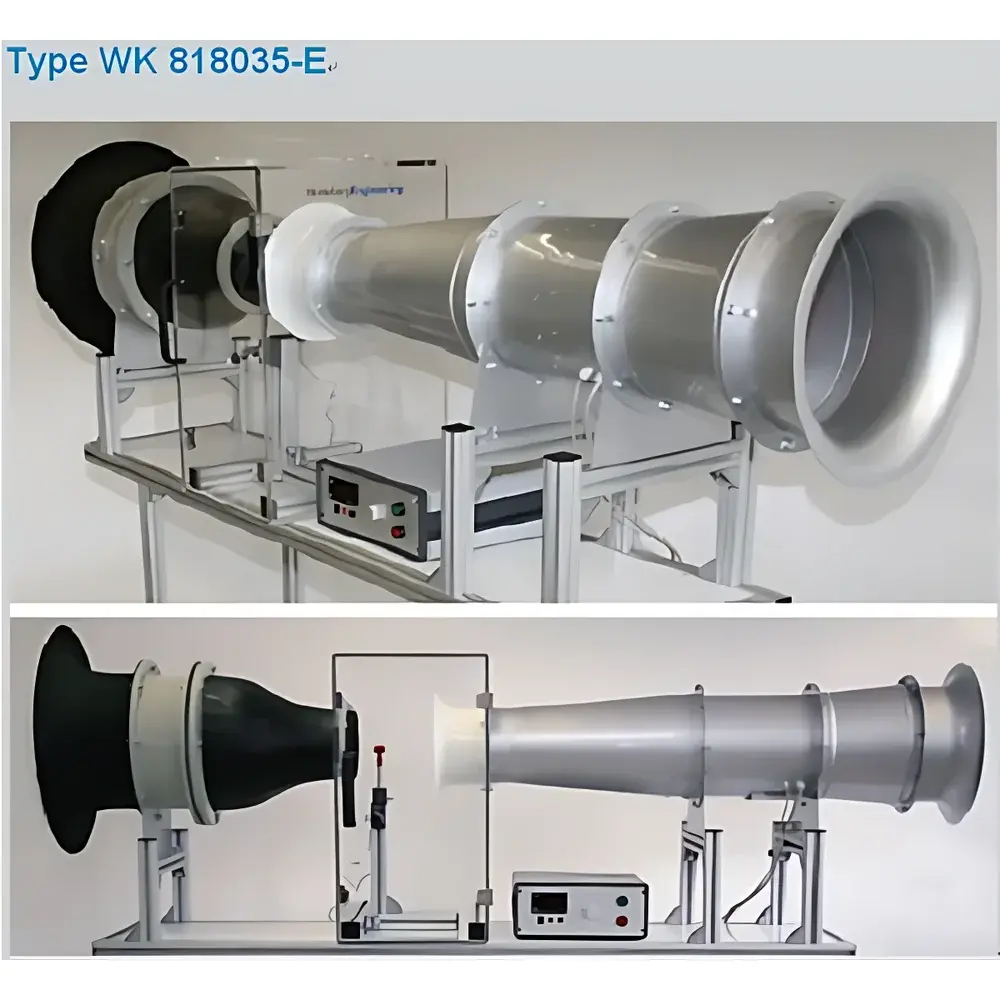
Westenberg WK 818035-E High-Precision Calibration Wind Tunnel
| Origin | Germany |
|---|---|
| Manufacturer Type | Authorized Distributor |
| Origin Category | Imported |
| Model | WK 818035-E |
| Pricing | Upon Request |
Overview
The Westenberg WK 818035-E is a high-precision, boundary-layer-controlled calibration wind tunnel engineered for metrological traceability in air velocity and volumetric flow measurement. Designed and manufactured in Germany, this facility-grade wind tunnel operates on the principle of controlled laminar-to-turbulent transition management within a rigorously conditioned test section, enabling repeatable, low-uncertainty calibration of anemometers, cup vane sensors, hot-wire probes, pitot tubes, and ultrasonic wind sensors. Its core function is to serve as a primary or secondary reference standard in accredited calibration laboratories—particularly those engaged in compliance with DIN ISO/IEC 17025, MEASNET requirements for wind energy assessment, and traceability to PTB (Physikalisch-Technische Bundesanstalt), Germany’s national metrology institute. The tunnel features a closed-loop, recirculating airflow architecture with active temperature stabilization, acoustic damping, and turbulence intensity control below 0.15% (at mid-range velocities), ensuring minimal flow disturbance and high spatial uniformity across the calibration plane.
Key Features
- Test section dimensions: 400 mm × 400 mm cross-section with 1.2 m effective calibration length, optimized for sensor array mounting and multi-point velocity profiling
- Velocity range: 0.1–45 m/s, continuously adjustable via precision frequency-controlled centrifugal blower and calibrated bypass damper system
- Integrated reference instrumentation: Dual NIST-traceable hot-wire anemometers (±0.25% reading uncertainty) and a primary-standard rotating vane flowmeter (ISO 5167-compliant) for real-time volumetric flow verification
- Boundary layer management: Adjustable contraction nozzle, honeycomb flow straightener, and precision-machined settling chamber to suppress secondary flows and ensure <1.5% boundary layer thickness at 10 m/s
- Environmental control: Integrated PID-regulated air temperature stabilization (±0.3 °C) and humidity monitoring (±2% RH), logged synchronously with velocity data
- Structural compliance: Rigid stainless-steel frame with vibration-damped optical table integration; CE-marked per Machinery Directive 2006/42/EC and EMC Directive 2014/30/EU
Sample Compatibility & Compliance
The WK 818035-E accommodates a broad spectrum of air velocity sensing technologies—including mechanical cup-and-vane anemometers, thermal anemometers (constant-temperature and constant-current), pressure-based sensors (pitot-static tubes, differential pressure transducers), and ultrasonic time-of-flight arrays—without requiring sensor-specific adapters. Mounting interfaces conform to ISO 9000-series fixture standards and include modular rail systems with micrometer-adjustable XYZ positioning. Calibration procedures executed on this platform meet the technical requirements of MEASNET Technical Note TN-01 (Wind Turbine Anemometer Calibration), VDI/VDE 3513 Part 2 (Calibration of Air Velocity Measuring Instruments), and DIN EN ISO/IEC 17025:2017 Clause 6.4.2 (Validation of Calibration Methods). All calibration reports issued from this system may carry DAkkS accreditation endorsement when operated within an accredited laboratory environment under documented quality management procedures.
Software & Data Management
Control and data acquisition are managed via Westenberg’s proprietary WinTunnel v4.2 software suite, running on a dedicated industrial PC with real-time Windows OS configuration. The software supports automated calibration sequences per ISO 16811 (Anemometer Calibration), including ramped velocity sweeps, dwell-time stabilization, and statistical outlier rejection based on IEC 62443-3-3 cybersecurity-aligned data integrity protocols. Raw sensor output, reference readings, environmental parameters, and metadata (operator ID, calibration date, equipment IDs) are stored in encrypted SQLite databases compliant with FDA 21 CFR Part 11 requirements for electronic records and signatures. Export formats include CSV, XML (in accordance with ASTM E2500-17 data exchange schema), and PDF calibration certificates with digital signature and QR-code traceability to PTB reference archives.
Applications
- Primary and secondary calibration of meteorological anemometers used in weather stations, aviation wind shear detection, and climate monitoring networks
- Verification and adjustment of turbine nacelle-mounted anemometers prior to IEC 61400-12-1 power curve testing
- Research-grade characterization of boundary layer development and turbulence spectra for CFD model validation
- Development and type-testing of novel MEMS-based airflow sensors for HVAC diagnostics and cleanroom monitoring
- Accredited calibration services supporting GLP/GMP-regulated environmental testing laboratories (e.g., ISO 14644-3 cleanroom certification)
- Inter-laboratory comparison studies organized under EURAMET and COOMET metrology frameworks
FAQ
Is the WK 818035-E supplied with DAkkS-accredited calibration documentation?
No—the wind tunnel itself is delivered with factory verification reports traceable to PTB standards; however, DAkkS accreditation applies to the calibration service performed by the end-user laboratory, not the instrument hardware.
Can the tunnel be integrated into an existing ISO 17025 quality management system?
Yes—its software architecture, audit trail functionality, and procedural documentation package are fully compatible with ISO/IEC 17025:2017 Clause 8.5 (Management of Measurement Uncertainty) and Annex A3 (Validation of Non-Standard Methods).
What maintenance intervals are recommended for long-term metrological stability?
Annual verification of blower performance, flow straightener integrity, and reference sensor calibration is advised; Westenberg provides certified service kits and remote diagnostic support via secure TLS-encrypted connection.
Does the system support custom calibration protocols beyond ISO and IEC standards?
Yes—WinTunnel v4.2 allows user-defined test templates, including non-linear velocity ramps, multi-sensor simultaneous evaluation, and custom uncertainty propagation models aligned with GUM (JCGM 100:2008).
Related Products



