
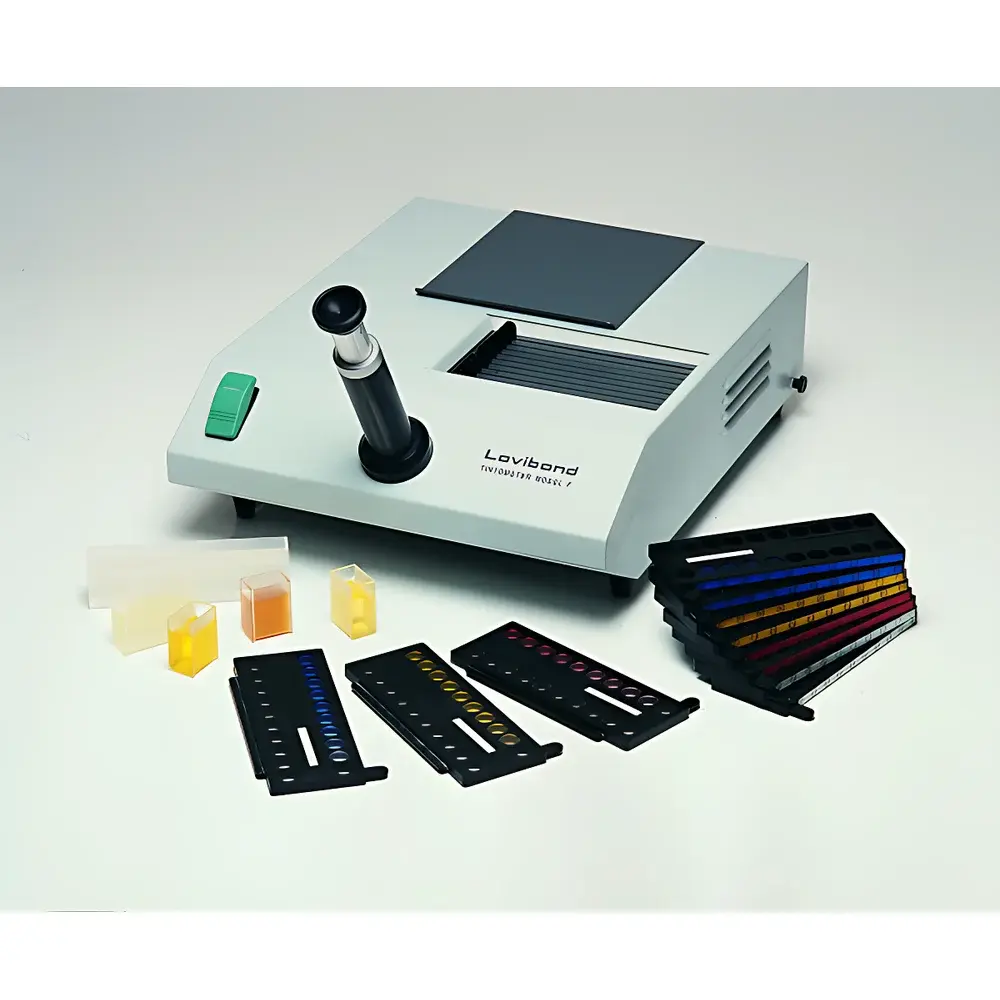
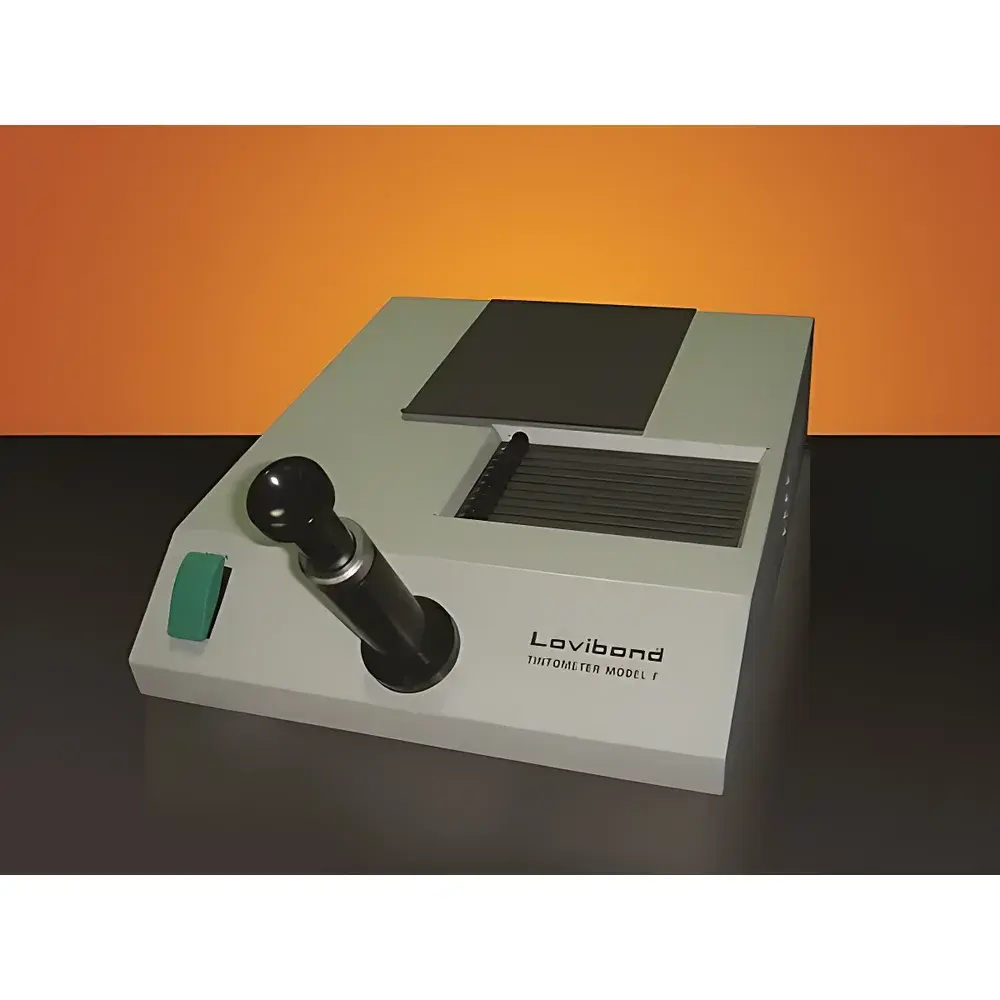
Lovibond Model F Visual Colorimeter
| Brand | Lovibond (Tintometer) |
|---|---|
| Origin | United Kingdom |
| Model | Model F |
| Optical Principle | Visual color matching against calibrated glass color standards |
| Illumination | Standardized D65 daylight simulator with controlled viewing geometry |
| Viewing System | Dual-field comparator with fixed 45°/0° optical path |
| Sample Format | Liquid or semi-solid in standard 10 mm or 25 mm pathlength cuvettes |
| Compliance | ASTM D1500, ISO 2049, AOCS Cc 13b-92, IP 15, BS 684-2.17 |
Overview
The Lovibond Model F Visual Colorimeter is a precision-engineered, manually operated color comparison instrument designed for routine and regulatory-compliant color assessment of transparent and translucent liquids—as well as semi-opaque materials such as fats, waxes, and viscous syrups. It operates on the fundamental principle of visual color matching: the analyst observes a sample in one field of view and compares it side-by-side with a calibrated combination of red, yellow, and blue glass color standards (Lovibond Tintometer® color discs) in the adjacent field. This dual-field comparator design eliminates subjective lighting variability by incorporating a built-in D65 daylight-simulating illuminator with diffused, uniform intensity and fixed 45°/0° viewing geometry—ensuring repeatability across operators and laboratories. Unlike spectrophotometric instruments, the Model F delivers traceable, human-perception-based color evaluation aligned with decades of industry-standard reference methods, making it indispensable for QC labs where method equivalence to legacy specifications (e.g., ASTM D1500 for petroleum products or AOCS Cc 13b-92 for edible oils) is mandatory.
Key Features
- Fixed dual-field optical comparator with parfocal eyepiece and anti-glare baffling for consistent visual alignment
- Calibrated Lovibond glass color discs: red (0.1–40.0), yellow (0.1–40.0), and blue (0.1–4.0) in 0.1-unit increments; certified traceable to NPL (UK) and NIST-referenceable standards
- D65 daylight simulator with stabilized tungsten-halogen source and UV-filtered output (CIE illuminant D65, 6504 K)
- Neutral density disc set (0.05–1.0 OD) for luminance adjustment without chromatic shift—critical for matching low-saturation or high-brightness samples
- Mechanically indexed disc carriage with tactile detents and engraved scale for repeatable positioning and documentation
- Compatible with standard 10 mm and 25 mm pathlength glass or quartz cuvettes (supplied separately); optional sample holders for pastes and gels
- No software dependency or electrical calibration required—ideal for environments with limited IT infrastructure or strict GxP audit requirements
Sample Compatibility & Compliance
The Model F accommodates a broad spectrum of industrial and food-grade materials—including mineral oils, biodiesel blends, crude glycerin, liquid glucose, corn syrup, molasses, vegetable oils (soybean, palm, sunflower, rapeseed), hydrogenated fats, pharmaceutical excipients, and polymer solutions. Its methodology satisfies multiple international test standards: ASTM D1500 (Petroleum Products), ISO 2049 (Animal and Vegetable Fats and Oils), AOCS Cc 13b-92 (Color of Vegetable Oils), IP 15 (Petroleum and Related Products), and BS 684-2.17 (Methods of Testing Fats and Fatty Foods). As a reference-grade visual comparator, it supports GLP and GMP workflows where documented operator training, controlled environmental lighting, and manual result recording are integral to audit readiness. No electronic data capture is performed—results are recorded directly into paper-based or validated LIMS-integrated logbooks per 21 CFR Part 11-compliant procedures.
Software & Data Management
The Lovibond Model F is a fully analog instrument and does not incorporate embedded electronics, firmware, or digital connectivity. Consequently, no proprietary software, drivers, or cloud platforms are associated with its operation. All measurements are recorded manually using standardized reporting templates—typically including sample ID, date/time, operator initials, observed Lovibond units (R/Y/B), neutral density correction (if applied), pathlength, and cuvette identification. Laboratories integrating the Model F into regulated environments commonly pair it with validated electronic lab notebooks (ELN) or LIMS modules that enforce structured entry, electronic signatures, and audit trails for each recorded observation—ensuring full compliance with FDA 21 CFR Part 11, EU Annex 11, and ISO/IEC 17025 documentation requirements.
Applications
- Quality control of refined edible oils and frying fats in production and storage facilities
- Batch release testing of pharmaceutical solvents and active ingredient solutions
- Monitoring thermal degradation or oxidation in lubricants and transformer oils
- Raw material acceptance of corn syrup, invert sugar, and malt extracts in confectionery manufacturing
- Regulatory submission support for color specifications in food additive dossiers (EFSA, FDA, CFDA)
- Reference method validation against spectrophotometric colorimeters in metrology labs
- Training platform for sensory analyst calibration and inter-laboratory proficiency testing
FAQ
Is the Model F compliant with ASTM D1500?
Yes—the Model F is explicitly designed and validated for ASTM D1500 testing of petroleum products and meets all apparatus requirements specified in Sections 6.1–6.3 of the standard.
Can it measure opaque or solid samples?
Not directly; however, semi-opaque materials (e.g., melted cocoa butter, clarified tallow) may be assessed in heated temperature-controlled cells (optional accessory), while true solids require dissolution or thin-film preparation.
Are replacement color discs available with NIST-traceable certification?
Yes—Lovibond supplies factory-calibrated disc sets with individual certificates of calibration traceable to the UK’s National Physical Laboratory (NPL), with optional NIST-equivalent verification reports.
Does the instrument require annual recalibration?
No—glass color standards are inherently stable; periodic verification against master reference discs (recommended every 24 months) is sufficient per ISO/IEC 17025 Clause 6.5.
What pathlength cuvettes are supported?
Standard configurations support 10 mm and 25 mm rectangular glass cuvettes; custom pathlengths (5 mm, 50 mm) are available upon request with corresponding disc compensation guidance.





