
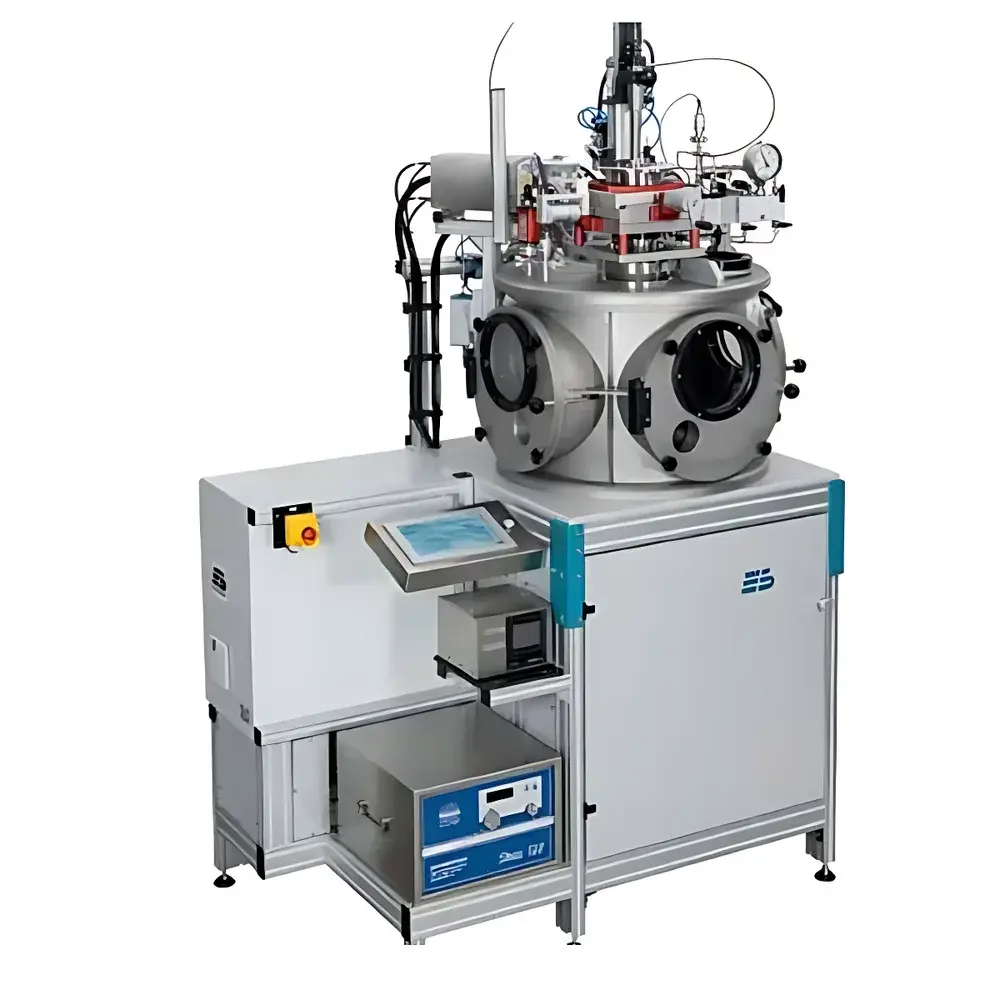
Edmund Bühler MSP 60-h Horizontal Melt Spinning System
| Brand | Edmund Bühler |
|---|---|
| Origin | Germany |
| Manufacturer Type | Authorized Distributor |
| Origin Category | Imported |
| Model | MSP 60-h |
| Sample Capacity | max. 60 g |
| Dimensions (L×W×H) | 1200 × 1206 × 1993 mm (height excluding pyrometer) |
| Generator Power | 12 kW |
| Copper Wheel Diameter | Ø 250 mm |
| Max. Wheel Speed | 60 rps |
| Cooling Rate | ~10⁵ K/s |
| Operating Vacuum | < 10⁻² – 10⁻⁵ mbar |
| Crucible Material | Boron Nitride (BN) with Capillary Slit Nozzle |
| Max. Crucible Temperature | ~1600 °C |
| Electrical Supply | 400 V, 3-phase, 50/60 Hz (RF generator) |
| Fiber Diameter Range | µm-scale |
Overview
The Edmund Bühler MSP 60-h Horizontal Melt Spinning System is a high-vacuum, radio-frequency (RF)-heated rapid solidification apparatus engineered for the reproducible fabrication of metallic ribbons, amorphous strips, and ultrafine fibers via melt spinning. Operating on the principle of planar flow casting under controlled inert or high-vacuum conditions, the system delivers exceptional thermal gradients (>10⁵ K/s) at the melt–substrate interface—enabling metastable phase formation, suppression of crystallization, and generation of nanoscale microstructures in Fe-, Co-, Ni-, Zr-, and rare-earth-based alloys. Its horizontal configuration ensures precise alignment between the BN crucible’s capillary slit nozzle and the rotating copper wheel surface, minimizing melt stream deviation and optimizing ribbon width uniformity. Designed for materials science laboratories engaged in bulk metallic glass development, soft magnetic alloy prototyping, and functional intermetallic synthesis, the MSP 60-h integrates vacuum integrity, RF power stability, and mechanical positioning accuracy to meet stringent requirements for process repeatability and structural fidelity.
Key Features
- High-vacuum chamber equipped with turbomolecular pumping system achieving base pressure < 10⁻⁵ mbar—critical for oxidation-sensitive melts (e.g., Mg-, Ti-, or Al-based alloys)
- 12 kW RF generator with impedance-matching network optimized for stable heating of BN crucibles up to ~1600 °C
- Horizontally mounted, water-cooled copper wheel (Ø 250 mm) rotating at up to 60 revolutions per second (3600 rpm), delivering controlled quenching rates in excess of 10⁵ K/s
- Motorized horizontal crucible translation (±50 mm range) for dynamic adjustment of melt impingement point—ensuring full utilization of the wheel’s active surface and enabling multi-zone ribbon deposition
- Boron nitride crucible with precision-machined capillary slit nozzle (customizable width and aspect ratio) for consistent melt ejection geometry and laminar flow control
- Integrated fiber/ribbon collection chamber with removable stainless-steel trays and optional inert-gas purge capability for post-solidification handling
- Modular vacuum interlock architecture compliant with EN 61508 (functional safety) and CE Machinery Directive 2006/42/EC
Sample Compatibility & Compliance
The MSP 60-h accommodates a broad spectrum of metallic systems—including but not limited to Fe–B–Si–Nb (FINEMET-type), Co–Fe–Si–B, Zr–Cu–Ni–Al (Vitreloy), Mg–Zn–Ca, and Ni–Nb–Sn alloys—provided they exhibit suitable melt viscosity and wetting behavior on copper substrates. Crucible geometry and nozzle design are tailored to match material-specific rheological properties (e.g., low-viscosity Al-based melts require narrower slits; high-surface-tension Zr alloys benefit from pre-wetting grooves). All vacuum components conform to ISO 10816-3 vibration standards, while RF shielding meets IEC 61000-6-4 emission limits. The system supports GLP-compliant operation through configurable process logging (time-stamped temperature, pressure, rotation speed, and RF power), traceable to NIST-traceable calibration certificates for thermocouples and vacuum gauges.
Software & Data Management
Operation is managed via a dedicated industrial PC running real-time control software with deterministic loop timing (<10 ms cycle resolution). The interface provides synchronized acquisition of pyrometer-derived melt pool temperature, capacitance manometer pressure readings, tachometric wheel speed feedback, and RF forward/reflected power metrics. All parameters are stored in HDF5 format with embedded metadata (user ID, timestamp, sample ID, vacuum history), ensuring audit readiness for FDA 21 CFR Part 11–aligned environments. Export options include CSV, MATLAB .mat, and ASTM E1447-compliant XML schemas. Remote monitoring via secure TLS-encrypted OPC UA server enables integration into centralized laboratory information management systems (LIMS) without compromising local data sovereignty.
Applications
- Development of amorphous and nanocrystalline soft magnetic ribbons for high-efficiency transformers and inductors
- Rapid screening of glass-forming ability (GFA) in multicomponent alloy systems
- Production of precursor ribbons for subsequent mechanical alloying or spark plasma sintering (SPS)
- Synthesis of metastable intermetallic phases inaccessible via conventional casting
- Fundamental studies of solidification kinetics, solute trapping, and dendritic fragmentation under extreme cooling conditions
- Preparation of metal–matrix composite precursors via in-situ particle incorporation during melt ejection
FAQ
What vacuum level is required for processing reactive metals such as titanium or magnesium?
A base pressure ≤5×10⁻⁵ mbar is recommended, achieved using the integrated turbomolecular pump backed by a dry scroll pump. Optional cryo-trapping enhances residual gas removal for oxygen-sensitive compositions.
Can the nozzle geometry be modified for different ribbon widths or thicknesses?
Yes—BN crucibles are supplied with standard 0.5 mm slit nozzles; custom widths (0.2–2.0 mm) and tapered profiles are available upon request, with documentation provided per ISO 8000-110 data quality specifications.
Is the system compatible with inert gas backfilling for non-vacuum operation?
The chamber supports controlled argon or helium backfilling to 1 bar absolute, enabling processing of moderately reactive alloys where ultra-high vacuum is unnecessary.
How is temperature monitored during melting?
A dual-wavelength pyrometer (650/900 nm) tracks melt pool temperature in real time, calibrated against fixed-point references (Co–C, 1324 °C; Ni–NiO, 1090 °C) and traceable to PTB standards.
What maintenance intervals are specified for the RF generator and vacuum system?
RF generator inspection is scheduled every 1,000 operating hours; turbomolecular pump oil replacement occurs every 8,000 hours or per manufacturer’s vacuum performance log thresholds.



