
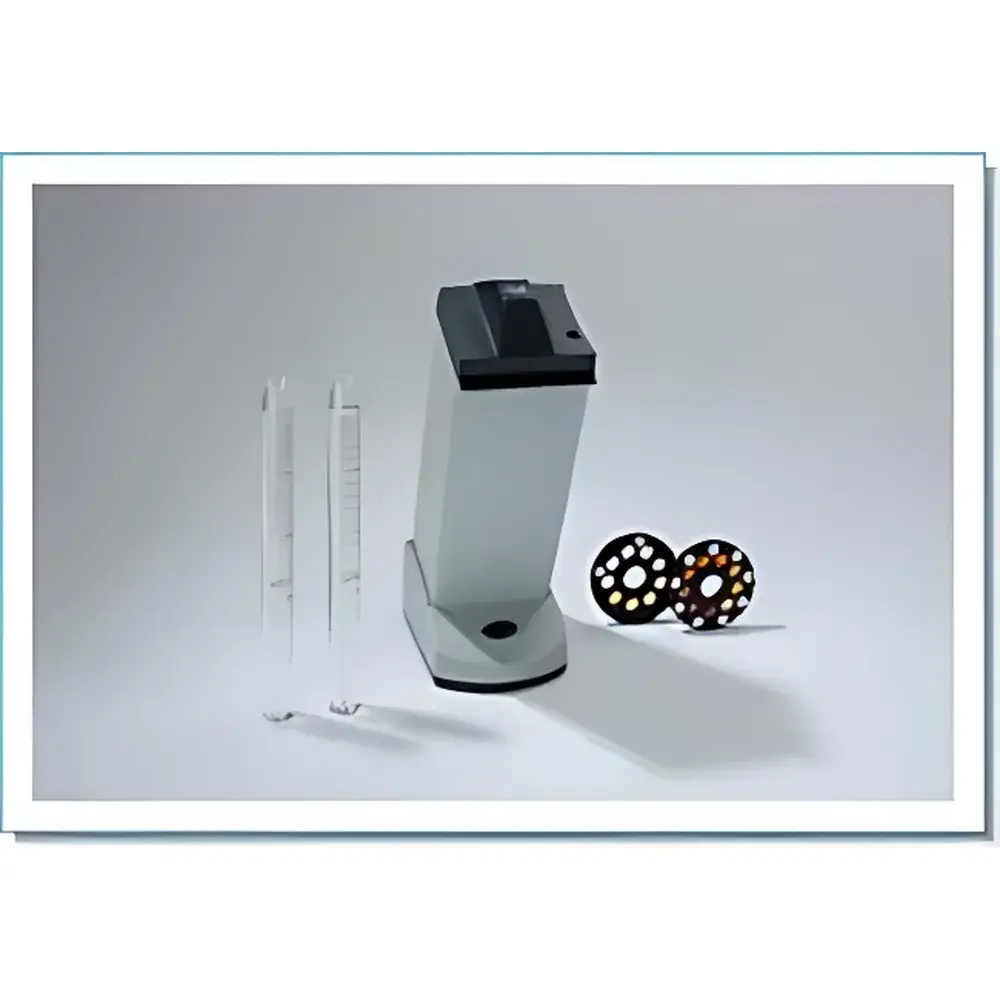
Lovibond AF329 Platinum-Cobalt Colorimeter
| Brand | Lovibond (Tintometer Ltd.) |
|---|---|
| Origin | United Kingdom |
| Model | AF329 |
| Measurement Range | 0–500 Pt-Co Units |
| Compliance | ASTM D1209, AOCS Td 1b-64, ISO 2211, ISO 6271, BS 5339 |
| Application Scope | Clear, pale-yellow liquids only |
| Optical System | Visual comparator with standardized glass color standards |
Overview
The Lovibond AF329 Platinum-Cobalt Colorimeter is a precision visual color measurement instrument engineered for traceable, repeatable assessment of yellowness in transparent, low-turbidity liquids. Based on the internationally recognized Platinum-Cobalt (Pt-Co) scale—also known as the Hazen scale—the AF329 operates via direct visual comparison between a sample and a set of calibrated, stable glass color standards. This method adheres strictly to first-principle photometric principles: light transmission through a fixed-path-length cell (typically 100 mm) is evaluated under controlled illumination against reference hues defined by precise concentrations of platinum and cobalt chloride solutions. Unlike electronic spectrophotometers, the AF329 eliminates spectral interpolation errors and detector drift, delivering inherently stable results where absolute hue fidelity and long-term inter-laboratory reproducibility are prioritized over spectral flexibility.
Key Features
- Optical comparator design utilizing 18 matched, factory-calibrated Lovibond glass color standards covering the full 0–500 Pt-Co range in 10-unit increments (0, 10, 20…500)
- Integrated daylight-simulating tungsten-halogen lamp with diffuser and viewing port optimized for CIE Standard Illuminant A (2856 K)
- Fixed 100 mm path-length sample cell holder compatible with standard 25 mm diameter round-bottom glass tubes
- Mechanically robust aluminum alloy housing with anti-glare black interior finish to minimize stray light interference
- No electronics, batteries, or software required—ensures zero calibration drift and minimal maintenance over decades of use
- Complies with ISO/IEC 17025-recommended practices for visual color assessment when operated under GLP conditions
Sample Compatibility & Compliance
The AF329 is validated exclusively for clear, non-turbid, non-fluorescent liquids with negligible suspended solids (<0.1 NTU) and low absorbance outside the visible yellow region (400–500 nm). Typical compliant matrices include potable water, wastewater effluents, glycerin, ethylene glycol, acetone, chlorinated solvents (e.g., carbon tetrachloride), plasticizers (e.g., dioctyl phthalate), and refined petroleum distillates. It is not suitable for opaque, hazy, or highly viscous samples, nor for samples exhibiting fluorescence or strong UV absorption. Regulatory alignment includes full conformance with ASTM D1209 (Standard Test Method for Color of Clear Liquids), AOCS Td 1b-64 (for edible oils), ISO 2211 (water quality), ISO 6271 (petrochemicals), and BS 5339 (UK water standards). Each instrument ships with a UKAS-traceable calibration certificate referencing NPL (National Physical Laboratory) reference materials.
Software & Data Management
The AF329 is a purely analog, operator-dependent instrument with no embedded firmware, connectivity, or digital output. Consequently, it requires no software installation, network configuration, or cybersecurity protocols. All measurements are recorded manually in laboratory notebooks or LIMS-compatible spreadsheets. For laboratories operating under FDA 21 CFR Part 11 or EU Annex 11 requirements, documentation must include operator identity, date/time, sample ID, observed Pt-Co unit, and verification signature. While the device itself does not generate electronic audit trails, its use within a documented SOP—including lighting validation, standard verification, and observer training records—fully satisfies GLP and GMP traceability expectations for color endpoint testing.
Applications
- Drinking water and wastewater treatment: monitoring chlorine-induced yellowing, organic precursor levels, and post-filtration clarity
- Petrochemical QA/QC: specification testing of solvents, lubricant bases, and hydrocarbon fractions per ASTM D1209
- Pharmaceutical excipient release: color verification of USP/EP-grade glycerol, propylene glycol, and ethanol
- Food & feed additives: assessing purity of liquid antioxidants and emulsifiers per AOCS guidelines
- Chemical manufacturing: batch release testing of plasticizers, monomers, and halogenated intermediates
- Academic and regulatory reference labs: serving as a primary standard for method validation and inter-laboratory comparison studies
FAQ
Is the AF329 compliant with FDA or pharmacopeial requirements for color testing?
Yes—when used within a validated SOP and supported by documented operator competence, the AF329 meets USP <631>, EP 2.2.28, and JP 6.04 requirements for visual Pt-Co assessment.
Can I use plastic cuvettes instead of glass tubes?
No—only certified 100 mm path-length glass tubes with optical-grade clarity and dimensional tolerance ±0.2 mm are permitted per ASTM D1209 Section 7.2.
How often must the glass standards be replaced?
Lovibond recommends replacement every 5 years under normal storage (dark, dry, ambient temperature), or immediately if scratches, clouding, or discoloration are observed.
Does the AF329 require annual recalibration?
No—calibration is intrinsic to the physical standards. However, periodic verification against a NIST-traceable reference set (e.g., Lovibond Reference Set RS-1) is recommended annually.
Is training provided with purchase?
Yes—Lovibond-certified application specialists deliver on-site or virtual operator training covering illumination validation, observer screening (Ishihara test), and SOP documentation per ISO/IEC 17025 Clause 7.2.2.




