
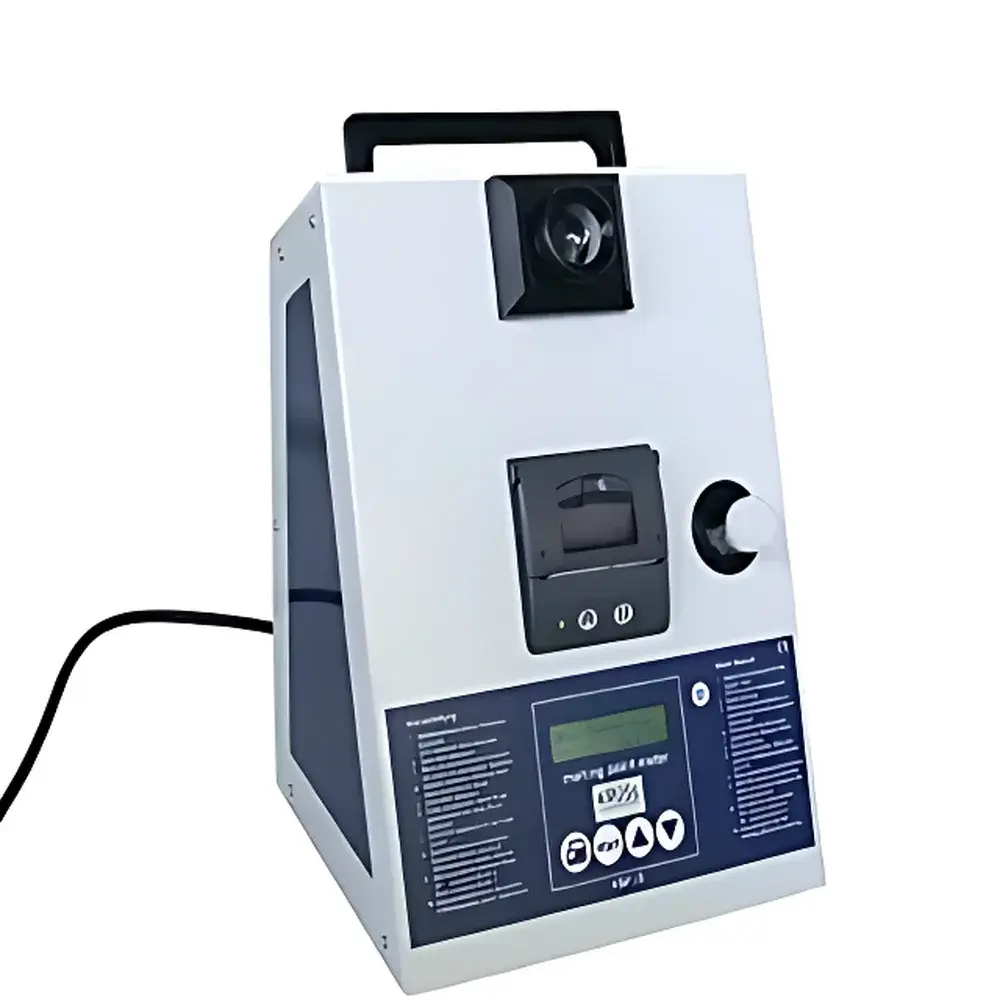
KRUESS KSP1D/KSP1N Visual Melting Point Apparatus
| Brand | KRUESS |
|---|---|
| Origin | Germany |
| Model | KSP1D / KSP1N |
| Temperature Range | 30–360 °C |
| Accuracy | ±0.3 °C (30–200 °C), ±0.5 °C (200–360 °C) |
| Heating Rate | 1 °C/min |
| Optical Magnification | 10× |
| Capillary Capacity | 3 capillaries |
| Capillary Dimensions | 80 mm length × 1.4 mm OD × 0.8 mm ID |
| Cooling | Integrated fan-assisted rapid cooling |
| Display | Backlit LCD with real-time temperature and status |
| Interface | RS-232 |
| Power Supply | 90–264 V AC, 40 W |
| Safety Rating | IP20 |
| Weight | 2.3 kg |
| Language Support | English & German (UI + error messages) |
| Printer | Built-in thermal printer (KSP1D only) |
Overview
The KRUESS KSP1D and KSP1N are precision visual melting point apparatuses engineered for reliable, operator-controlled determination of solid-phase transition temperatures in crystalline organic compounds and pharmaceutical intermediates. Based on classical capillary tube methodology, these instruments employ a calibrated heated metal block and high-resolution optical observation via an integrated 10× illuminated magnifier to enable real-time detection of meniscus formation, shrinkage, and complete liquefaction—key visual endpoints defined by pharmacopoeial standards including USP , Ph. Eur. 2.2.14, and JP 2.60. Designed and manufactured in Hamburg, Germany, the KSP series meets stringent requirements for method reproducibility in QC laboratories operating under GLP or GMP frameworks. The KSP1D variant includes a built-in thermal printer for immediate hard-copy documentation of results, while the KSP1N offers identical thermal and optical performance without printing functionality—both models support dual-language interface (English/German) and comply with IEC 61010-1 for laboratory electrical safety.
Key Features
- Digital PID temperature control ensuring stable ramping at 1 °C/min across the full 30–360 °C range, with certified accuracy of ±0.3 °C below 200 °C and ±0.5 °C up to 360 °C
- Sealed membrane keypad resistant to solvent exposure and routine lab cleaning agents, enhancing long-term reliability in regulated environments
- Integrated axial cooling fan enabling sub-5-minute cooldown from 360 °C to 50 °C—critical for high-throughput sample screening
- Backlit LCD display showing real-time temperature, heating status, elapsed time, and diagnostic codes in both English and German
- Optical system featuring adjustable focus, LED illumination, and 10× magnification for unambiguous identification of phase-change events
- Three-position capillary holder accommodating standard 80 mm × 1.4 mm OD × 0.8 mm ID glass tubes—compatible with ASTM E324 and ISO 6383-1 specimen preparation protocols
- KSP1D model includes RS-232 serial interface and embedded thermal printer supporting audit-ready output per FDA 21 CFR Part 11 data integrity expectations
Sample Compatibility & Compliance
The KSP1D/KSP1N is validated for use with dry, finely powdered crystalline samples loaded into standard thin-walled capillaries. It supports routine analysis of APIs, excipients, polymers, fatty acids, waxes, and metallurgical reference materials where visual endpoint detection remains the regulatory gold standard. Instrument design conforms to IEC 61010-1:2010 (Safety Requirements for Electrical Equipment for Measurement, Control, and Laboratory Use) and carries CE marking for the European Economic Area. Thermal calibration traceability follows DIN EN ISO/IEC 17025 guidelines when performed using NIST-traceable reference standards (e.g., indium, tin, zinc). No software validation package is required, as the device operates as a dedicated hardware instrument without embedded OS or network connectivity—minimizing cybersecurity and qualification burden in regulated labs.
Software & Data Management
As a standalone benchtop instrument, the KSP1D/KSP1N does not rely on external PC software for operation. All temperature control, timing, and display functions are managed by embedded firmware compliant with IEC 62304 Class B. The KSP1D’s RS-232 port enables optional connection to LIMS or ELN systems for automated result transfer; raw ASCII output includes timestamp, setpoint, observed melt onset/offset, and operator ID field (if entered manually). Thermal printouts include instrument ID, date/time stamp, and user-defined sample ID—satisfying basic ALCOA+ principles (Attributable, Legible, Contemporaneous, Original, Accurate) for paper-based records. No electronic signature capability is provided, consistent with its classification as a Type A (non-critical) analytical device per Annex 11 risk assessment guidance.
Applications
- Pharmaceutical quality control: Identity verification and purity assessment of active pharmaceutical ingredients per USP monographs
- Chemical manufacturing: Batch release testing of fine chemicals and specialty intermediates
- Academic research: Polymorph screening and thermal stability profiling of novel organic solids
- Food & cosmetics: Melting behavior analysis of emulsifiers, cocoa butter analogs, and wax-based formulations
- Materials science: Characterization of low-melting-point alloys, solder pastes, and phase-change materials
FAQ
What capillary dimensions are supported?
Standard capillaries measuring 80 mm in length, 1.4 mm outer diameter, and 0.8 mm inner diameter are recommended and fully compatible.
Is the instrument suitable for automated data archiving?
The KSP1D supports ASCII-formatted data export via RS-232; integration with LIMS requires third-party middleware or custom scripting—no native USB or Ethernet interface is provided.
Does it meet FDA 21 CFR Part 11 requirements?
While the instrument itself lacks electronic signatures or audit trails, its printed and manually recorded outputs satisfy Part 11 criteria for non-electronic records; full compliance depends on site-specific SOPs and record retention practices.
Can it be used for decomposition point determination?
No—the KSP series is optimized for sharp melting transitions; decomposition or charring events require complementary techniques such as TGA or DSC.
What maintenance is required?
Annual verification using certified reference materials (e.g., pure caffeine, urea) is recommended; optical lens cleaning with lint-free cloth and isopropanol is sufficient for routine upkeep.



