
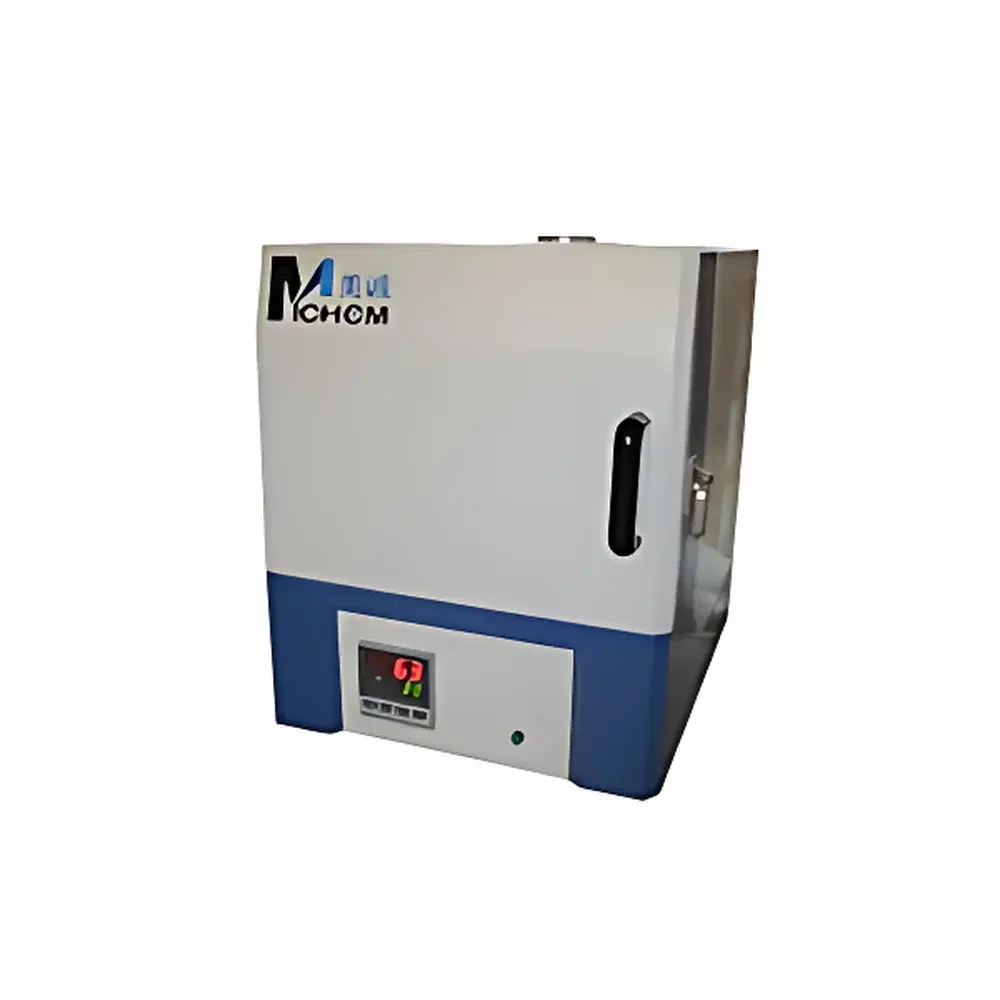
MICHEM TM/E Series Integrated Muffle Furnace
| Brand | MICHEM |
|---|---|
| Model | TM/E |
| Type | Benchtop Box-Type Muffle Furnace |
| Maximum Temperature | 1200 °C |
| Chamber Volume | 9 L |
| Power Supply | 220 V / 16 A |
| Rated Power | 3 kW |
| Heating Element | Resistance Wire |
| Temperature Sensor | K- or S-type Thermocouple |
| Insulation | Nano-Ceramic Fiber (80 mm thickness) |
| Chamber Dimensions (W×D×H) | 200 × 300 × 150 mm |
| External Dimensions (W×D×H) | 490 × 570 × 610 mm |
| Net Weight | 85 kg |
| Temperature Stability | ±0.2 % of Full Scale |
| Programmable Steps | 30 |
| Timer Range | 0–9999 min per step |
| Safety Features | Door-Interlocked Power Cut-off, Open-Circuit Heater Alarm (Audible & Visual) |
Overview
The MICHEM TM/E Series Integrated Muffle Furnace is a compact, benchtop box-type furnace engineered for precision thermal processing in analytical, quality control, and research laboratories. Designed around the fundamental principle of resistive heating within a thermally isolated chamber, it delivers stable, uniform high-temperature environments up to 1200 °C without direct flame or combustion byproducts. Its integrated architecture—merging furnace chamber, insulation matrix, and microprocessor-based controller into a single structural unit—reduces footprint by over 25% compared to conventional modular designs while maintaining full operational integrity. The furnace operates on standard 220 V / 16 A single-phase power, eliminating the need for three-phase infrastructure, and achieves rapid thermal ramping (e.g., 100 °C to 1200 °C in under 40 minutes) through optimized heat transfer dynamics and low-thermal-mass ceramic fiber insulation.
Key Features
- Integrated Structural Design: Unified chassis housing both heating chamber and PID controller minimizes spatial requirements and eliminates inter-unit cabling, enhancing system reliability and reducing installation complexity.
- Nano-Ceramic Fiber Insulation: 80 mm-thick advanced nanostructured ceramic fiber blanket provides exceptional thermal resistance; surface temperature remains below 60 °C after 1 h at 1200 °C, significantly lowering ambient heat load and improving lab safety.
- Precision Multi-Step Temperature Programming: Supports up to 30 programmable segments with independently adjustable ramp rates, soak durations (0–9999 min), and target temperatures—enabling complex thermal profiles required for ashing, calcination, and heat treatment protocols.
- Robust Thermal Stability: Achieves ±0.2 % full-scale temperature stability during hold phases via adaptive PID control, validated against NIST-traceable reference thermocouples (K- or S-type).
- Fail-Safe Protection System: Includes door-actuated mechanical contactor that de-energizes heating elements upon chamber access, plus real-time open-circuit detection for heater failure, triggering simultaneous audible and visual alarms.
- Energy-Efficient Operation: Rated at only 3 kW, the furnace meets IEC 61000-3-2 harmonic emission limits and reduces standby power consumption through intelligent thermal inertia compensation algorithms.
Sample Compatibility & Compliance
The TM/E series accommodates standard crucibles (alumina, silica, platinum) and sample boats up to 200 × 300 × 150 mm internal dimensions. Its muffle configuration ensures complete separation between combustion atmosphere and sample zone—critical for ash content determination (ASTM D3174, ISO 1171), loss-on-ignition (LOI) analysis (USP ), and residue testing per pharmacopeial methods. The furnace complies with EN 61000-6-3 (EMC emissions), EN 61000-6-2 (immunity), and UL 61010-1 safety standards for laboratory electrical equipment. Its programmable timer and temperature logging capability support GLP/GMP documentation requirements, including audit-ready event logs for power interruptions, alarm triggers, and setpoint changes.
Software & Data Management
While the base TM/E model features front-panel operation with LED display and tactile keypad, optional RS485/Modbus RTU interface enables integration with Lab Information Management Systems (LIMS) or SCADA platforms. All temperature and time data—including actual vs. setpoint deviation, alarm timestamps, and step completion status—are stored in non-volatile memory for post-run retrieval. Firmware supports configurable data export formats (CSV, ASCII) compatible with Excel, MATLAB, and statistical process control (SPC) software. For regulated environments, optional firmware upgrade adds 21 CFR Part 11-compliant electronic signatures, user role-based access control, and immutable audit trails.
Applications
This furnace serves routine and method-driven thermal processes across multiple sectors: quantitative ash analysis in coal, biomass, and food matrices; pre-treatment of catalysts and ceramics prior to XRD or SEM; gravimetric determination of volatile solids in wastewater sludge (EPA Method 2540E); thermal decomposition studies in polymer and composite R&D; and controlled oxidation of metallic samples for metallurgical assay. Its consistent temperature uniformity (±5 °C across chamber volume, per ASTM E220 calibration practice) ensures reproducibility across batch-to-batch analyses.
FAQ
What is the maximum recommended continuous operating temperature for the TM0912E model?
The TM0912E is rated for continuous operation at 1200 °C; prolonged use above this threshold may accelerate heating element degradation and compromise thermal stability.
Can the furnace be used under inert or reducing atmospheres?
No—the TM/E series is designed exclusively for air-atmosphere operation; its heating elements and insulation are not rated for hydrogen, argon, or vacuum conditions.
Is calibration traceability provided with the instrument?
Each unit ships with a factory calibration certificate referencing NIST-traceable thermocouples; users must perform periodic in-house verification per ISO/IEC 17025 guidelines.
How is temperature uniformity verified across the chamber?
Uniformity is validated during manufacturing using a 9-point thermocouple mapping procedure per ASTM E220, with results documented in the individual unit’s test report.
Does the door-interlock mechanism meet international safety standards?
Yes—the dual-pole mechanical contactor complies with EN 60204-1 Category 3 safety circuit requirements and is certified by TÜV Rheinland to PL e (Performance Level e) per ISO 13849-1.



