
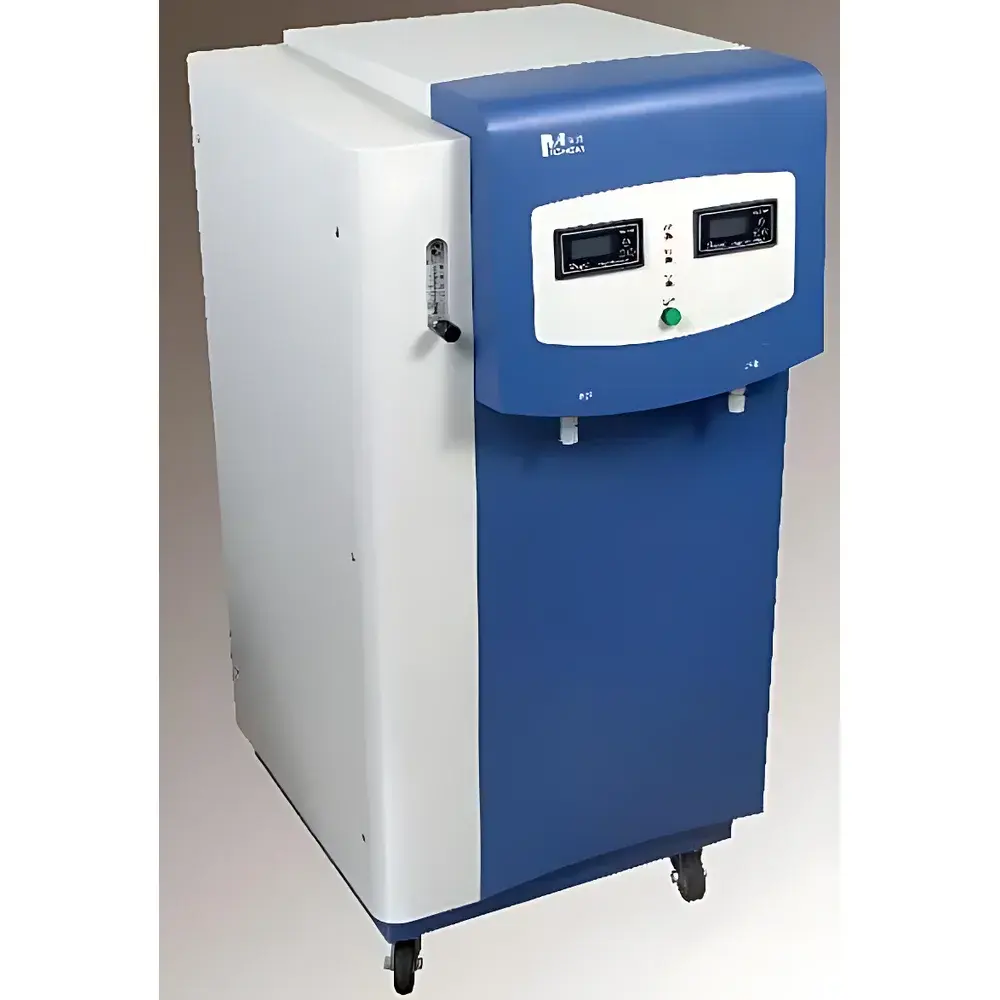
MICHEM MW Series Ultra-Pure Water System
| Brand | MICHEM |
|---|---|
| Model | MW-D10 / MW-D20 / MW-D30 / MW-D50 |
| Origin | Beijing, China |
| Production Capacity | 10–50 L/h |
| Feed Water | Municipal tap water (TDS < 360 ppm, pressure > 0.2 MPa) |
| Pure Water Resistivity | 1–5 µS/cm |
| Ultra-Pure Water Resistivity | 10–18.25 MΩ·cm @ 25 °C |
| Conductivity Sensor | 0.01 cm⁻¹ stainless steel electrode, ±0.1 °C temp. compensation |
| Optional Terminal Filtration | Sartorius 0.22 µm filter |
| Power Supply | AC 220 V / 50 Hz / 5 A |
| Noise Level | < 20 dB(A) |
| Certifications | Compliant with GB/T 6682–2008, ASTM D1193–20, CLSI EP22-A, and NSF/ANSI 61 components |
Overview
The MICHEM MW Series Ultra-Pure Water System is an integrated, dual-loop laboratory water purification platform engineered for precision analytical applications requiring both Type II pure water and Type I ultra-pure water simultaneously. It employs a multi-stage purification architecture anchored by reverse osmosis (RO), followed by electrodeionization (EDI) or mixed-bed ion exchange, activated carbon adsorption, ultraviolet (UV) oxidation at 185/254 nm, and optional 0.22 µm terminal filtration. This configuration ensures consistent removal of dissolved ions, organic compounds (measured as total organic carbon, TOC), endotoxins, nucleases, particles, and microorganisms—critical parameters for trace-level instrumentation such as ICP-MS, HPLC-MS, GC-MS, and cell culture workflows. The system operates directly from municipal tap water feedstock, eliminating the need for pre-treatment infrastructure while maintaining compliance with national and international laboratory water standards including GB/T 6682–2008 (China), ASTM D1193–20 (USA), CLSI EP22-A (clinical labs), and ISO 3696:1987.
Key Features
- Simultaneous dual-stream output: Independent pure water (1–5 µS/cm) and ultra-pure water (up to 18.25 MΩ·cm @ 25 °C) paths with real-time resistivity monitoring on both lines.
- Stainless-steel powder-coated chassis: Compact footprint (as small as 440 × 555 × 700 mm), mobile design suitable for benchtop or under-bench installation without dedicated plumbing.
- Low-noise operation: Integrated high-efficiency booster pump generating < 20 dB(A) acoustic pressure—compatible with quiet laboratory environments.
- Intelligent control interface: Backlit LCD display with touch-sensitive controls showing real-time conductivity/resistivity, water temperature, system status, and maintenance alerts.
- Automated safeguards: Auto-shutdown upon reservoir fullness, feed water interruption, or consumable exhaustion; configurable alarm thresholds for resistivity deviation and TOC excursion.
- NSF-certified componentry: Key membranes and resins sourced from Dow Chemical and Koch Membrane Systems (formerly GE Water), validated per NSF/ANSI Standard 61 for drinking water system components.
Sample Compatibility & Compliance
The MW Series delivers water quality validated for use across regulated and research-intensive domains. Ultra-pure water output meets or exceeds the most stringent specifications for molecular biology (nuclease-free), pharmaceutical QC (USP ), and clinical diagnostics (CLIA, CAP). Its ≤10 ppb TOC and <0.001 EU/mL endotoxin levels support endotoxin-sensitive assays including limulus amebocyte lysate (LAL) testing. Particle count ≤1/mL (≥0.22 µm) satisfies requirements for semiconductor rinse applications and optical substrate cleaning. All models are designed for GLP/GMP-aligned environments, supporting audit-ready data logging (when paired with optional RS232/USB data export) and compliant with FDA 21 CFR Part 11 when integrated into validated networked lab information systems.
Software & Data Management
While the base MW Series features embedded firmware without cloud connectivity, it provides local data integrity through non-volatile memory storing up to 30 days of timestamped resistivity, TOC (via optional online sensor), and temperature logs. Optional analog/digital outputs enable integration with building management systems (BMS) or centralized lab monitoring platforms. For regulatory traceability, the system supports manual calibration verification logs and consumable lifecycle tracking—including resin exhaustion estimation based on cumulative volume and feedwater TDS history. Firmware updates are performed via USB stick, ensuring version control and validation documentation retention per ISO/IEC 17025 clause 5.9.
Applications
- High-sensitivity elemental analysis: ICP-OES, ICP-MS, AAS, and ICP-AES where chloride, sodium, or silica contamination skews detection limits.
- Chromatographic techniques: Mobile phase preparation for UHPLC, HPLC, IC, and GC; column equilibration and system flushing.
- Molecular life sciences: PCR reagent preparation, electrophoresis buffer formulation, mammalian cell culture media, and monoclonal antibody purification.
- Reference material dilution: Certified reference standard preparation in metrology labs accredited to ISO/IEC 17025.
- Industrial process support: Precision optics cleaning, photomask rinsing, and thin-film deposition pre-wash protocols.
FAQ
What feed water quality is required for stable operation?
Municipal tap water with TDS ≤ 360 ppm and inlet pressure ≥ 0.2 MPa is sufficient. Pre-filtration is recommended if turbidity exceeds 1 NTU or chlorine residual exceeds 2 ppm.
Can the system be validated per IQ/OQ/PQ protocols?
Yes—documentation packages including FAT/SAT checklists, calibration certificates for resistivity sensors, and material compliance statements (RoHS, REACH, NSF 61) are available upon request.
How often must consumables be replaced?
RO membrane service life averages 2–3 years; mixed-bed cartridges range from 6–12 months depending on feedwater TDS and daily usage volume. The system calculates remaining cartridge capacity based on flow meter integration and historical usage.
Is remote monitoring supported?
Standard models include dry-contact relay outputs and 4–20 mA analog signals for resistivity and flow rate. Ethernet or Wi-Fi modules are available as factory-installed options for SNMP or Modbus TCP integration.
Does the system comply with USP purified water requirements?
The pure water stream meets USP conductivity limits (≤1.3 µS/cm at 25 °C) when operated within specified feed conditions and maintained per manufacturer-recommended intervals.



