
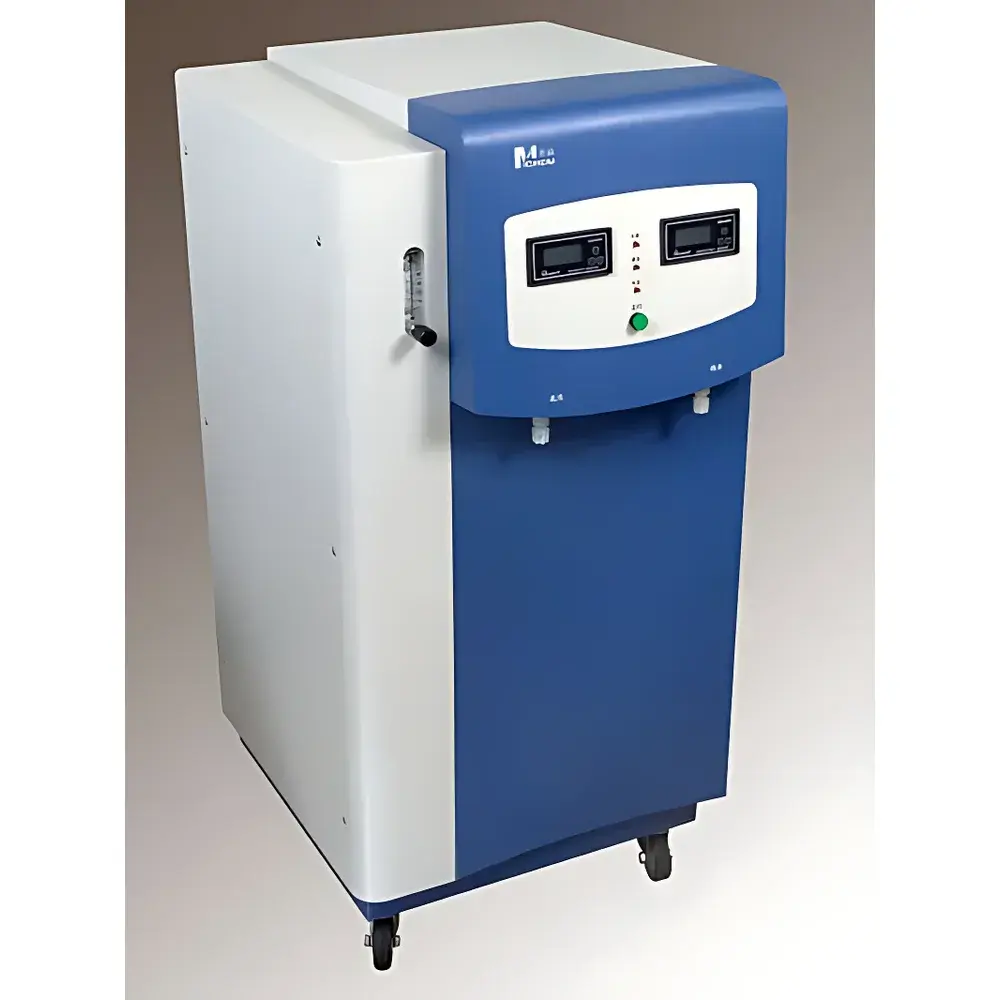
MICHEM MW Series Ultra-Pure Water System
| Brand | MICHEM |
|---|---|
| Model | MW-D10 / MW-D20 / MW-D30 / MW-D50 |
| Production Origin | Beijing, China |
| Purification Technology | Integrated Reverse Osmosis + Dual-Stage Deionization + UV Oxidation + 0.22 µm Final Filtration |
| Conductivity of Pure Water Output | 1–5 µS/cm |
| Resistivity of Ultrapure Water Output | 10–18.25 MΩ·cm @ 25 °C |
| Feed Water Requirement | Municipal tap water, TDS < 360 ppm, pressure > 0.2 MPa |
| Power Supply | AC 220 V / 50 Hz / 5 A |
| Noise Level | < 20 dB(A) |
| Dimensions (W×D×H mm) | 440×555×700 (MW-D10/D20) |
Overview
The MICHEM MW Series Ultra-Pure Water System is an integrated laboratory-grade water purification platform engineered for precision analytical applications requiring consistent, high-fidelity water quality. It employs a multi-stage purification architecture combining reverse osmosis (RO), dual-bed mixed-ion exchange resins, 185/254 nm ultraviolet photo-oxidation, and terminal 0.22 µm membrane filtration to remove dissolved ions, organic compounds, microorganisms, endotoxins, and particulates from municipal tap feed water. Unlike single-stage distillation or basic deionization units, the MW system delivers two independent, simultaneously generated water streams—Type II pure water (1–5 µS/cm) and Type I ultrapure water (up to 18.25 MΩ·cm at 25 °C)—in accordance with ISO 3696:1987, ASTM D1193-20, and GB/T 6682–2008 Class I specifications. Its closed-loop design minimizes atmospheric recontamination, while real-time resistivity/conductivity monitoring ensures continuous traceability of water quality throughout operation.
Key Features
- Simultaneous dual-stream output: Independent pure water (1–5 µS/cm) and ultrapure water (10–18.25 MΩ·cm) pathways enable concurrent use in diverse applications without cross-contamination risk.
- Robust six-stage purification train: Pre-filtration → RO membrane → activated carbon → mixed-bed ion exchange → UV oxidation (185/254 nm) → 0.22 µm sterile filtration ensures compliance with stringent analytical water standards.
- High-accuracy digital monitoring: Stainless-steel 0.01 cm−1 conductivity cell with ±0.1 °C temperature compensation provides traceable, NIST-traceable resistivity readings displayed on a backlit LCD interface.
- Intelligent operational safeguards: Automatic shutdown on low feed pressure, full reservoir detection, or resin exhaustion; audible/visual alerts for scheduled maintenance and consumable replacement.
- Low-noise, energy-efficient architecture: Optimized booster pump operates below 20 dB(A); overall power consumption is >90% lower than conventional distillation systems, reducing lifecycle operating costs.
- Modular, service-oriented design: Front-access cartridge bays facilitate rapid field replacement of RO membranes, ion exchange columns, and UV lamps without tools or system depressurization.
Sample Compatibility & Compliance
The MW Series is validated for compatibility with critical instrumentation requiring ultra-low background interference—including ICP-MS, HPLC, LC-MS, IC, AAS, AES, and ELISA assay preparation. Its ultrapure water output meets or exceeds the purity thresholds specified in ASTM D1193-20 (Type I), CLSI EP21-A (formerly NCCLS), CAP Laboratory Accreditation Program requirements, and USP Total Organic Carbon limits. Endotoxin levels (<0.001 EU/mL) and microbial counts (≤1 CFU/mL) satisfy ISO 13485-compliant cleanroom and biopharmaceutical QC workflows. All wetted components comply with NSF/ANSI Standard 61 and FDA 21 CFR Part 11–ready data logging configurations are available upon request for GLP/GMP environments.
Software & Data Management
While the base MW system operates via intuitive tactile controls and real-time analog display, optional firmware upgrades support RS232/USB data export for integration into centralized laboratory information management systems (LIMS). Logged parameters include timestamped resistivity, TOC trend estimates (derived from UV absorbance decay kinetics), cumulative volume dispensed, and consumable usage metrics. Audit trails conform to ALCOA+ principles (Attributable, Legible, Contemporaneous, Original, Accurate, Complete, Consistent, Enduring, Available) and support 21 CFR Part 11-compliant electronic signatures when paired with authorized authentication modules.
Applications
- Trace elemental analysis by ICP-OES and ICP-MS, where chloride, sodium, and silica contamination must remain below sub-ppt detection limits.
- HPLC mobile phase preparation and column equilibration, minimizing baseline drift and ghost peaks caused by organic residues.
- Cell culture media formulation and molecular biology reagent dilution, ensuring absence of nucleases, pyrogens, and RNase activity.
- Calibration standard preparation for clinical chemistry analyzers and reference material certification protocols.
- Rinsing of optical substrates, semiconductor wafers, and photomask cleaning processes demanding particle-free, low-metal-content rinse water.
- Pharmaceutical stability testing and dissolution media preparation per USP and .
FAQ
What feed water quality is required for optimal MW system performance?
City-supplied tap water with TDS ≤ 360 ppm and inlet pressure ≥ 0.2 MPa is sufficient. The system tolerates feed conductivity up to 550 µS/cm—broader than many competitive platforms—due to its high-rejection RO stage and robust pre-treatment.
How often do consumables need replacement under typical lab usage?
Resin cartridges yield ~8,000 L (MW-D10/D20) or ~16,000 L (MW-D30/D50) before regeneration or replacement. RO membranes typically last 18–24 months depending on feed water hardness and chlorine exposure. UV lamps are rated for 9,000 hours of continuous operation.
Is the system compatible with regulated GxP environments?
Yes. With optional software-enabled audit trail logging, user access controls, and electronic signature capability, the MW Series supports validation per FDA 21 CFR Part 11, EU Annex 11, and ISO/IEC 17025 requirements.
Can the MW system be integrated into existing lab plumbing networks?
It is designed as a point-of-use (POU) unit and does not require permanent plumbing. However, optional wall-mount brackets and flexible inlet/outlet tubing kits allow semi-permanent installation adjacent to instrument benches or central utility panels.
Does the system include calibration documentation for metrological traceability?
All factory-installed resistivity sensors are calibrated against NIST-traceable standards, and a Certificate of Conformance (CoC) with initial calibration data is supplied with each unit. On-site recalibration services are available through MICHEM-certified field engineers.



