
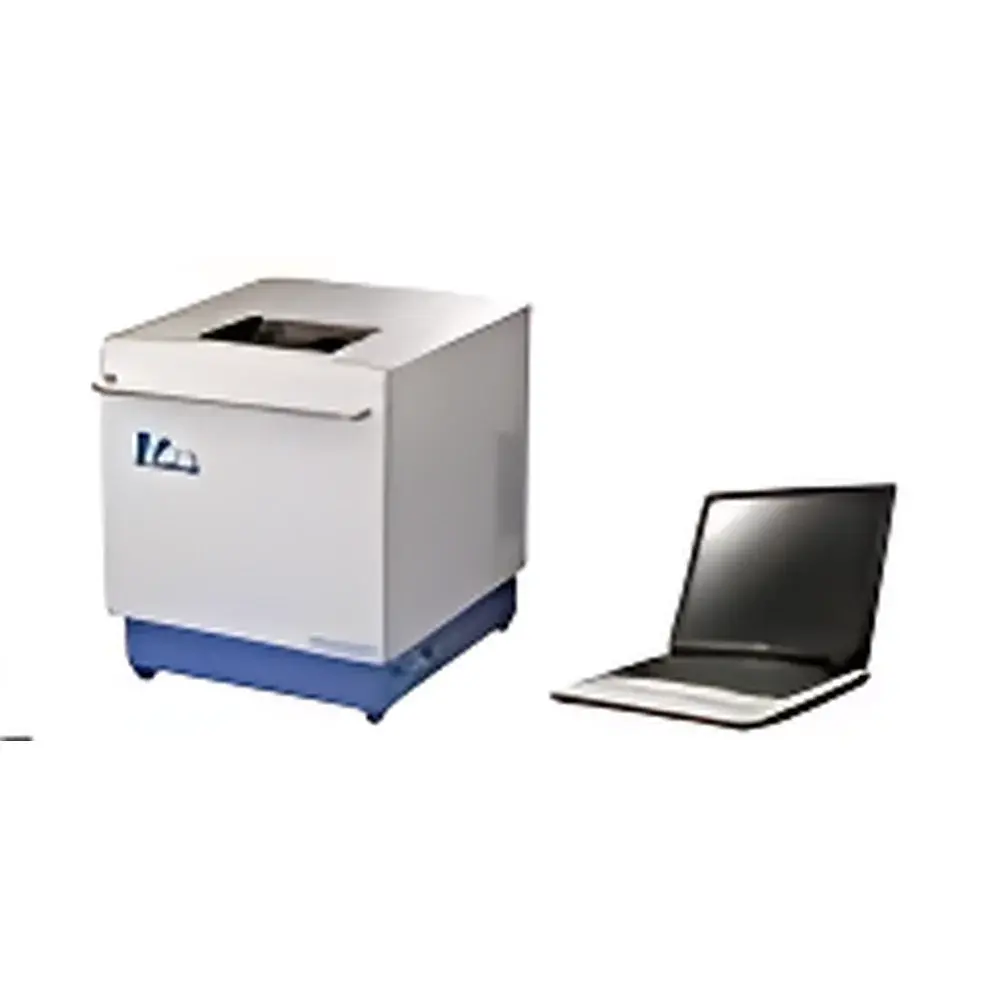
MICHEM MD6 Intelligent Microwave Digestion System
| Brand | MICHEM |
|---|---|
| Model | MD6 |
| Origin | Beijing, China |
| Microwave Frequency | 2450 ± 13 MHz |
| Output Power | 1200 W |
| Power Control | 0–100% PID automatic continuous adjustment |
| Cavity Volume | 45 L |
| Dimensions (W×D×H) | 490 × 610 × 610 mm |
| Net Weight | 48 kg |
| Temperature Range | 0–300 °C |
| Temperature Accuracy | ±0.5 °C |
| Pressure Range | 0–6 MPa (900 psi) |
| Pressure Accuracy | ±0.01 MPa |
| Cavity Coating | PFA (DuPont™) |
| Microwave Leakage | ≤0.3 mW/cm² |
| Safety Features | Dual-stage explosion-proof door (Patent ZL 200420032536), rupture disk pressure relief, Pt100 direct-contact temperature sensing, real-time dual-parameter (T&P) monitoring |
| Vessel Configuration | PEEK outer vessel (10 MPa rating), TFM inner vessel (chemically inert, 300 °C stable) |
| Rotation | 360° reversible turntable with magnetic & mechanical stirring (0–5000 rpm) |
| Sample Capacity | Up to 10 vessels per run (standard: 4 or 6 vessels |
| volume range | 10–1500 mL) |
| Control Options | A-type laptop-based software interface (unlimited method storage, real-time T&P curve logging) or C-type microcontroller (15 pre-programmed methods, 8-step ramping) |
| Ventilation | 3 m³/min forced-air cooling, <20 min cooldown to safe opening temperature |
Overview
The MICHEM MD6 Intelligent Microwave Digestion System is a high-performance, CE-compliant benchtop instrument engineered for rapid, reproducible, and trace-metal-safe sample preparation in analytical laboratories. It operates on the principle of microwave-assisted acid digestion—where controlled microwave energy (2450 MHz) induces rapid, volumetric heating within sealed reaction vessels under elevated temperature and pressure. This non-conductive, dielectric heating mechanism enables uniform thermal penetration across heterogeneous matrices, significantly accelerating decomposition kinetics compared to conductive heating methods such as hot plates or block digesters. Designed for compatibility with elemental analysis workflows—including ICP-MS, ICP-OES, AAS, and AFS—the MD6 delivers complete mineralization of complex biological, environmental, geological, and industrial samples while minimizing analyte loss, contamination, and reagent blank contribution. Its architecture adheres to core principles of green chemistry: reduced acid consumption (typically 5–10 mL per sample), closed-vessel operation eliminating volatile element escape (e.g., As, Hg, Se), and >80% energy savings versus conventional digestion.
Key Features
- Robust 45-L cavity constructed with DuPont™ PFA coating—resistant to concentrated HNO₃, HF, HCl, and aqua regia at temperatures up to 300 °C
- Dual-parameter real-time monitoring: Pt100 platinum resistance thermometer (±0.5 °C accuracy) and direct-contact pressure transducer (±0.01 MPa resolution, up to 6 MPa / 900 psi)
- Intelligent PID-controlled power modulation—enabling precise, stepless microwave output adjustment (0–100%) without frequency hopping or duty-cycle interruption
- Patented dual-stage safety door (ZL 200420032536) featuring lateral displacement release and secondary mechanical lockout under overpressure conditions
- 360° bidirectional rotating turntable with integrated magnetic and mechanical stirring (0–5000 rpm), ensuring homogeneous field distribution and consistent thermal profiles across all vessels
- Six-layer safety architecture: (1) real-time T&P feedback control, (2) programmable slope-limiting ramp profiles, (3) auto-shutdown at user-defined thresholds, (4) disposable rupture disks (200/400 psi), (5) PFA-lined cavity with waveguide attenuators, and (6) physically isolated control unit
- Compliance-ready data handling: A-type configuration includes validated software supporting audit trails, electronic signatures, and 21 CFR Part 11–compatible method archiving
Sample Compatibility & Compliance
The MD6 accommodates standard rotor configurations for 4 or 6 high-pressure digestion vessels (optional 10-position upgrade), with individual vessel capacities ranging from 10 mL to 1500 mL. Vessels consist of TFM® fluoropolymer liners housed within reinforced PEEK® outer sleeves—certified to withstand sustained pressures up to 10 MPa and thermal excursions to 300 °C. This construction ensures compatibility with aggressive chemistries required for silicate dissolution (HF-containing mixtures), organic matrix destruction (HNO₃/H₂O₂), and halogenated polymer digestion. The system conforms to ISO 17025 requirements for method validation and supports GLP/GMP-aligned documentation practices. All pressure and temperature data are time-stamped and exportable in CSV or XML format for integration into LIMS environments. Microwave leakage remains consistently below 0.3 mW/cm² (per IEC 61000-4-3 and GB 4706.21), well within the international safety limit of 5 mW/cm².
Software & Data Management
The optional A-type control platform runs on a dedicated Windows-based laptop with MICHEM Digisoft™ v4.x—a validated application designed for method development, execution, and compliance reporting. It provides live graphical overlay of temperature and pressure curves for each vessel, synchronized with power output and rotational status. Users may define multi-step heating protocols (up to 8 segments per method), assign vessel-specific calibration offsets, and enforce password-protected access levels. All session logs—including timestamps, operator ID, method version, raw sensor outputs, and final digestion parameters—are cryptographically hashed and stored with immutable audit trails. Export functions support ASTM E2500-23–compliant data packages, facilitating third-party review and regulatory submission. The C-type microcontroller variant offers simplified operation via LED display and keypad, retaining 15 programmable methods with 8-step ramp logic—suitable for routine QC labs requiring GxP traceability without full electronic record infrastructure.
Applications
The MD6 serves as a foundational sample preparation tool across regulated and research-intensive domains. In environmental testing laboratories, it enables EPA Methods 3051A, 3052, and ASTM D5511-compliant digestion of soils, sediments, and sludges for heavy metal quantification. Clinical and pharmaceutical labs utilize it for USP and ICH Q2(R2)-aligned digestion of APIs, excipients, and biologics prior to elemental impurity screening (ICH Q3D). Geological and metallurgical applications include ISO 11885 digestion of ores and alloys for multi-element ICP-MS analysis. Its versatility extends beyond digestion: the system supports microwave-assisted extraction (MAE) per AOAC 2005.02, protein hydrolysis for amino acid analysis, and open-vessel synthesis under reflux conditions when configured with ME-series accessories. Method transfer studies confirm equivalence or superiority to conventional hot-block digestion in recovery (>95% for Cr, Pb, Cd in NIST SRM 2711a), precision (RSD <3% for triplicate digests), and throughput (10 samples in <35 min vs. 6–8 h conventionally).
FAQ
What safety certifications does the MD6 hold?
The MD6 complies with IEC 61010-1 (Electrical Safety), IEC 61000-4-3 (EMC Immunity), and GB 4706.21 (Microwave Oven Safety). Its PFA cavity coating meets FDA 21 CFR 177.1550 for food-contact polymers. Full test reports are available upon request.
Can the MD6 be integrated into an automated laboratory workflow?
Yes—via RS-232 or USB virtual COM port, the A-type controller supports SCPI command sets for remote initiation, status polling, and log retrieval. Optional PLC interface modules enable synchronization with robotic sample handlers and autosamplers.
Is method validation support provided?
MICHEM supplies IQ/OQ documentation templates, certified reference material (CRM) digestion protocols (e.g., NIST SRMs), and on-site installation qualification services aligned with ISO/IEC 17025 Clause 5.5.2.
What maintenance is required for long-term reliability?
Annual calibration of temperature and pressure sensors by an accredited metrology lab is recommended. Routine cleaning of the cavity, turntable, and waveguide cover with isopropanol is sufficient; no consumable parts require replacement under normal operation.
Does the system support variable rotor sizes or custom vessel geometries?
Standard rotors accept 4–10 positions with interchangeable adapters. Custom TFM/PEEK vessel designs (e.g., conical-bottom, septum-sealed) can be qualified under MICHEM’s Application Development Program, subject to pressure containment verification.



