
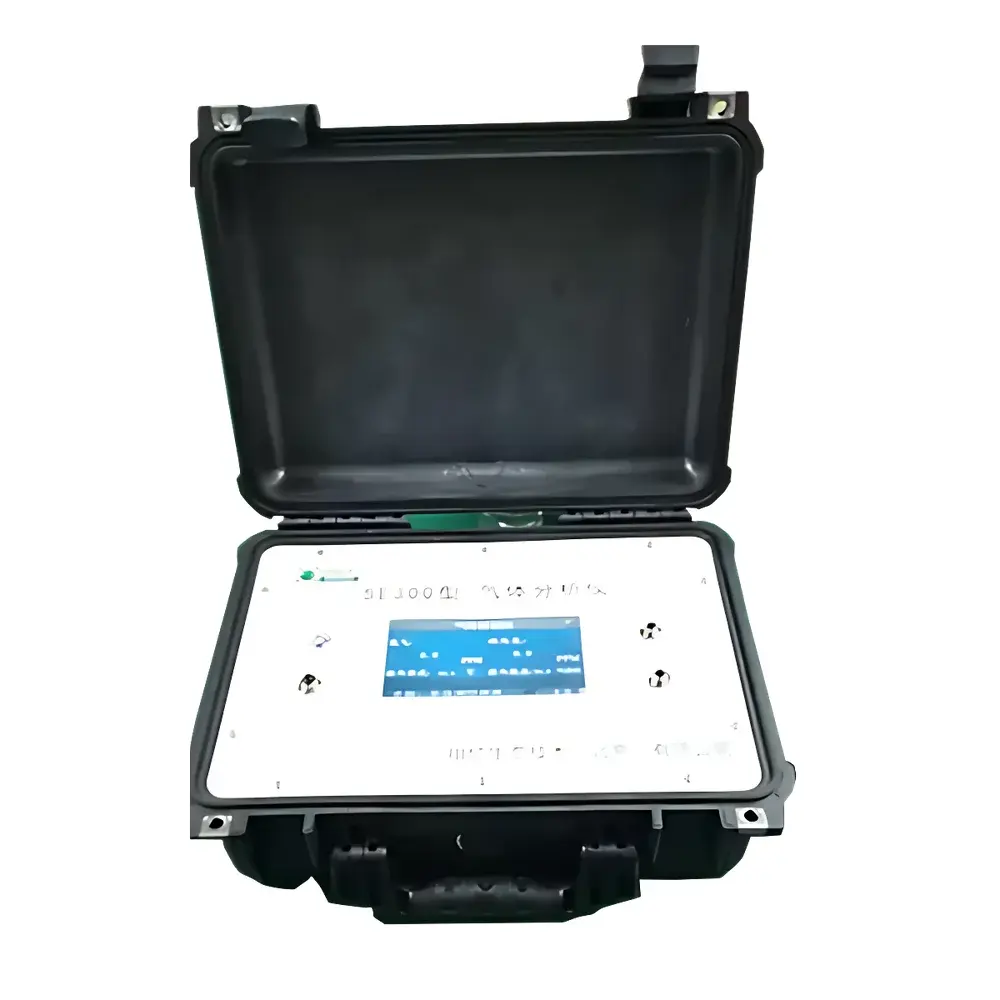
LESHI SE321 Portable NH₃/H₂S Analyzer
| Brand | LESHI |
|---|---|
| Origin | Beijing, China |
| Model | SE321 |
| Detection Gases | NH₃, H₂S |
| Instrument Type | Portable |
| Sensor Technology | Electrochemical |
| Display | Backlit LCD Touchscreen |
| Sampling System | Integrated diaphragm pump, stainless-steel probe, 12-ft PTFE-lined sampling hose, particulate filter, and mass flow meter |
| Design | Modular, field-serviceable architecture |
| Compliance Context | Designed for ambient air quality monitoring per ISO 16000-24 and EPA Method IO-4.2 (electrochemical sensor-based gas detection) |
Overview
The LESHI SE321 Portable NH₃/H₂S Analyzer is an engineered field-deployable instrument designed for real-time, quantitative measurement of ammonia (NH₃) and hydrogen sulfide (H₂S) in ambient air and controlled environments. It operates on the principle of amperometric electrochemical sensing—where target gases diffuse through a selective hydrophobic membrane into an aqueous electrolyte cell containing three electrodes: a working (sensing) electrode, a counter electrode, and a reference electrode. Upon contact with the working electrode surface, NH₃ and H₂S undergo catalyzed oxidation reactions, generating a diffusion-limited current proportional to gas concentration over defined linear ranges. This transduction mechanism ensures high selectivity, low cross-sensitivity, and stable baseline performance under variable temperature and humidity conditions typical of outdoor or industrial boundary monitoring.
Key Features
- Long-life electrochemical sensors with >24-month operational stability under continuous use and calibrated storage conditions
- Low-range detection capability optimized for ambient air applications: NH₃ range 0–50 ppm; H₂S range 0–20 ppm (typical), with resolution ≤0.01 ppm
- Ruggedized IP54-rated enclosure with shock-absorbing rubber overmold, suitable for field transport and operation across –10 °C to +50 °C ambient temperatures
- 7-inch capacitive touchscreen LCD with adjustable backlight intensity—enabling clear data visualization in direct sunlight or low-light conditions
- Fully integrated sampling system including a corrosion-resistant stainless-steel probe, 3.6-meter (12 ft) chemically inert PTFE-lined sampling hose, particulate filter (0.3 µm rated), and digital mass flow meter (±2% FS accuracy)
- Modular sensor and filter cartridges—field-replaceable without tools or calibration interruption—supporting GLP-aligned maintenance logs
Sample Compatibility & Compliance
The SE321 is validated for use with dry, non-condensing ambient air samples containing particulate loadings 90% RH), corrosive (e.g., Cl₂, SO₂ >5 ppm), or solvent-saturated streams. While not certified to ATEX or IECEx standards, its design aligns with functional safety expectations for Class II, Division 2 environments when operated per manufacturer guidelines. Data acquisition meets traceability requirements for environmental reporting under ISO 16000-24 (indoor air—determination of NH₃ and H₂S) and supports method validation per EPA IO-4.2 for electrochemical sensor-based ambient gas monitoring. Instrument firmware records all zero/span events, sensor diagnostics, and user-initiated actions—providing audit-ready metadata for QA/QC review.
Software & Data Management
Onboard firmware enables real-time concentration display, time-stamped logging (1-second to 60-minute intervals), and internal storage of ≥100,000 data points. USB-C interface supports CSV export and firmware updates. Optional Bluetooth 5.0 module enables wireless telemetry to Android/iOS mobile apps for geotagged survey mapping and multi-instrument fleet synchronization. All stored datasets include embedded timestamps, sensor serial IDs, battery voltage, pump status, and filter life indicators—facilitating compliance with GLP documentation standards. No cloud dependency; local data ownership and encryption-at-rest are maintained by default.
Applications
- Perimeter air monitoring at wastewater treatment plants, composting facilities, livestock barns, and fertilizer storage sites
- Industrial hygiene assessments near chemical synthesis units or biogas upgrading stations
- Educational laboratory exercises in environmental chemistry, sensor physics, and air quality modeling
- Calibration verification of fixed-site analyzers using portable reference-grade measurements
- Short-term emission source attribution studies requiring spatially resolved NH₃/H₂S gradients
FAQ
What is the recommended calibration frequency for routine ambient monitoring?
For regulatory-grade data collection, we recommend span calibration every 7 days and zero calibration before each deployment—consistent with EPA IO-4.2 guidance for electrochemical sensors.
Can the SE321 operate continuously for extended periods on battery power?
Yes—the rechargeable Li-ion battery provides up to 12 hours of continuous operation at 1-L/min sampling flow; battery health and remaining runtime are displayed in real time.
Is sensor cross-interference between NH₃ and H₂S compensated in firmware?
The dual-sensor architecture employs orthogonal electrode materials and algorithmic correction based on factory-derived interference matrices—reducing mutual cross-sensitivity to <3% of reading under standard test conditions.
Does the instrument support external data integration via Modbus or analog output?
Not natively; however, optional USB-to-serial adapters enable RS-232/RS-485 protocol translation for SCADA or building management system (BMS) integration.
How is sensor drift managed during long-term field deployments?
Each sensor module includes onboard temperature and humidity compensation, and the firmware applies adaptive baseline correction using periodic auto-zero cycles triggered by user-defined idle intervals.
Related Products







