
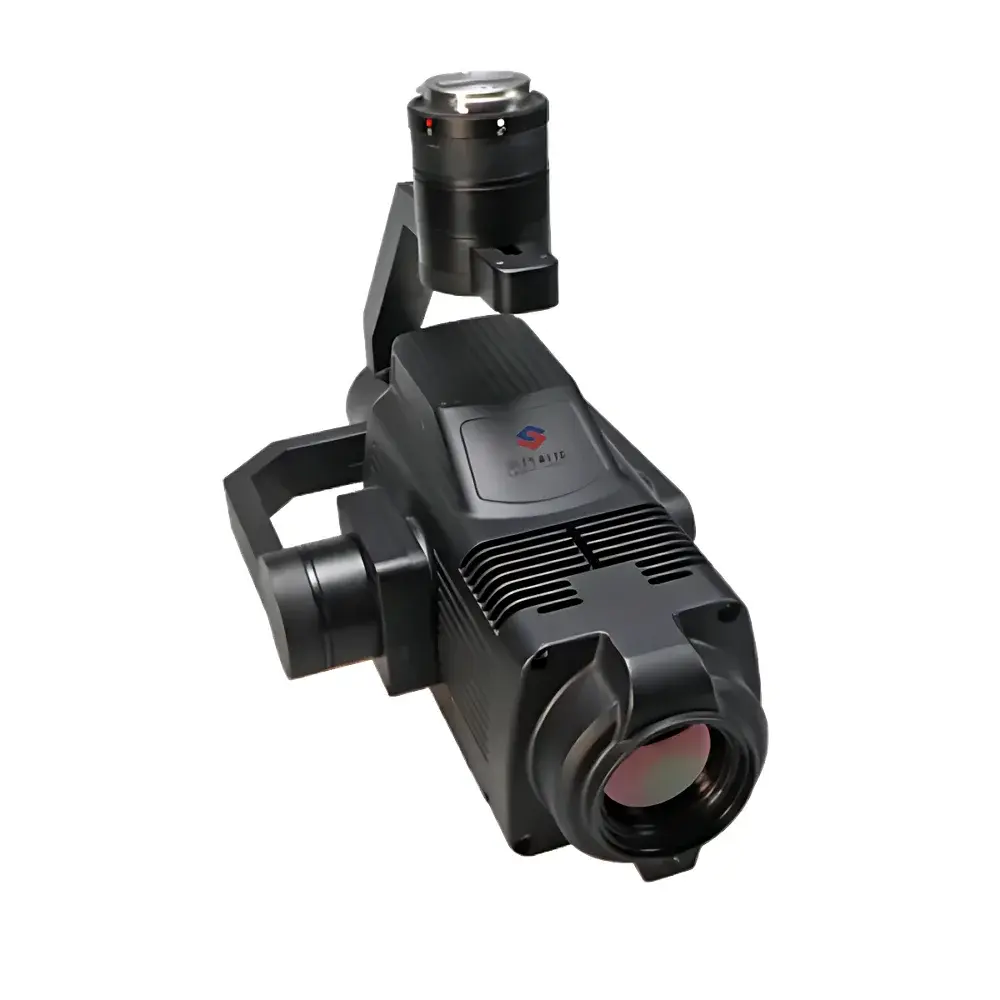
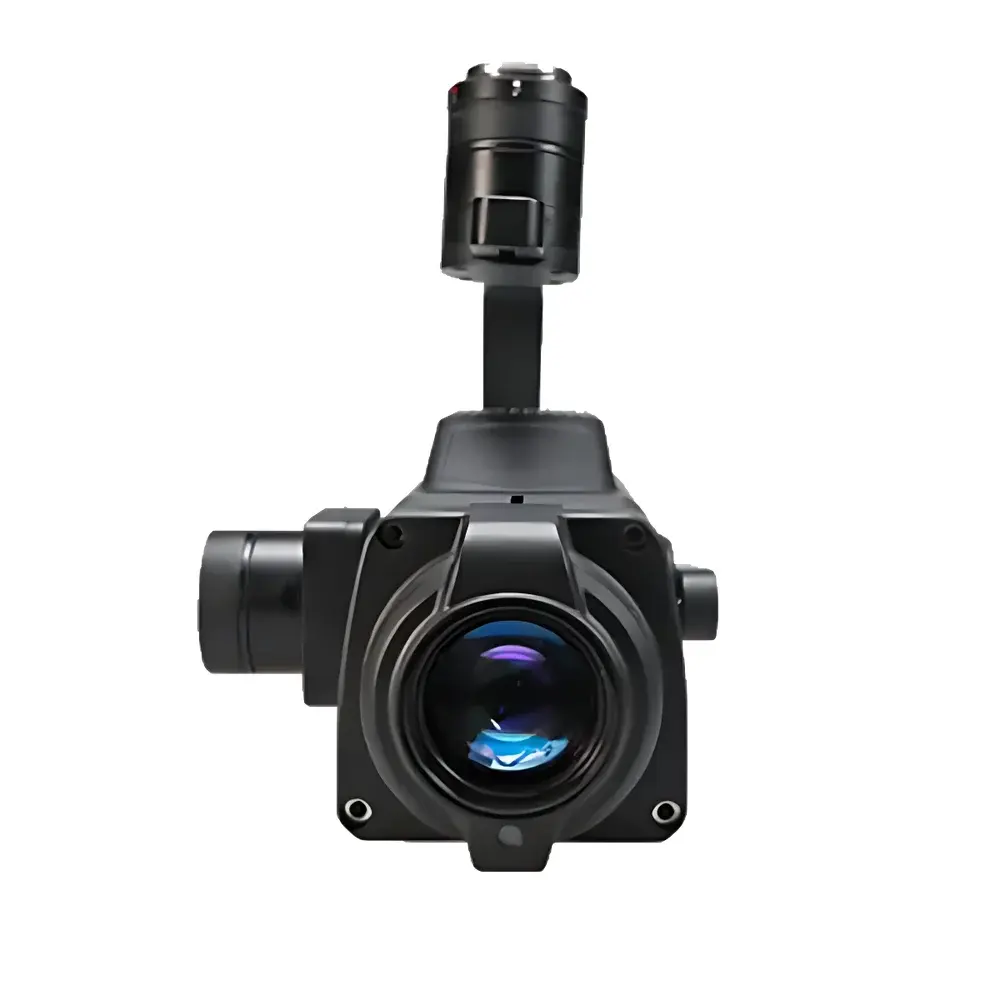
GIR320DC Airborne VOC Leak Detection System by Leshi Technology
| Brand | Leshi |
|---|---|
| Origin | Beijing, China |
| Manufacturer Type | Authorized Distributor |
| Country of Origin | China |
| Model | GIR320DC |
| Pricing | Available Upon Request |
Overview
The GIR320DC Airborne VOC Leak Detection System is a purpose-built, lightweight optical gas imaging (OGI) platform engineered for integration with small unmanned aerial vehicles (UAVs). Designed in accordance with ASTM D7520–22 and EPA OOOOa compliance frameworks, the system employs tunable infrared (IR) absorption spectroscopy—specifically mid-wave infrared (MWIR) spectral band targeting—to visualize volatile organic compounds (VOCs) including methane, ethane, propane, benzene, toluene, xylene (BTX), and chlorinated hydrocarbons. Unlike point-sampling or photoionization detector (PID)-based systems, the GIR320DC delivers real-time, spatially resolved plume imaging without physical contact, enabling non-intrusive surveying of elevated, confined, or otherwise inaccessible infrastructure such as flare stacks, valve manifolds, distillation columns, and pipeline right-of-ways. Its UAV-mounted architecture eliminates personnel entry into hazardous zones, directly supporting OSHA 1910.120 and IEC 61511 safety integrity level (SIL) requirements for process safety management.
Key Features
- Compact, drone-integrated form factor (≤2.1 kg payload weight; 120 × 95 × 85 mm dimensions) optimized for Class II/III UAV platforms including DJI Matrice 300 RTK and Autel EVO Max 4T
- Real-time thermal-VOC overlay visualization with <100 ms latency via low-latency H.265 video streaming over 5.8 GHz OcuSync 3.0 or LTE/5G uplink
- Dual-sensor fusion architecture: uncooled microbolometer IR detector (320 × 240 resolution, NETD ≤50 mK) synchronized with embedded VOC-specific spectral filtering (3.2–3.5 µm bandpass)
- Onboard edge-processing unit enabling real-time plume quantification (ppm·m column density estimation) and GPS-tagged leak coordinates (WGS84, ±1.5 m CEP)
- IP54-rated environmental enclosure rated for operation between −20 °C and +50 °C, with vibration resistance compliant with MIL-STD-810H Section 514.7
Sample Compatibility & Compliance
The GIR320DC detects gaseous-phase VOCs across industrial emission profiles, with demonstrated sensitivity to hydrocarbon vapors at detection limits ranging from 0.1–5 ppm·m depending on compound absorbance cross-section and atmospheric path length. It supports LDAR (Leak Detection and Repair) program execution per EPA Method 21 and EU Directive 2014/68/EU (PED), and its data output format (GeoTIFF + CSV metadata) conforms to ISO 14064-3 verification protocols. All firmware and calibration logs maintain audit-ready timestamps traceable to UTC/NIST time servers, satisfying GLP-compliant recordkeeping requirements under 21 CFR Part 11 for environmental monitoring applications.
Software & Data Management
The system operates with Leshi’s proprietary AeroScan Suite v3.2—a desktop and cloud-enabled platform supporting mission planning, georeferenced video annotation, automated plume centroid tracking, and regulatory report generation (EPA Form 7520-1, UK Environment Agency LDAR templates). Raw sensor data is stored locally on removable microSDXC cards (up to 512 GB) and optionally synced to secure AWS S3 buckets with AES-256 encryption. Role-based access control (RBAC), electronic signatures, and full audit trails—including user actions, calibration events, and GPS drift corrections—are retained for ≥7 years to meet ISO/IEC 17025:2017 clause 7.10.2 documentation retention mandates.
Applications
- Refinery and petrochemical facility perimeter surveillance and routine LDAR compliance auditing
- Offshore platform fugitive emission mapping where manned access is logistically constrained or prohibited
- Mobile enforcement operations conducted from EPA-certified mobile command vehicles equipped with LTE bonding and dual-display operator consoles
- Post-incident vapor dispersion assessment following chemical release events (e.g., railcar derailments, storage tank overfills)
- Pre-commissioning verification of flange integrity and weld quality in new-build process units
FAQ
Does the GIR320DC require periodic factory recalibration?
Yes. Annual traceable calibration against NIST-traceable methane and benzene reference standards is recommended; field zero-checks using ambient air are supported daily via integrated auto-zero algorithm.
Can it detect non-hydrocarbon VOCs such as ammonia or hydrogen sulfide?
No. The MWIR spectral filter is optimized for C–H bond vibrational absorption; detection of NH₃ or H₂S requires alternative LWIR or UV-DOAS configurations not included in this model.
Is raw spectral data export available for third-party analysis?
Yes. Full-resolution radiometric IR frames (16-bit .RAW) and synchronized GPS/IMU telemetry (.CSV) are accessible via USB-C interface or secure API endpoints.
What UAV autopilot protocols does it support?
MAVLink 2.0 (QGroundControl compatible) and DJI Payload SDK v4.0 for direct gimbal and exposure control integration.
Does the system comply with EU CE marking requirements for airborne instrumentation?
It carries CE marking under 2014/53/EU (RED) and 2014/30/EU (EMC), with technical documentation available upon request for Notified Body review.




