
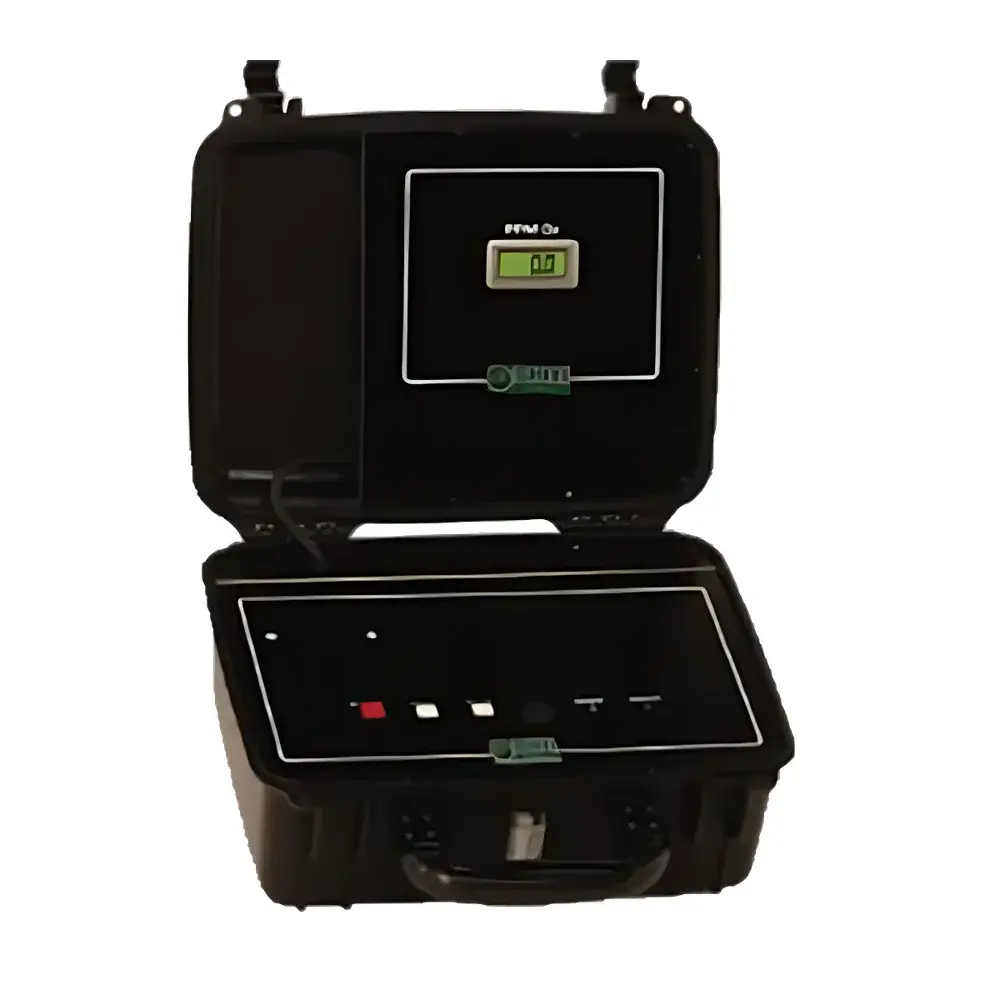
LESHI SE302 Portable NDIR Carbon Dioxide Analyzer
| Brand | LESHI |
|---|---|
| Origin | Beijing, China |
| Model | SE302 |
| Instrument Type | Portable |
| Detection Target | Single-component (CO₂) |
| Compliance | HJ 870–2017 |
| Detection Principle | Non-Dispersive Infrared (NDIR) |
| Display | Backlit LCD |
| Power Supply | Rechargeable Li-ion Battery |
| Data Output | USB interface, internal storage, optional portable printer |
| Sample Handling | Integrated diaphragm pump, stainless steel probe, dual-stage filtration, condensate removal system, mass flow control |
Overview
The LESHI SE302 Portable NDIR Carbon Dioxide Analyzer is an engineered field-deployable instrument designed for quantitative measurement of carbon dioxide (CO₂) concentration in ambient air and flue gas streams. It operates on the principle of non-dispersive infrared (NDIR) spectroscopy—exploiting the characteristic absorption band of CO₂ near 4.26 µm—with a dedicated optical path optimized for selectivity, minimal cross-sensitivity to water vapor and common combustion gases (e.g., CO, NOₓ, SO₂), and long-term baseline stability. The analyzer meets the technical requirements specified in China’s HJ 870–2017 standard for determination of CO₂ emissions from stationary sources using infrared absorption methods. Its compact architecture enables rapid deployment in dynamic environments—including boiler rooms, industrial furnace stacks, HVAC ducts, indoor air quality surveys, and mobile emission audits—without reliance on external power or gas supply infrastructure.
Key Features
- High-selectivity NDIR sensor with temperature-compensated detection optics, delivering consistent accuracy across variable ambient conditions (5–40 °C, <90% RH non-condensing)
- Integrated sample conditioning system: stainless steel probe, PTFE-lined sampling hose, refrigerated condensate trap, dual-stage particulate filter (≤0.3 µm), and laminar-flow mass flow controller (±2% full scale)
- Self-contained operation powered by rechargeable lithium-ion battery (≥6 h continuous use at 1 L/min flow rate); optional AC adapter for benchtop or extended monitoring
- 7-inch color capacitive touchscreen interface with intuitive icon-driven menu navigation, real-time trend graphing, and configurable alarm thresholds
- Fast thermal stabilization (<90 s warm-up time to operational readiness), with response time (T₉₀) ≤15 s for CO₂ step changes
- Modular hardware design enables field-replaceable sensor cartridges, pump assemblies, and filtration modules—reducing downtime and lifecycle maintenance cost
- Onboard data logging (up to 100,000 records), timestamped with GPS metadata (when paired with external GNSS module), exportable via USB 2.0 to FAT32-formatted flash drives
Sample Compatibility & Compliance
The SE302 is validated for direct analysis of dry or moderately humid gas matrices within the range of 0–5000 ppmv or 0–20% vol CO₂ (configurable range). It accommodates sample temperatures up to 180 °C when used with high-temp probe accessories. Gas stream particulate loading must remain below 10 mg/m³ to prevent filter clogging; inlet pressure must be maintained between −5 and +5 kPa relative to ambient. The analyzer conforms to HJ 870–2017 for method validation parameters—including linearity (R² ≥ 0.999), repeatability (CV ≤ 2%), zero drift (<±1% FS/24 h), and span drift (<±2% FS/24 h). While not certified to ISO 14064 or EPA Method 3A, its performance characteristics support Tier 2 verification under GHG Protocol guidance for facility-level carbon accounting.
Software & Data Management
Instrument firmware supports firmware-over-the-air (FOTA) updates via USB or microSD card. The embedded data management suite includes audit-trail-enabled logging (user login, parameter changes, calibration events), CSV-formatted export with ISO 8601 timestamps, and configurable auto-save intervals (1 s to 60 min). Optional PC software (Windows/macOS) provides post-processing tools: baseline correction, moving-average smoothing, CO₂-equivalent calculation (using default GWP₁₀₀ = 1), and report generation compliant with GLP documentation templates. Data files include embedded instrument ID, serial number, calibration certificate reference, and operator ID—supporting traceability in regulated QA/QC workflows.
Applications
- Combustion efficiency assessment in coal-, oil-, and gas-fired boilers, kilns, and incinerators via O₂–CO₂ correlation analysis (O₂ extension module required)
- Continuous carbon emission spot-checking for compliance with China’s national carbon trading scheme (ETS) monitoring plans
- Indoor air quality (IAQ) evaluation in schools, offices, hospitals, and public transport hubs per GB/T 18883–2022 guidelines
- Field validation of fixed CEMS systems during periodic performance audits
- Research-grade CO₂ flux studies in soil respiration chambers, greenhouse enclosures, and bioreactor exhaust lines
- Leak detection and ventilation verification in CO₂-enriched agricultural facilities and beverage carbonation systems
FAQ
Does the SE302 require periodic calibration with certified gas standards?
Yes—initial factory calibration is traceable to NIM (National Institute of Metrology, China) reference gases. Users must perform zero/span verification every 30 days or before critical measurements using certified CO₂/N₂ mixtures (e.g., 1000 ppm ±2% and zero air).
Can the instrument measure CO₂ in high-moisture flue gas without external conditioning?
It incorporates an integrated thermoelectric condenser and hydrophobic membrane filter, enabling stable operation up to 90% RH. For saturated streams (>100 °C dew point), external chilled mirror or permeation dryer is recommended.
Is the data output compatible with LIMS or SCADA platforms?
Raw ASCII data via USB CDC virtual COM port supports Modbus RTU protocol (custom register map available); third-party integration requires middleware configuration for OPC UA or MQTT translation.
What is the expected service life of the NDIR detector under normal field use?
The pyroelectric NDIR sensor exhibits >5 years operational lifetime with typical usage (≤8 h/day, clean sample matrix); optical window contamination is the primary failure mode—mitigated by scheduled cleaning per maintenance manual Section 4.2.
Related Products







