
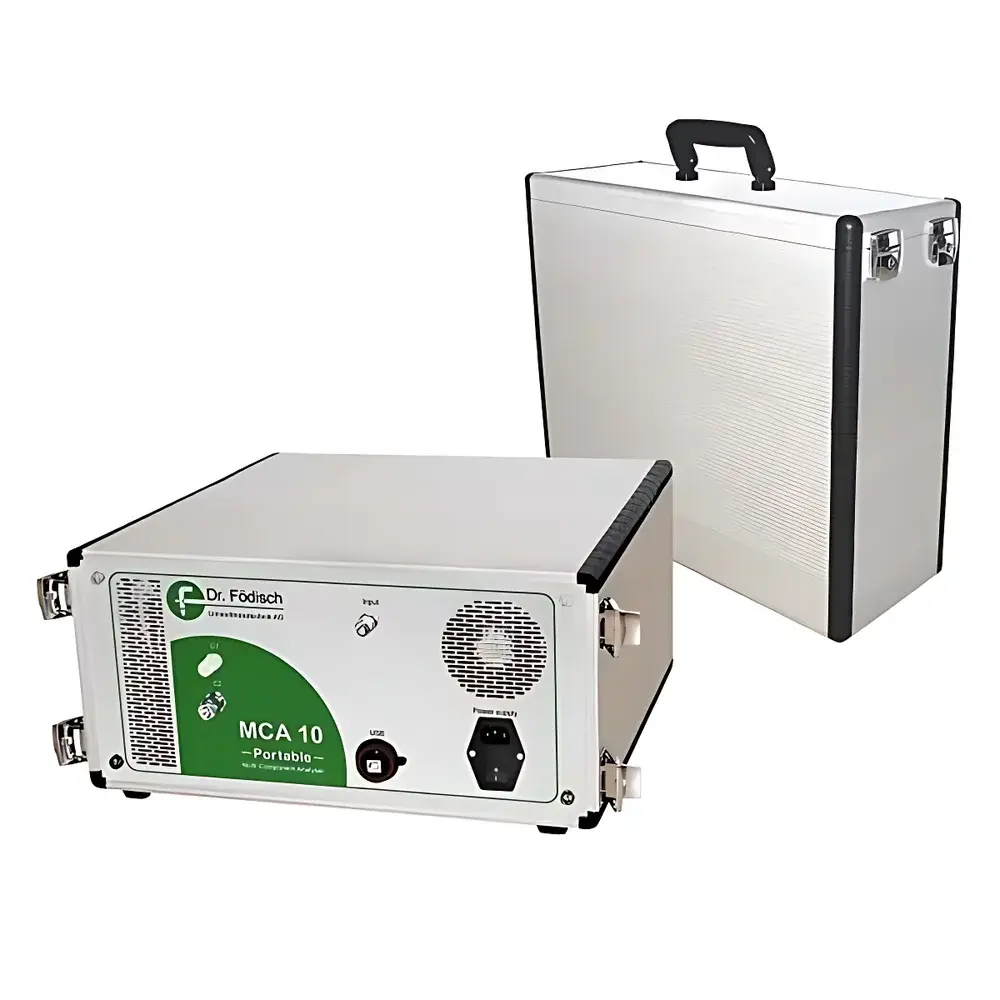
Foedisch MCA10m Portable Flue Gas Analyzer
| Brand | Foedisch |
|---|---|
| Origin | Germany |
| Model | MCA10m |
| Instrument Type | Portable Flue Gas Analyzer |
| Measurement Accuracy (Full Scale) | ±0.1% |
| Repeatability | ≤2% |
| Response Time (T90) | 3 s |
| Long-Term Stability | ±2% per 8 h |
| Measured Gases | O₂, CO, CO₂, NO, SO₂, NO₂ |
| Detection Principle | Electrochemical (O₂, CO, NO, SO₂, NO₂) and NDIR (CO₂) |
| Operating Temperature Range | -10 °C to +50 °C |
| IP Rating | IP42 |
| Power Supply | Rechargeable Li-ion battery (≥6 h continuous operation) |
| Data Storage | Internal SD card (≥16 GB), up to 1 million data points |
| Compliance | EN 50379-1/-2, DIN EN 15267-3, MCERTS certified (UK), ISO 12039, ISO 10849, ASTM D6522 |
Overview
The Foedisch MCA10m Portable Flue Gas Analyzer is an engineered solution for on-site combustion efficiency assessment and regulatory-compliant emissions verification in industrial and municipal energy systems. Designed and manufactured in Germany, the MCA10m employs a hybrid gas detection architecture: electrochemical sensors for O₂, CO, NO, SO₂, and NO₂—each individually temperature-compensated and factory-calibrated against traceable NIST-standard reference gases—and a non-dispersive infrared (NDIR) sensor for high-stability CO₂ measurement. Its real-time multi-parameter output includes volumetric concentrations (vol%), ppm, mg/m³ (dry/wet basis), flue gas temperature, ambient temperature, static pressure, dew point, excess air coefficient (λ), combustion efficiency, and heat loss via flue gas—calculated in accordance with DIN 1343 and VDI 2066 guidelines. The analyzer meets the metrological requirements of EN 50379-1/-2 for portable emission monitoring equipment and supports traceable calibration verification under ISO/IEC 17025-accredited laboratories.
Key Features
- Rugged field-ready design with IP42 ingress protection, reinforced polymer housing, and shock-absorbing rubber bumpers for transport and on-site use
- Integrated Peltier-cooled gas conditioning system featuring stainless-steel thermoelectric cooler, multi-stage particulate filtration (stainless mesh + sintered metal + hydrophobic PTFE membrane), and automatic condensate management via peristaltic pump and electronic level sensing
- Corrosion-resistant PTFE sampling probe and heated sampling line (optional) for stable operation in high-humidity, high-dust environments (e.g., coal-fired boilers, biomass furnaces, waste incinerators)
- Real-time calculation of regulatory reporting parameters: oxygen-referenced concentrations (e.g., 3% O₂, 6% O₂), NOₓ as NO₂-equivalent, and thermal efficiency per EN 12952-15
- Onboard data logging with time-stamped records, GPS tagging (via optional Bluetooth module), and configurable alarm thresholds for exceedance events
- Hot-swap battery system enabling uninterrupted operation during extended field campaigns; battery life ≥6 h at 25 °C with all sensors active
Sample Compatibility & Compliance
The MCA10m is validated for use across diverse fuel types—including natural gas, LPG, town gas, light/heavy fuel oil, wood, and bituminous coal—under variable load conditions (20–100% boiler capacity). Its gas path materials (316L stainless steel, PTFE, FKM elastomers) resist acid condensates (H₂SO₄, HNO₃) formed during low-temperature flue gas sampling. All sensor outputs comply with MCERTS Performance Standards for Portable Emission Monitoring Systems (PEMS), EN 15267-3 (QAL1 certification), and U.S. EPA Method 3A/7E equivalency for field reference analyzers. The device supports audit-ready documentation per ISO 17025 and GLP/GMP principles, including full calibration history, sensor drift logs, and user-accessible firmware versioning.
Software & Data Management
Foedisch’s proprietary WinControl MCA software (Windows 10/11 compatible) enables configuration, live telemetry visualization, report generation (PDF/CSV/XLSX), and firmware updates via USB or Bluetooth. Data export conforms to EN 14181 requirements for automated monitoring systems, including mandatory metadata fields: instrument ID, operator ID, calibration date, sampling location coordinates, and uncertainty budget per ISO 5725. Audit trails are retained for ≥12 months and support 21 CFR Part 11-compliant electronic signatures when deployed in regulated QA/QC environments. Optional cloud synchronization allows secure remote access to measurement archives through Foedisch’s TLS-encrypted portal.
Applications
- Periodic stack testing and compliance verification for stationary sources under EU IED Directive (2010/75/EU), U.S. Clean Air Act Subpart A, and China’s GB 13271–2014
- Combustion optimization and burner tuning in industrial boilers, thermal oil heaters, and kilns
- Emergency response and leak investigation at power plants, chemical facilities, and municipal waste treatment centers
- Commissioning and performance acceptance testing (PAT) of new combustion installations per ASME PTC 4 and VGB R310e
- Educational and research applications in environmental engineering labs requiring traceable, multi-gas field instrumentation
FAQ
What calibration gases are required for routine verification?
Certified zero air (N₂ balance) and span gases traceable to NIST or BIPM standards: 5.0% O₂ in N₂, 100 ppm CO in N₂, 1000 ppm CO₂ in N₂, 100 ppm NO in N₂, 50 ppm SO₂ in N₂, and 50 ppm NO₂ in N₂.
Can the MCA10m measure H₂S or CH₄?
No—the MCA10m is configured for the standard regulatory gas set (O₂, CO, CO₂, NO, SO₂, NO₂); H₂S and CH₄ require optional sensor modules (MCA10m-H2S or MCA10m-CH4), each with dedicated electrochemical or NDIR detection cells.
Is external power required during operation?
No—the internal rechargeable Li-ion battery supports full functionality for ≥6 hours; AC adapter is provided for charging and benchtop use only.
How often must the PTFE filter be replaced in high-dust applications?
Filter replacement interval depends on particulate loading; typical service life is 20–40 hours in coal-fired boiler exhaust; visual inspection and pressure drop monitoring (>15 mbar ΔP) are recommended maintenance indicators.
Does the instrument support automatic O₂ correction to reference conditions?
Yes—user-selectable reference O₂ levels (3%, 6%, 11%, or custom) are applied in real time to all concentration outputs, with dry/wet basis selection and stoichiometric coefficient adjustment per fuel type.







