
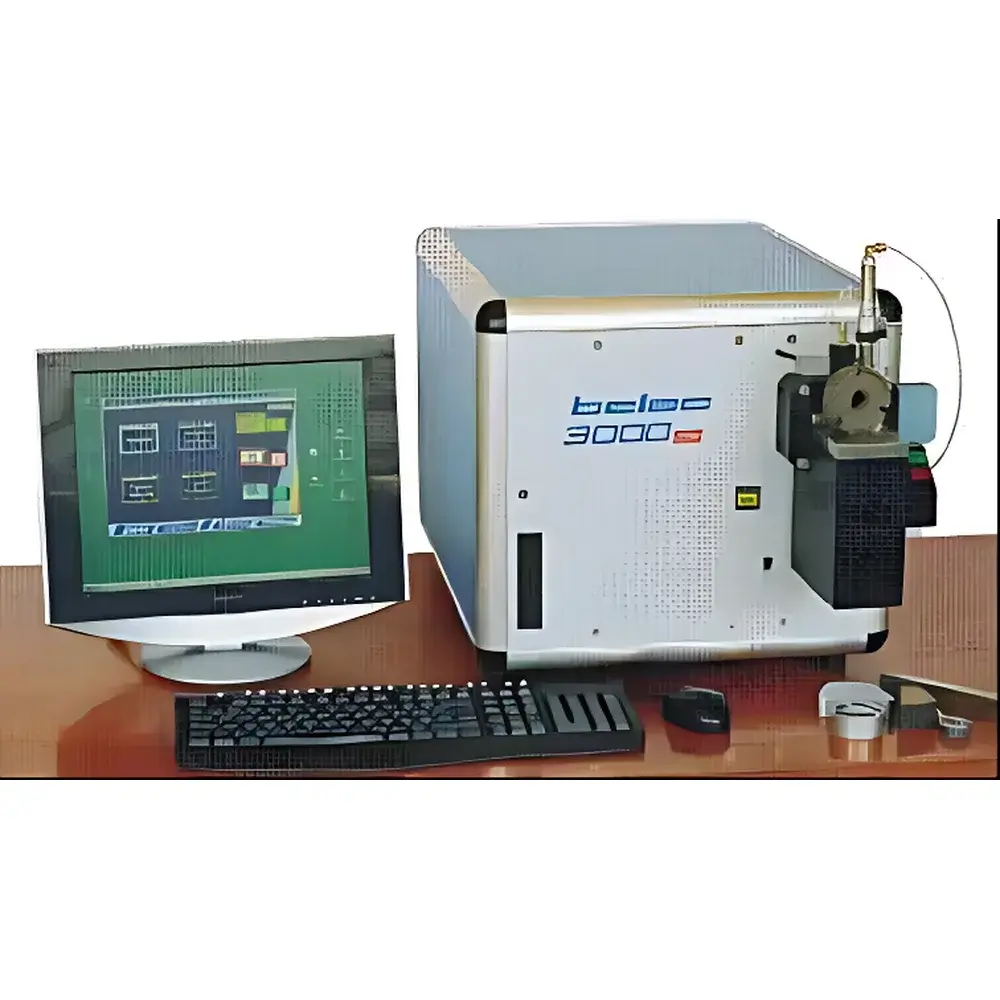
Belec Lab 3000s Compact Fixed-Position Spark Optical Emission Spectrometer
| Brand | Belec |
|---|---|
| Origin | Germany |
| Model | Belec Lab 3000s |
| Instrument Type | Fixed-position (compact benchtop) |
| Excitation Source | Spark discharge |
| Detector | CCD (Charge-Coupled Device) |
| Focal Length | 300 mm |
| Grating Groove Density | 3600 lines/mm |
| Wavelength Range | 175–430 nm |
| Number of Analytical Channels | 24 |
| Elemental Coverage | Includes C, P, S, N (light elements) |
| Sample Form Compatibility | Solid metallic samples, wire ≥0.5 mm diameter, tubes, rods, and flat solids |
| Dimensions (W×D×H) | 440 × 415 × 579 mm |
Overview
The Belec Lab 3000s is a compact, fixed-position spark optical emission spectrometer (OES) engineered for precision elemental analysis of solid metallic materials in quality control, foundry, and incoming inspection laboratories. Based on the fundamental principle of atomic emission spectroscopy, the instrument excites sample surfaces using controlled high-voltage spark discharges in an argon-purged optical chamber, inducing characteristic line emissions from constituent elements. These emissions are dispersed by a high-resolution 300-mm focal length Czerny-Turner spectrometer equipped with a 3600 lines/mm holographic grating, and detected across a UV-Vis range (175–430 nm) using a thermoelectrically stabilized CCD array. Unlike portable OES systems, the Lab 3000s employs a rigid, vibration-damped optical bench and sealed argon flow path—ensuring long-term wavelength stability, minimal spectral drift, and reproducible quantification without field recalibration. Its design bridges the operational rigor of floor-standing laboratory OES with the spatial efficiency required for space-constrained QC labs.
Key Features
- Compact footprint (440 × 415 × 579 mm) optimized for benchtop integration without sacrificing optical performance or argon purge integrity.
- Dedicated spark source with low-wear tungsten electrodes—designed for >10,000 shots per electrode set under standard operating conditions; no routine alignment or gas-flow adjustment required.
- 24 pre-configured analytical channels covering major alloying and trace elements—including carbon (C), phosphorus (P), sulfur (S), and nitrogen (N)—enabling full compliance with ASTM E415, ISO 11577, and EN 10027 grade verification protocols.
- CCD-based detection system offering simultaneous multi-element acquisition, reduced integration time variability, and inherent resistance to photomultiplier tube (PMT) aging effects—eliminating channel-to-channel gain drift over extended operation.
- Ruggedized optical housing with temperature-stabilized mounting and hermetic argon purging to maintain spectral resolution ≤0.015 nm (FWHM at 200 nm) throughout daily use.
Sample Compatibility & Compliance
The Belec Lab 3000s accepts flat, cylindrical, and irregularly shaped conductive metal samples—including castings, forgings, machined parts, wires (≥0.5 mm diameter), and tubing—without requiring specialized fixtures beyond standard clamping electrodes. Surface preparation follows ISO 11084:2020 guidelines (grinding or milling to remove oxide layers). The instrument complies with IEC 61000-6-3 (EMC) and IEC 61010-1 (safety), and its analytical output supports GLP/GMP documentation workflows via audit-trail-enabled software logging. Calibration is traceable to NIST SRM reference materials (e.g., SRM 1250a, 1251a), and method validation adheres to ISO/IEC 17025 requirements for testing laboratories.
Software & Data Management
Belec Win 21 is a CE-certified, multilingual (12 languages including English, German, Chinese, Spanish, and Japanese) Windows-based platform compliant with FDA 21 CFR Part 11 for electronic records and signatures. It provides real-time spectral visualization, automatic background correction, inter-element interference correction (e.g., Mn 403.307 nm on Fe 403.307 nm), and customizable reporting templates exportable as PDF, CSV, or XML. All measurement events—including operator ID, timestamp, calibration status, and raw intensity values—are logged with immutable timestamps. Data exchange supports USB 2.0, RS-232, Ethernet TCP/IP, and OPC UA interfaces for integration into LIMS or MES environments.
Applications
- Grade identification and sorting of stainless steels, aluminum alloys, copper-based materials, and tool steels in receiving inspection.
- Low-carbon steel certification (C ≤ 0.02%) and residual element monitoring (e.g., Sn, As, Pb) in automotive and aerospace casting supply chains.
- In-process verification of heat treatment batches via rapid C/S/P/N quantification—reducing reliance on destructive wet chemistry or combustion analysis.
- Supplier qualification audits where certified reference material (CRM)-matched calibration curves are required for ISO 9001 clause 8.4.2 conformance.
- Educational metallurgy labs requiring stable, low-maintenance OES platforms for undergraduate spectroscopy and alloy composition coursework.
FAQ
Does the Belec Lab 3000s require external cooling water or compressed air?
No—it operates with passive thermal management and integrated argon recirculation; only bottled argon (≥99.996% purity) and standard 230 V AC power are required.
Can the instrument be upgraded to add additional analytical channels post-purchase?
Channel expansion is not supported—the 24-channel configuration is hardware-defined during manufacturing and aligned with fixed grating dispersion geometry.
Is ASTM E1086 method validation included with the system?
Yes—factory-installed calibration includes ASTM E1086-compliant stainless steel and aluminum CRM sets, with documented uncertainty budgets and linearity verification reports.
What maintenance intervals are recommended for routine operation?
Daily: Electrode cleaning and argon line leak check. Annually: CCD dark-current verification and optical window inspection—no lamp replacement or vacuum pump servicing required.
Does Belec Win 21 support automated report generation for ISO/IEC 17025 accreditation?
Yes—customizable templates include mandatory fields for analyst signature, equipment ID, calibration date, uncertainty statements, and CRM traceability—fully exportable for internal audit submission.





