
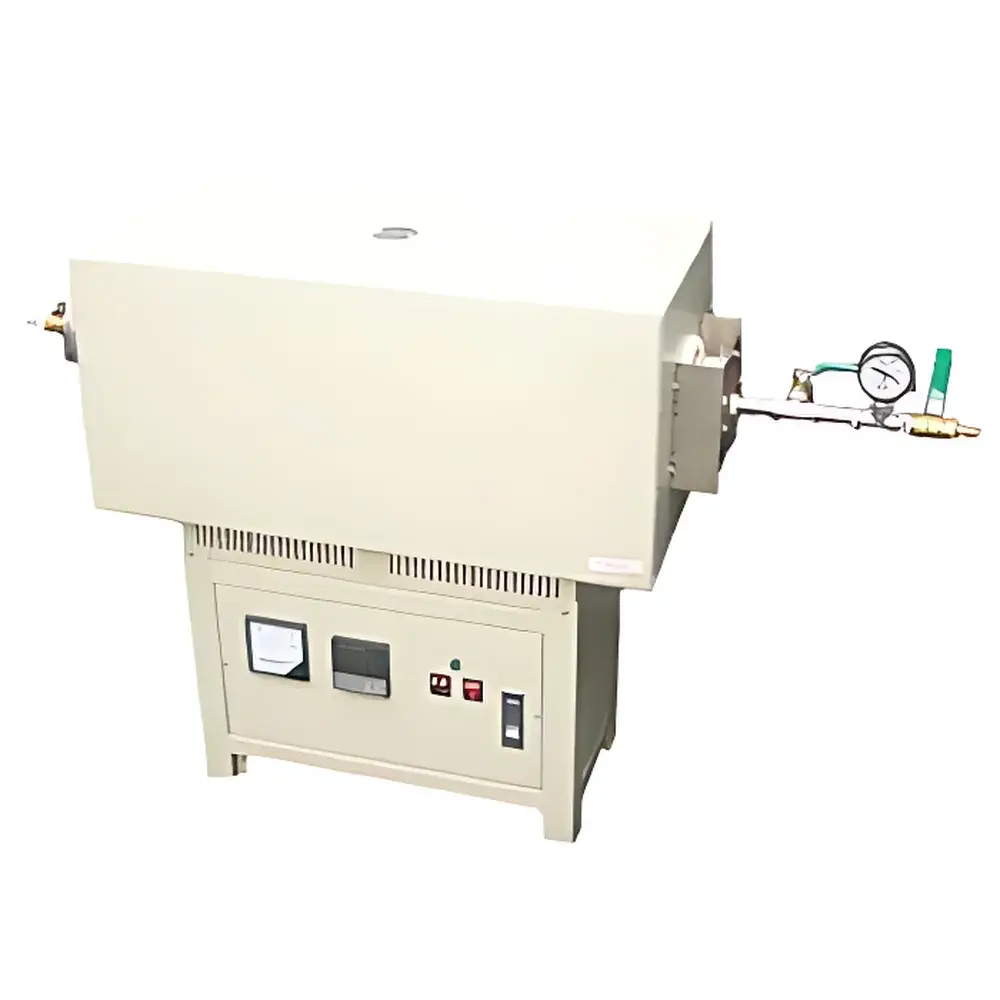
Zhuochi SK3-3-12-8 Energy-Efficient Programmable Vacuum Tube Furnace
| Brand | Zhuochi |
|---|---|
| Origin | Zhejiang, China |
| Model | SK3-3-12-8 |
| Chamber Dimensions | Ø80 × 400 mm |
| Max Operating Temperature | 1200 °C |
| Rated Power | 3 kW |
| Voltage | 220 V AC |
| Heating Element Material | High-Purity Kanthal A1 or Silicon Carbide (SiC) |
| Insulation | Low-thermal-mass lightweight refractory fiber |
| Tube Material Options | Fused quartz (Ø80 × 600 mm) or high-purity alumina (Al₂O₃) tube |
| Vacuum Seal System | Stainless steel flange with high-temp silicone rubber gasket (rated to 300 °C) and integrated vacuum gauge port |
| Control System | LTDE programmable PID controller with multi-segment ramp-soak programming, timer-based auto-start/shutdown, and real-time temperature logging capability |
| Compliance | Designed for laboratory use under ISO/IEC 17025-aligned environments |
Overview
The Zhuochi SK3-3-12-8 is a benchtop programmable vacuum tube furnace engineered for precise thermal processing under controlled atmospheric conditions. It operates on the principle of resistive heating via high-stability metallic or ceramic heating elements embedded within a low-thermal-inertia insulation matrix, enabling rapid thermal response and exceptional temperature uniformity across the heated zone. The furnace chamber is defined by a cylindrical fused quartz or alumina tube sealed at both ends using stainless steel vacuum flanges and high-temperature elastomeric seals—capable of sustaining base pressures down to 10⁻² mbar when paired with an external vacuum pump. Its architecture supports inert gas purging, dynamic vacuum cycling, and static vacuum annealing protocols widely employed in materials synthesis (e.g., CVD precursor decomposition), catalyst activation, sintering of nanomaterials, and pre-oxidation/reduction treatments prior to XRD or TEM sample preparation.
Key Features
- Programmable LTDE PID controller with up to 30 segment ramp-soak profiles, supporting customizable heating rates (0.1–30 °C/min), dwell times, and automatic cooldown sequences
- Low-thermal-mass fiber insulation reduces standby power consumption by >40% compared to traditional brick-lined furnaces, meeting energy efficiency benchmarks for Class II laboratory equipment
- Double-layer quartz tube option available (inner working tube + outer protective sleeve) for enhanced thermal stability and contamination control in sensitive reactions
- Integrated vacuum interface with analog vacuum gauge port (0–760 Torr range), compatible with digital gauges and mass flow controllers for reactive gas introduction
- Front-access horizontal tube configuration with sliding support carriage for repeatable sample positioning and minimal thermal gradient disruption during loading/unloading
- Over-temperature cut-off, door-open safety interlock, and grounded chassis design compliant with IEC 61010-1 safety standards for laboratory electrical equipment
Sample Compatibility & Compliance
The SK3-3-12-8 accommodates standard cylindrical samples up to Ø75 mm × 350 mm in length, suitable for powder beds, pelletized ceramics, thin-film substrates, and wire specimens. Quartz tube compatibility enables processing of halide-sensitive compounds and low-vapor-pressure organometallics; alumina tubes provide superior resistance to alkaline melts and reducing atmospheres above 1100 °C. The system meets mechanical and electromagnetic compatibility requirements per EN 61326-1 for laboratory measurement and control equipment. While not certified for medical device manufacturing, its programmable logging functionality supports audit-ready data capture aligned with GLP practices—including timestamped setpoint history, actual temperature traces, and event markers for vacuum initiation or gas flow activation.
Software & Data Management
The LTDE controller features RS485 Modbus RTU output for integration into centralized lab automation networks. Optional PC software (Zhuochi FurnaceLink v3.x) provides real-time graphical monitoring, CSV export of temperature/vacuum/time datasets, and password-protected parameter locking for SOP enforcement. All profile executions generate immutable log files containing controller firmware version, user ID (if configured), start/stop timestamps, and deviation alerts exceeding ±5 °C from target—facilitating traceability in regulated research environments governed by FDA 21 CFR Part 11 principles. No cloud connectivity is embedded; data remains local unless explicitly exported via USB or serial interface.
Applications
- Thermal decomposition studies of metal-organic frameworks (MOFs) under nitrogen or argon
- Controlled oxidation of transition metal nanoparticles for core-shell structure development
- Graphitization of carbon precursors at 1000–1200 °C under vacuum or low-flow Ar
- Pre-sintering of YSZ electrolyte layers prior to hot-pressing in SOFC fabrication
- Activation of supported Ni, Co, or Pt catalysts via H₂ reduction at sub-atmospheric pressure
- Crystallization kinetics analysis of chalcogenide glasses using in-situ DSC-correlated thermal hold protocols
FAQ
What vacuum level can the SK3-3-12-8 achieve without auxiliary pumping?
The furnace itself does not include a vacuum pump; it provides a sealed chamber interface. With a typical two-stage rotary vane pump, base pressures of 1×10⁻² mbar are routinely attainable.
Is the quartz tube rated for hydrogen service at 1200 °C?
Fused quartz exhibits gradual devitrification above 1100 °C in reducing atmospheres; for prolonged H₂ exposure ≥1100 °C, high-purity alumina (99.8% Al₂O₃) tubes are recommended.
Can the LTDE controller store multiple independent programs?
Yes—up to 16 user-defined programs may be saved internally, each with unique segment configurations, alarms, and output assignments.
Does the system support external thermocouple input for sample temperature verification?
The standard configuration uses a Type K sheathed thermocouple embedded in the furnace wall. An optional dual-input controller variant (LTDE-DT) accepts a second thermocouple for differential measurement, sold separately.
What maintenance intervals are recommended for long-term reliability?
Inspect vacuum seals every 200 operating hours; replace quartz tubes after 50 thermal cycles above 1000 °C or upon visible crystallization; recalibrate the controller annually using NIST-traceable reference sources.



