
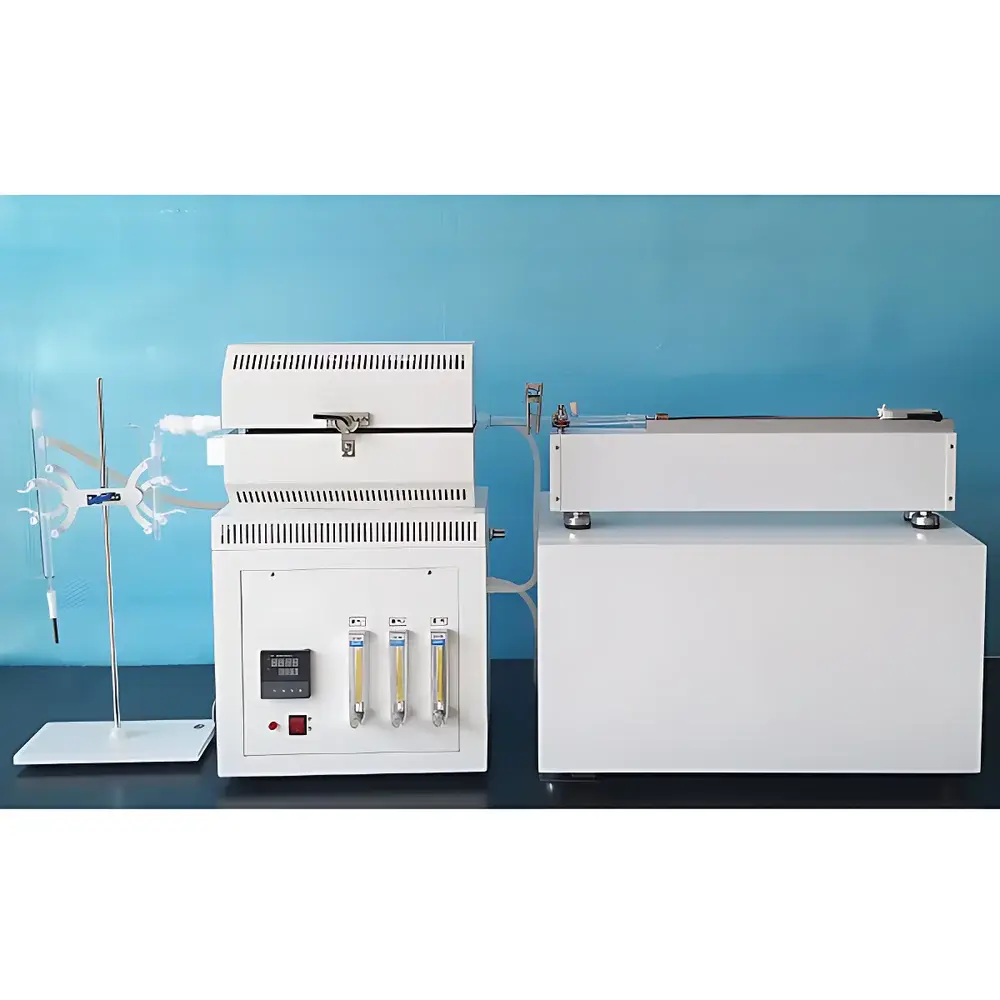
Zhuochi AOX-3J Halogen Combustion Furnace for Determination of Halogens in Electrical and Electronic Products
| Brand | Zhuochi |
|---|---|
| Origin | Zhejiang, China |
| Manufacturer Type | Authorized Distributor |
| Product Category | Domestic |
| Model | AOX-3J |
| Instrument Type | Tube Furnace |
| Max Temperature | 1150 °C |
| Temperature Control Accuracy | ±1 °C |
| Max Power | 1500 W |
| Heating Rate to Max Temp | 30 min |
| Heating Method | Resistance Wire |
| Internal Chamber Diameter | 20 mm |
| Control System | PID |
| Nominal Volume | 2 L |
| Tube ID | 20 mm |
Overview
The Zhuochi AOX-3J Halogen Combustion Furnace is a dedicated high-temperature combustion system engineered for the quantitative determination of adsorbable organic halogens (AOX)—specifically fluorine, chlorine, and bromine—in polymeric materials and electronic components. It operates on the principle of high-temperature catalytic combustion coupled with controlled hydrolysis under humidified oxygen atmosphere, enabling complete conversion of organohalogen compounds into corresponding hydrogen halides (HX). These gaseous species are then quantitatively absorbed into alkaline aqueous solution and subsequently analyzed by ion chromatography (IC), in full compliance with GB/T 39560.302–2024 (“Determination of certain substances in electrical and electronic products — Part 3-2: Combustion-ion chromatography method for screening fluorine, chlorine and bromine in polymers and electronic parts”) and HJ/T 83–2001 (“Determination of adsorbable organic halogens (AOX) in water—Ion chromatography method”). The furnace integrates a purpose-built quartz high-temperature hydrolysis combustion tube with integrated water delivery, inert gas purging, and precision sample introduction to ensure stoichiometric halogen recovery and minimal matrix interference.
Key Features
- Quartz high-temperature hydrolysis combustion tube (20 mm ID) with side-arm inlet for humidified carrier gas and oxygen—designed to sustain stable operation at up to 1150 °C while enabling uniform steam distribution across the reaction zone.
- Integrated programmable water delivery module delivering ISO 3696 Grade 1 water at controlled flow rates to generate reproducible high-temperature hydrolytic conditions essential for quantitative HX release from refractory organohalogens.
- PID-controlled resistance-heating furnace with ±1 °C temperature stability over the operational range (900–1150 °C), ensuring consistent thermal decomposition kinetics and minimizing charring or incomplete oxidation.
- Dual-mode sample introduction: manual sample boat loading (standard) or optional automated sampler compatible with 1–100 mg sample mass range; quartz sample boats provide chemical inertness and thermal stability.
- Sealed, inert-gas-purged sample transfer path from inlet to combustion zone, eliminating atmospheric contamination and enhancing analyte recovery—critical for low-level halogen analysis in RoHS-relevant matrices.
- Modular absorption trap configuration: glass absorption tube (10–20 mL capacity) with immersed gas outlet and IC-compatible outlet port; optional halogen scavenger column available between combustion and absorption zones for high-halogen-content samples.
Sample Compatibility & Compliance
The AOX-3J is validated for use with solid and semi-solid matrices including printed circuit board laminates, plastic housings, cable insulation, solder masks, and conformal coatings—common substrates in electrical/electronic equipment subject to IEC 62321-2 and GB/T 39560 series standards. Its design supports GLP-aligned workflows: all critical parameters (temperature setpoint, water feed rate, gas flow, dwell time) are logged and traceable. The system meets functional requirements for AOX determination under ISO 9562 and ASTM D5909, and its combustion efficiency has been verified against certified reference materials (CRMs) for chlorinated polymers. When paired with compliant ion chromatography systems, the full workflow satisfies data integrity expectations under FDA 21 CFR Part 11 when implemented with appropriate audit trail and electronic signature controls.
Software & Data Management
The AOX-3J operates via an embedded PID controller with local digital interface for setting and monitoring temperature profiles, water dosing intervals, and purge gas timing. While the base unit does not include PC-based software, it provides analog/digital I/O ports (RS-485, 0–10 V output) for integration into laboratory information management systems (LIMS) or centralized process control platforms. All operational parameters—including ramp rate, hold time, and final temperature—are stored in non-volatile memory with timestamping. For full regulatory traceability, users are advised to pair the furnace with validated third-party data acquisition software supporting 21 CFR Part 11 audit trails, electronic signatures, and secure user access levels.
Applications
- RoHS 2 (EU Directive 2011/65/EU) and China RoHS II (SJ/T 11364–2014) compliance testing of F, Cl, Br in EEE products.
- Screening of halogenated flame retardants (e.g., PBDEs, HBCDD, TBBPA derivatives) in polymer formulations prior to IC or ICP-MS detection.
- AOX monitoring in wastewater effluents from electronics manufacturing facilities per HJ/T 83–2001.
- Method development and validation studies for halogen speciation in complex matrices containing fillers, pigments, or stabilizers.
- Quality control of recycled plastics where halogen contamination poses recycling stream risks.
FAQ
What standards does the AOX-3J directly support?
It is explicitly designed for GB/T 39560.302–2024 and HJ/T 83–2001, and functionally compatible with ISO 9562, ASTM D5909, and EN 15971 for AOX determination.
Is the combustion tube replaceable, and what is its expected service life?
Yes—the quartz hydrolysis tube is a field-replaceable consumable; typical lifetime exceeds 500 cycles under routine use at ≤1050 °C with proper cooling protocols.
Can the system be used for iodine determination?
While optimized for F/Cl/Br, iodine recovery is possible but requires method-specific validation due to volatility and potential loss during absorption; supplemental trapping or modified absorbent may be needed.
Does the instrument include calibration verification tools?
No built-in calibration standard is included; users must employ certified AOX reference materials (e.g., chlorobenzoic acid, chlorophenol CRMs) for periodic performance verification.
What maintenance is required for the water delivery system?
The water delivery module requires quarterly inspection of tubing integrity and monthly cleaning of the water reservoir with ultrapure water to prevent mineral deposition in the micro-dosing valve.



