
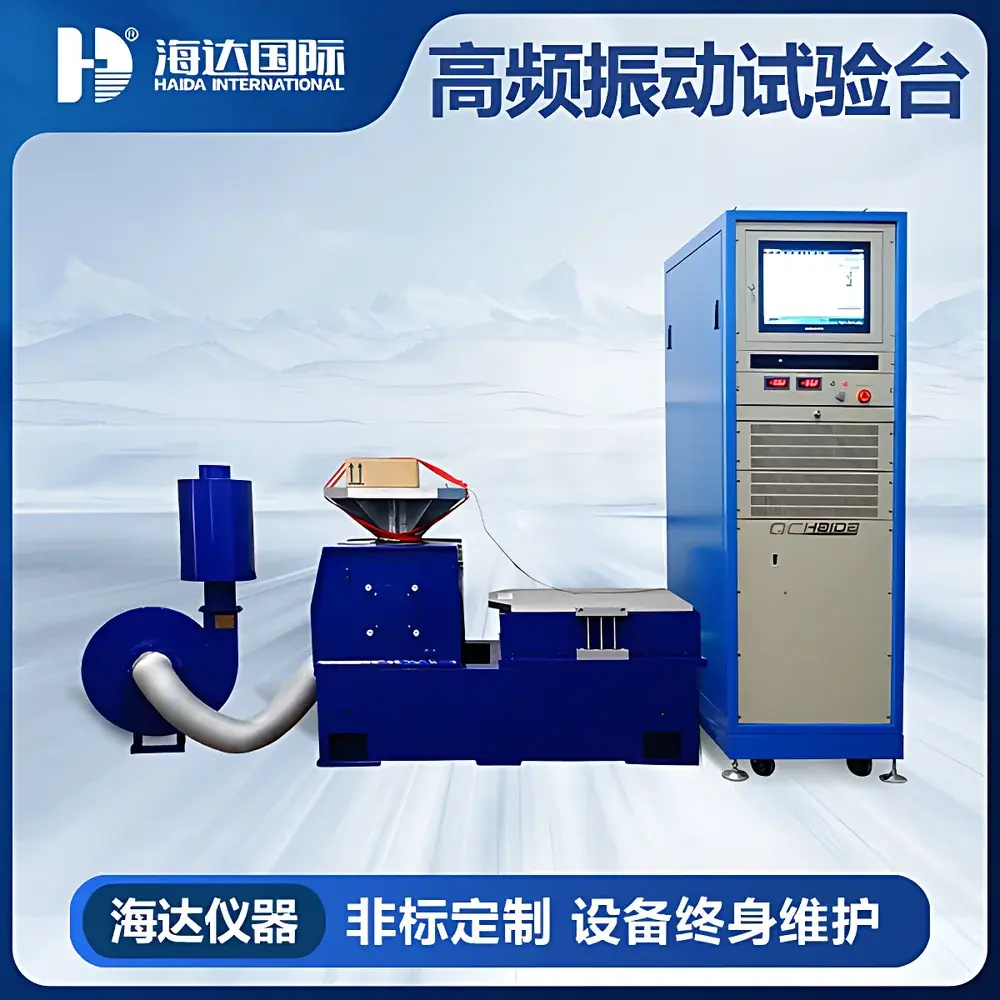
HAIDA HD-G826 High-Frequency Electromagnetic Vibration Shaker System
| Brand | HAIDA INTERNATIONAL |
|---|---|
| Origin | Guangdong, China |
| Manufacturer Type | OEM Manufacturer |
| Instrument Type | Electromagnetic Vibration Shaker |
| Rated Force | 120 kgf (peak) |
| Frequency Range | 2–3000 Hz |
| Maximum Test Load | 120 kg |
| Tabletop Dimensions | 1200 mm × 790 mm × 840 mm (without extension platform) |
| Maximum Acceleration | 100 g (980 m/s²) |
| Sinusoidal Force Capacity | 300 kgf (peak) |
| Random Force Capacity | 300 kgf (rms) |
| Shock Force Capacity | 600 kgf (peak) |
| Peak-to-Peak Displacement | 25.4 mm |
| Velocity Limit | 1.8 m/s |
| Power Amplifier Output | 3 kVA / 100 V / 30 A |
| Switching Frequency | 116 kHz |
| Efficiency | ≥90% |
| Cooling Noise Level | ≤70 dB(A) |
| Compliance | MIL-STD-810, ISO 5344, ISO 10816, IEC 60068-2-6, IEC 60068-2-27, US DoD Standards |
Overview
The HAIDA HD-G826 High-Frequency Electromagnetic Vibration Shaker System is a precision-engineered electrodynamic vibration test platform designed for high-fidelity simulation of mechanical stress environments encountered during transportation, operational deployment, and service life of critical components and assemblies. Operating on the principle of Lorentz-force actuation—where controlled current through a voice-coil conductor within a radial magnetic field generates proportional linear motion—the system delivers repeatable, traceable, and metrologically sound acceleration profiles across a broad dynamic bandwidth (2 Hz to 3000 Hz). Its dual-magnetic-circuit exciter architecture ensures low magnetic leakage, uniform flux density distribution, and minimal harmonic distortion—key requirements for compliance-driven qualification testing in aerospace, defense, automotive electronics, and medical device manufacturing. The shaker is rated for 120 kg maximum payload and capable of delivering up to 100 g (980 m/s²) peak acceleration, making it suitable for both low-frequency structural resonance screening and high-frequency fatigue assessment of printed circuit boards (PCBs), avionics modules, sensor housings, and miniature electromechanical systems.
Key Features
- Robust electromagnetic shaker with dual-magnetic-circuit design for enhanced field uniformity and thermal stability
- Integrated high-efficiency digital switching power amplifier (3 kVA output, ≥90% efficiency, 116 kHz switching frequency)
- Advanced forced-air cooling system featuring honeycomb airflow channels in the armature coil and dual-split ducting in the center magnet assembly—optimized for continuous high-power operation at elevated frequencies
- Phosphated and automotive-grade baked enamel finish on all structural surfaces for long-term corrosion resistance and mechanical durability
- Modular platform configuration supporting vertical shaker mode and optional horizontal slip-table operation (aluminum alloy, hard-anodized, 500 × 500 mm, rated to 2000 Hz)
- Comprehensive hardware safety interlock network including over-temperature, over-current, over-voltage, phase-loss, displacement limit, external emergency stop, and logic fault detection
- Real-time system diagnostics with automatic shutdown via front-panel emergency termination switch
Sample Compatibility & Compliance
The HD-G826 accommodates test specimens up to 120 kg mass and 1200 mm × 790 mm footprint without extension platforms; with optional magnesium-alloy damping-enhanced extension tables, lateral modal coupling is minimized for multi-axis test configurations. The system meets or exceeds requirements defined in MIL-STD-810H Method 514.8 (Vibration), ISO 5344:2004 (Electrodynamic shakers — Performance verification), ISO 10816-1 (Mechanical vibration evaluation of machines), IEC 60068-2-6 (Sinusoidal vibration), and IEC 60068-2-27 (Shock). It supports full audit trail generation and user-accessible calibration certificate archives aligned with GLP/GMP documentation practices. While not inherently 21 CFR Part 11 compliant out-of-the-box, its Windows-based controller software architecture permits integration with validated electronic signature and data integrity modules when deployed in regulated pharmaceutical or medical device validation workflows.
Software & Data Management
Control and analysis are executed via a dedicated Windows-based digital vibration controller application featuring intuitive wizard-driven test setup, real-time FFT spectrum monitoring, and automated report generation in PDF and CSV formats. The interface supports full parameterization of sine, random, shock, and mixed-mode profiles—including SRS synthesis, PSD editing, and breakpoint table definition—with USB 2.0 connectivity ensuring deterministic timing synchronization between host PC and amplifier subsystem. All test logs—including waveform files, control settings, environmental metadata, and pass/fail status—are timestamped and stored with immutable file attributes. Optional firmware upgrades enable remote diagnostics, predictive maintenance alerts, and compatibility with third-party test management systems (TMS) via TCP/IP API.
Applications
The HD-G826 serves as a core qualification tool in product development and quality assurance laboratories conducting environmental stress screening (ESS), HALT/HASS pre-screening, PCB solder joint reliability validation, connector vibration endurance testing, MEMS packaging integrity assessment, and airborne electronics ruggedization verification. Typical use cases include: sinusoidal sweep testing of satellite payload mounting brackets per ECSS-E-ST-10-03C; random vibration profiling of automotive ADAS control units per ISO 16750-3; transient shock simulation of handheld medical devices per IEC 60601-1-11; and resonant dwell testing of turbine blade assemblies under simulated flight spectra. Its extended high-frequency capability (up to 3000 Hz) enables accurate replication of acoustic-induced vibration modes relevant to jet engine nacelle components and ultrasonic transducer housing validation.
FAQ
What standards does the HD-G826 support for vibration test execution?
The system complies with MIL-STD-810H (Method 514.8), ISO 5344, ISO 10816, IEC 60068-2-6 and -2-27, and ASTM D999 for package vibration testing.
Can the HD-G826 perform simultaneous multi-axis vibration testing?
No—it is a single-axis (vertical) shaker system by default; horizontal testing requires an optional oil-film slip table, and true 6-DOF testing necessitates integration with auxiliary shakers and a coordinated MIMO controller.
Is calibration certification included with shipment?
Yes—a NIST-traceable factory calibration certificate covering force, acceleration, displacement, and velocity sensitivity is provided with each unit.
What is the recommended maintenance interval for the cooling system?
Air filters should be inspected every 200 operating hours and cleaned or replaced as needed; annual inspection of fan motor bearings and duct integrity is advised.
Does the system support closed-loop control using external accelerometers?
Yes—the controller accepts analog input from IEPE or charge-mode accelerometers for real-time feedback control and cross-channel averaging in random and shock modes.
Related Products



