
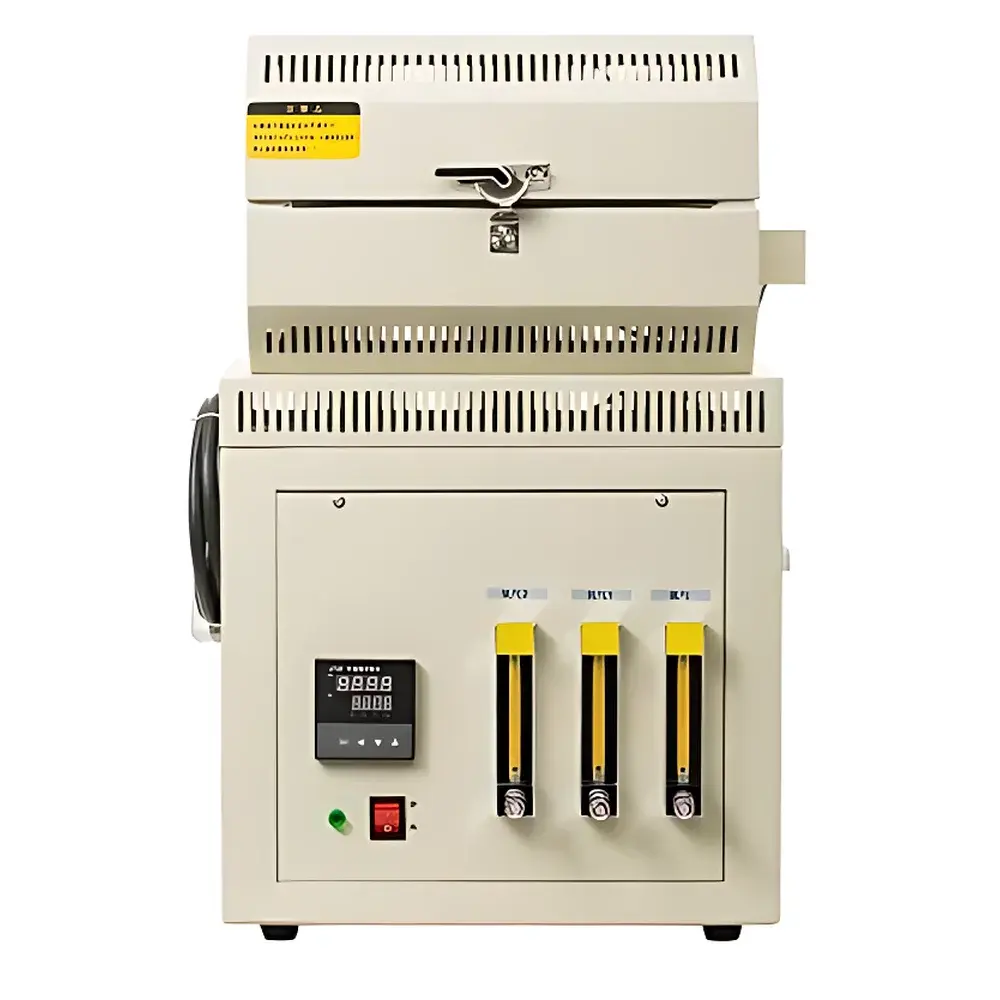
Zhochi AOX-3 Oxygen-Nitrogen Combustion Furnace for Adsorbable Organic Halogens (AOX) Analysis
| [Brand | Zhochi |
|---|---|
| Origin | Zhejiang, China |
| Model | AOX-3 |
| Detection Principle | High-Temperature Combustion Coupled with Coulometric Titration or Ion Chromatography |
| Temperature Range | 100–1150 °C |
| Max. Temp. Stability | ±1 °C |
| 炉 Chamber Dimensions | Ø40 × 300 mm |
| Power Supply | 220 V, 50 Hz |
| Rated Power | 1.5 kW |
| Sample Mass Range | 5–1000 mg |
| Detection Range | 0.8–1000 µg/L |
| LOD | 0.8 µg/L |
| Accuracy | ±1% |
| Repeatability | ≤1% |
| Resolution | 0.01 µg |
| Avg. Analysis Time (combustion only) | 3–10 min |
| Gas Requirements | O₂ ≥99.6% (99.999% recommended) |
| Compliance | HJ/T 83–2001, ISO 9562:1989, GB/T 15959–1995, GB 8978–1996, GB 3544–2008] |
Overview
The Zhochi AOX-3 Oxygen-Nitrogen Combustion Furnace is a dedicated high-temperature thermal oxidation system engineered for the quantitative determination of Adsorbable Organic Halogens (AOX) in environmental matrices. It operates on the principle of controlled high-temperature combustion (up to 1150 °C) followed by halogen quantification via either microcoulometric titration or ion chromatography — fully aligned with internationally recognized standard methods including ISO 9562:1989, HJ/T 83–2001, and GB/T 15959–1995. The furnace integrates a dual-zone ceramic fiber insulated chamber with embedded high-resistance heating elements, enabling rapid thermal ramping (≤50 °C/min), precise temperature regulation (±1 °C stability), and reproducible oxidative decomposition of organic halogen compounds into inorganic halide ions (Cl⁻, Br⁻, I⁻). Unlike general-purpose muffle furnaces, the AOX-3 features an optimized gas-flow architecture — with independent inner/outer tube oxygen supply, nitrogen-assisted adsorption column pressurization, and integrated wash-gas and absorption train interfaces — ensuring quantitative halogen recovery and minimal interferences from matrix-derived sulfur or nitrogen oxides.
Key Features
- Programmable LTDE temperature controller with PID+SSR regulation, supporting multi-step heating profiles, automatic hold timing, and user-defined ramp rates
- Ceramic fiber composite furnace chamber (two semi-cylindrical segments) with low thermal mass and high emissivity — enabling fast heat-up (<10 min to 900 °C) and efficient energy use
- Modular, front-accessible design with hinged top cover for real-time visual monitoring of sample combustion and carrier gas flow dynamics
- Dual oxygen inlet configuration: inner tube for sample oxidation, outer tube for post-combustion gas dilution and cooling — minimizing carbon carryover and improving halogen transfer efficiency
- Integrated built-in gas washing system with five standardized scrubbing bottles (for SO₂, NOₓ, and CO₂ removal) and two absorption units compatible with both coulometric cells and IC eluent streams
- Low-voltage (220 V), high-efficiency heating circuit rated at 1.5 kW — designed for continuous 24-hour operation under GLP-compliant laboratory conditions
- Robust mechanical construction: cold-rolled steel housing with phosphate conversion coating and electrostatic gray powder finish; total net weight ≈ 25 kg
Sample Compatibility & Compliance
The AOX-3 supports direct analysis of liquid and solid environmental samples following standardized adsorption pretreatment. Liquid matrices — including drinking water, surface water, groundwater, wastewater, seawater, pulp mill effluents, and treated process water — are first passed through activated carbon columns under nitrogen pressure (supplied via optional dual-pressure kit). Solid samples — such as soils, sediments, sludges, and waste oils — are homogenized, weighed into quartz boats (2 included), and introduced via the quartz push rod assembly. All procedures adhere strictly to HJ/T 83–2001 (China EPA) and ISO 9562:1989 requirements for AOX determination. Instrument validation documentation includes traceable calibration protocols, blank correction routines, and spike recovery verification per ISO/IEC 17025 guidelines. The system architecture permits full audit trail generation when paired with compliant data acquisition software meeting FDA 21 CFR Part 11 criteria (optional configuration).
Software & Data Management
While the AOX-3 furnace itself functions as a hardware module without embedded computing, it is fully compatible with third-party analytical software platforms used in regulated laboratories. When interfaced with microcoulometers (e.g., Thermo Fisher CDM-2, Metrohm 852) or ion chromatography systems (e.g., Dionex ICS-5000+, Shimadzu IC-2010), raw signal outputs (mV, µA, or peak area) are captured via analog/digital input modules. Optional PC-based control software provides real-time temperature logging, combustion event tagging, and automated report generation aligned with ISO 17025 reporting templates. All method parameters — including ramp rate, hold time, gas flow setpoints, and calibration curve coefficients — are stored in encrypted project files with user access controls and electronic signature support. System logs record operator ID, timestamp, and critical events (e.g., overtemperature alerts, door open/close cycles) to satisfy GLP/GMP audit requirements.
Applications
- Regulatory compliance testing for AOX in municipal and industrial wastewater discharges (per GB 3544–2008 and GB 8978–1996)
- Monitoring halogenated disinfection byproducts (DBPs) in drinking water treatment plants
- Environmental impact assessment of chlorinated solvents, pesticides, and flame retardants in soil and sediment
- Process validation in pulp & paper manufacturing where elemental chlorine-free (ECF) bleaching is employed
- Research-grade quantification of persistent organic pollutants (POPs) in biota and sludge digestates
- Method development and inter-laboratory comparison studies under CNAS or ILAC-MRA frameworks
FAQ
What detection techniques can be coupled with the AOX-3 furnace?
The AOX-3 is designed for seamless integration with either microcoulometric titrators (per GB/T 15959–1995) or ion chromatographs (per HJ/T 83–2001). No internal detector is included; users must supply a compatible coulometer or IC system.
Is purified oxygen mandatory for optimal performance?
Yes. While 99.6% oxygen meets minimum operational requirements, 99.999% ultra-high-purity O₂ is strongly recommended to eliminate the need for pre-combustion gas scrubbing and improve halogen recovery reproducibility — particularly for low-level samples near the 0.8 µg/L LOD.
Can the AOX-3 operate unattended overnight?
Yes. Its dual-stage overtemperature protection, stable PID-controlled thermal profile, and robust electrical architecture support continuous 24-hour operation. Routine maintenance intervals are specified at 500 operating hours or quarterly — whichever occurs first.
What consumables require regular replacement?
Activated carbon columns (user-supplied), quartz sample boats, quartz push rods, silicone tubing (15 mm OD), absorption tubes, and wash-bottle reagents (e.g., NaOH, H₂O₂, KNO₃ solutions) must be replaced based on usage frequency and matrix load. Ceramic furnace liners are rated for >2000 cycles at 1100 °C.
Related Products







