
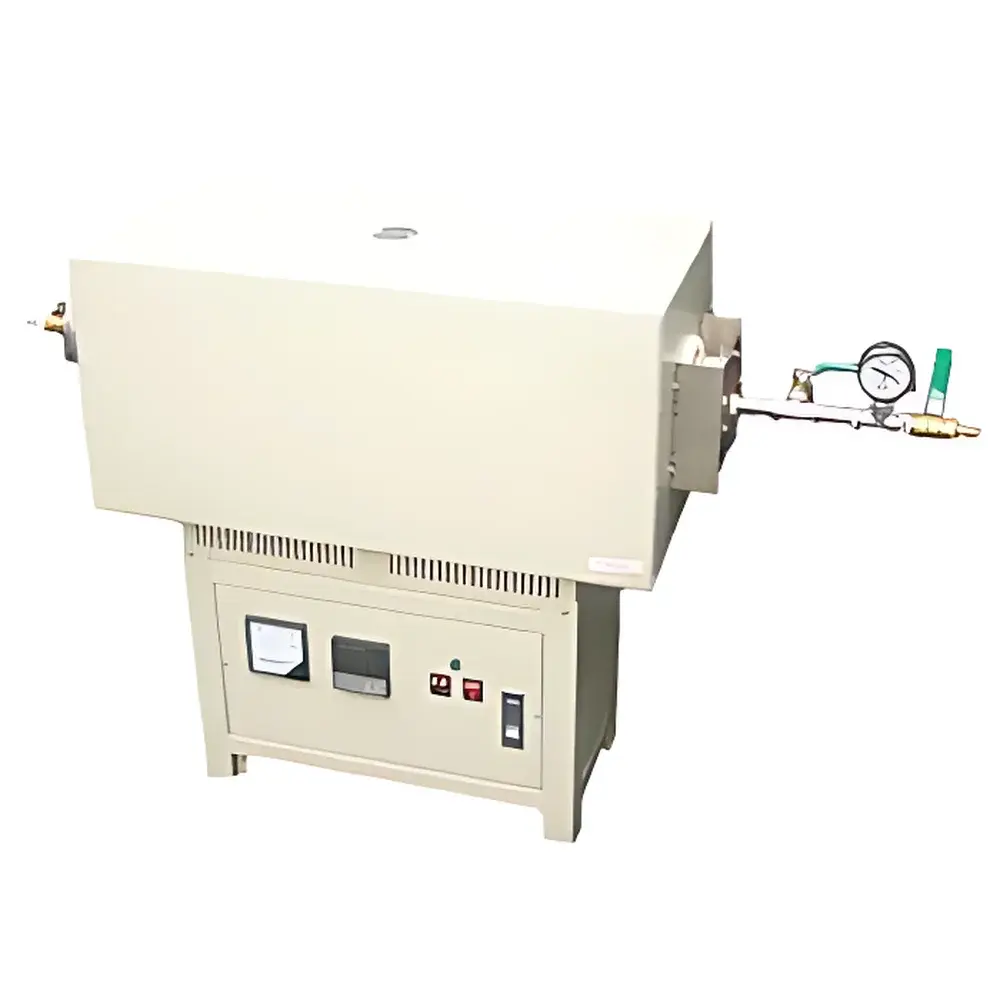
Zhuochi SK3-5-12-5 Energy-Efficient Programmable Vacuum Tube Furnace
| Brand | Zhuochi |
|---|---|
| Origin | Zhejiang, China |
| Model | SK3-5-12-5 |
| Chamber Dimensions | Ø50 × 700 mm |
| Max Operating Temperature | 1200 °C |
| Rated Power | 5 kW |
| Voltage | 200 V AC |
| Heating Rate | Adjustable from ambient to 1200 °C in 15–999 min |
| Tube Material | Fused quartz or alumina (standard: Ø50 × 900 mm) |
| Sealing System | Stainless steel flange, high-temp vacuum sealant, integrated vacuum gauge and inlet valve |
| Controller | LTDE programmable temperature controller with multi-segment ramp/soak/timer functionality |
| Compliance | Designed for laboratory-scale thermal processing under controlled atmosphere or vacuum |
Overview
The Zhuochi SK3-5-12-5 Energy-Efficient Programmable Vacuum Tube Furnace is a precision-engineered thermal processing system designed for controlled-atmosphere and vacuum-based heat treatment of materials in academic research laboratories, materials science departments, and R&D facilities. It operates on the principle of resistive heating via high-purity alloy heating elements embedded within a low-thermal-mass insulation structure—comprising ultra-lightweight refractory ceramic fiber—to minimize energy consumption while maintaining excellent thermal uniformity and stability. The furnace chamber is housed within a double-walled stainless steel shell with forced-air cooling, enabling safe operation at sustained temperatures up to 1200 °C. Its core architecture supports both static vacuum environments (down to 10⁻² mbar with optional pump integration) and dynamic gas flow conditions (via optional mass flow controllers), making it suitable for annealing, sintering, crystal growth, reduction, oxidation, and CVD precursor decomposition studies.
Key Features
- Programmable LTDE temperature controller with up to 30 segment ramp-soak profiles, supporting precise thermal cycling, timed start/stop, and automatic cooldown sequences.
- Low-heat-capacity furnace core constructed from high-purity ceramic fiber modules—reducing standby power draw and accelerating thermal response without compromising structural integrity at elevated temperatures.
- Standard fused quartz or high-purity alumina tube (Ø50 × 900 mm) with precision-ground end flanges and high-temperature silicone-free sealing compound rated to 1200 °C.
- Integrated vacuum interface: stainless steel front flange with KF-25 or CF-35 port, analog vacuum gauge (0–760 Torr), dual-position inlet valve, and optional vacuum pump coupling kit.
- Intelligent safety architecture including over-temperature cutoff (independent of main controller), door-open interlock, and real-time heater current monitoring.
- Front-panel USB port for firmware updates and data logging; RS485 Modbus RTU output available for SCADA or LIMS integration.
Sample Compatibility & Compliance
The SK3-5-12-5 accommodates cylindrical samples up to Ø48 mm × 650 mm in length when installed inside the standard Ø50 × 900 mm tube. Compatible sample holders include high-purity alumina crucibles, graphite boats, and custom-designed quartz carriers. The system meets general laboratory equipment safety requirements per IEC 61010-1:2010 and is engineered to support GLP-compliant workflows through traceable temperature calibration (NIST-traceable thermocouple input), audit-ready event logging, and user-access-level control (operator/administrator modes). While not certified to ISO/IEC 17025, its thermal performance aligns with ASTM E220 and ISO 8573-1 for controlled-heating applications requiring repeatability within ±3 °C across the working zone.
Software & Data Management
The LTDE controller provides local HMI-based operation with password-protected parameter editing, real-time curve visualization, and non-volatile memory for ≥10,000 hours of timestamped temperature history. Optional PC software (Zhuochi FurnaceLink™ v3.2) enables remote monitoring via USB or Ethernet, CSV export of time-temperature-pressure datasets, and automated report generation compliant with internal QA documentation standards. All logged events—including setpoint changes, alarm triggers, and power interruptions—are time-stamped with millisecond resolution and stored with immutable metadata, satisfying basic FDA 21 CFR Part 11 readiness requirements for electronic records when deployed with validated IT infrastructure.
Applications
- Thermal annealing of thin-film metal oxides (e.g., TiO₂, NiO) for photovoltaic and catalytic studies.
- Vacuum degassing of polymer composites and ceramic green bodies prior to sintering.
- Solid-state synthesis of phosphors, battery cathode precursors (e.g., LiCoO₂, NMC), and MAX-phase ceramics.
- Controlled-atmosphere carburizing and nitriding of small metallic specimens.
- Calibration of thermocouples and reference materials under inert or reducing gas environments.
- Pre-treatment of substrates for physical vapor deposition (PVD) and atomic layer deposition (ALD) processes.
FAQ
What vacuum level can the SK3-5-12-5 achieve without an external pump?
The base configuration includes a mechanical vacuum gauge and manual valve but does not include a vacuum pump; ultimate pressure depends on the connected pump—typically 10⁻² to 10⁻³ mbar with a standard two-stage rotary vane pump.
Is the quartz tube included with the furnace?
Yes, each unit ships with one standard fused quartz tube (Ø50 × 900 mm) and matching stainless steel end caps with high-temperature sealant pre-applied.
Can the furnace operate under flowing gas conditions?
Yes—gas inlet and outlet ports are provided; optional MFC kits (mass flow controllers for Ar, N₂, H₂, NH₃, etc.) are available for precise reactive or inert atmosphere control.
Does the controller support PID auto-tuning?
Yes, the LTDE controller features adaptive PID tuning with user-initiated optimization routines to maintain ±1 °C stability during extended soaks.
What is the recommended maintenance interval for the heating elements?
Under normal use at ≤1100 °C, heating elements typically exceed 3,000 operating hours before resistance drift exceeds specification; visual inspection and continuity testing are advised every 500 hours.



