
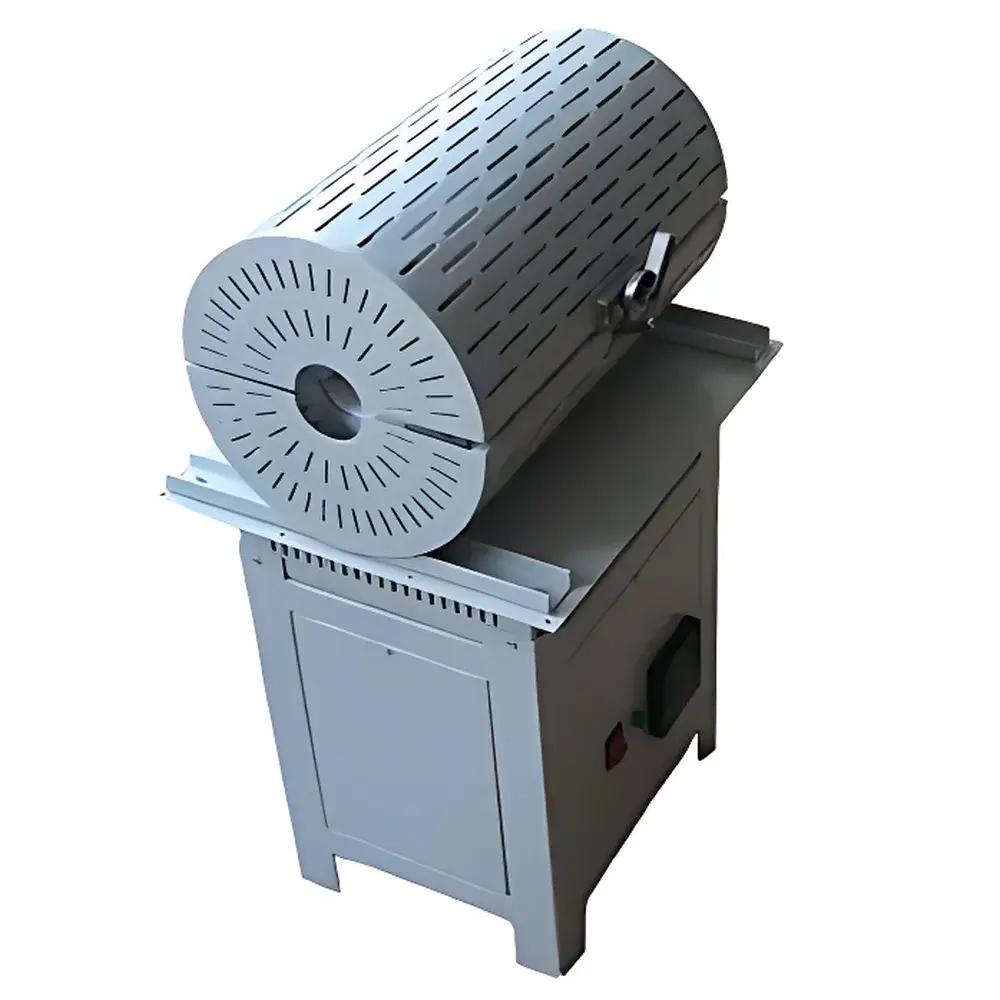
Zhuochi 30165-10 Horizontal Split-Type Programmable Tube Furnace
| Brand | Zhuochi |
|---|---|
| Origin | Zhejiang, China |
| Model | 30165-10 |
| Type | Horizontal Split-Type Tube Furnace |
| Max Temperature | 1000 °C |
| Furnace Chamber | Ø50 mm × 300 mm |
| Heating Power | 2.5 kW / 220 V |
| Effective Heating Zone | 200 mm |
| Temperature Accuracy | ±1 °C |
| Tube Length Compatibility | ≥400 mm |
| Control System | 30-Stage Programmable PID Controller |
| Safety Features | Dual Over-Temperature Protection, Earth Leakage & Electric Shock Protection |
| Optional | PC-Based Data Logging Software (RS485/USB Interface) |
Overview
The Zhuochi 30165-10 Horizontal Split-Type Programmable Tube Furnace is an engineered solution for precise, repeatable high-temperature thermal processing in academic research laboratories, materials science departments, and quality control environments. Designed around a horizontal split-tube architecture, this furnace employs dual semi-cylindrical heating elements that open laterally—enabling rapid, non-invasive access to the reaction zone without disturbing temperature equilibrium or requiring full cooldown between sample changes. Its operational principle relies on resistive heating via high-purity Kanthal A1 or FeCrAl alloy heating elements embedded in fiber-ceramic insulation, delivering uniform axial temperature distribution across the 200 mm effective heating zone. With a maximum operating temperature of 1000 °C and certified thermal stability of ±1 °C under steady-state conditions, it supports critical processes including annealing, sintering, calcination, reduction/oxidation reactions, and precursor decomposition—all while maintaining compliance with fundamental thermal safety and electromagnetic compatibility standards (IEC 61000-6-3, IEC 61000-6-4).
Key Features
- Horizontal split-body design with hinged semi-cylindrical heating chambers for tool-free, front-access loading and real-time visual monitoring of samples during operation
- 30-segment programmable PID controller enabling multi-step thermal profiles: ramp rates (0.1–30 °C/min), hold durations (1 min–99 h 59 min), and cyclic sequences with auto-restart logic
- High-density ceramic fiber insulation (density ≥128 kg/m³) minimizing thermal mass and improving energy efficiency—typical warm-up time to 1000 °C is <45 minutes
- Dual-stage over-temperature protection: primary limit set at 1050 °C (hardware cut-off), secondary software-based alarm triggered at user-defined thresholds
- Integrated earth leakage circuit breaker (30 mA sensitivity) and reinforced grounding system meeting IEC 61010-1 requirements for laboratory electrical safety
- Stainless steel inner lining (AISI 304) on both furnace door interior and chamber flange surfaces to resist oxidation and ensure long-term dimensional stability
- Standard RS485 interface (Modbus RTU protocol) and optional USB-to-RS485 adapter for integration into centralized lab automation systems
Sample Compatibility & Compliance
The 30165-10 accommodates standard quartz, alumina, or silicon carbide tubes with outer diameters up to Ø50 mm and minimum lengths of 400 mm—ensuring adequate overhang beyond the heating zone for thermal isolation and gas sealing. Its open-frame geometry permits direct coupling with gas delivery manifolds (e.g., N₂, Ar, H₂/N₂ mixtures) and vacuum pumping systems (down to 10⁻² mbar with optional mechanical pump). The furnace meets essential regulatory expectations for non-GMP laboratory use, including traceable calibration documentation per ISO/IEC 17025 guidelines and conformity with CE marking directives (2014/35/EU Low Voltage Directive, 2014/30/EU EMC Directive). While not certified for FDA 21 CFR Part 11 environments out-of-the-box, its optional data logging software supports audit-trail-enabled temperature recording suitable for GLP-aligned workflows.
Software & Data Management
An optional Windows-compatible software package provides real-time temperature visualization, remote parameter adjustment, and time-stamped data export in CSV format. Each logged record includes timestamp, setpoint, actual PV reading, ramp rate, and system status flags (e.g., “Heating”, “Soaking”, “Cooling”). The software implements local user authentication and generates immutable log files with SHA-256 checksums—facilitating retrospective verification during internal audits. All communication adheres to Modbus RTU over RS485, ensuring deterministic latency (<100 ms) and immunity to network congestion in multi-device lab networks.
Applications
- Thermal treatment of nanomaterials (e.g., graphene oxide reduction, metal-organic framework activation)
- Controlled-atmosphere synthesis of transition metal oxides for battery cathode precursors
- Post-deposition annealing of thin-film photovoltaic layers (CIGS, perovskites)
- Calibration and validation of thermocouples (Type K, S, R) per ASTM E230/E230M
- Preparation of reference standards for XRD and SEM-EDS analysis through stoichiometric solid-state reactions
- Accelerated aging studies of polymer composites under inert or oxidative atmospheres
FAQ
What tube materials are compatible with the 30165-10 at 1000 °C?
Quartz (fused silica) tubes are recommended for inert or reducing atmospheres; high-purity alumina (99.7% Al₂O₃) tubes are required for oxidizing conditions or extended dwell times above 900 °C.
Can the furnace be operated under vacuum?
Yes—when paired with a compatible vacuum flange kit and two-stage rotary vane pump, it achieves base pressures ≤1×10⁻² mbar; vacuum-rated O-rings and feedthroughs must be specified at time of order.
Is NIST-traceable calibration available?
Factory calibration uses Class 1 platinum resistance thermometers (PRTs) verified against NIST-traceable standards; full calibration certificates (ISO/IEC 17025 accredited) are available as a paid add-on service.
Does the controller support custom alarm logic beyond over-temperature?
The embedded firmware allows user-defined digital I/O triggers (e.g., external interlock break, cooling fan failure) mapped to audible/visual alerts and automatic shutdown sequences.
What maintenance intervals are recommended for sustained accuracy?
Biannual inspection of heating element continuity, thermocouple junction integrity, and insulation compression is advised; ceramic fiber modules should be replaced after ~2000 cumulative hours at >900 °C.



