
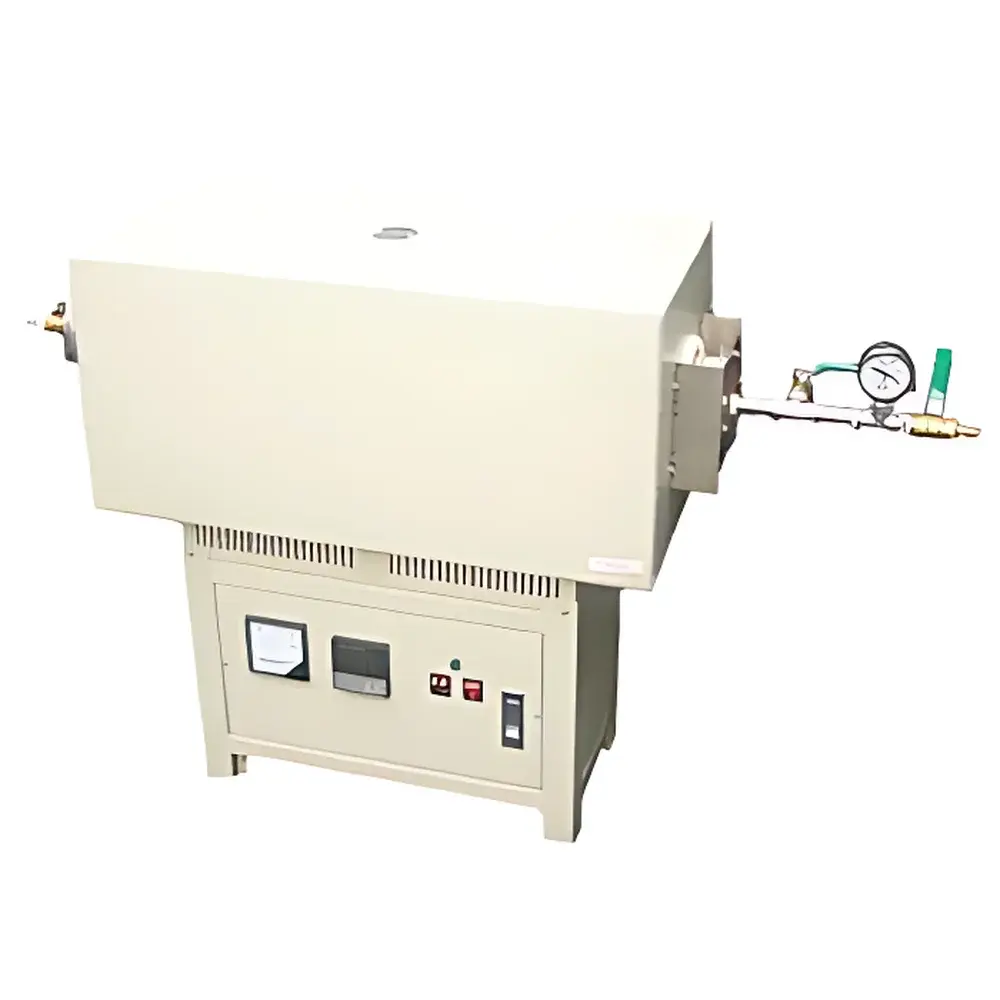
Zhuochi SK3-6-10-10 Energy-Efficient Programmable Vacuum Tube Furnace
| Brand | Zhuochi |
|---|---|
| Origin | Zhejiang, China |
| Model | SK3-6-10-10 |
| Chamber Dimensions | Ø100 × 1000 mm |
| Max Operating Temperature | 1000 °C |
| Rated Power | 6 kW |
| Voltage | 380 V AC |
| Heating Element | High-Purity Kanthal A1 or Silicon Carbide (SiC) |
| Insulation | Low-thermal-mass lightweight refractory fiber |
| Control System | LTDE Programmable PID Controller |
| Vacuum Compatibility | ≤10⁻² mbar (with optional mechanical pump) |
| Tube Material Options | Fused quartz (Ø100 × 1000 mm) or high-purity alumina ceramic tube |
| Sealing System | Stainless steel flange with high-temp silicone rubber gasket (rated to 300 °C) and optional metal-sealed O-ring upgrade |
Overview
The Zhuochi SK3-6-10-10 is a programmable vacuum tube furnace engineered for precise thermal processing under controlled atmosphere or reduced-pressure conditions. Designed for laboratory-scale synthesis, annealing, sintering, and heat treatment of advanced materials—including catalysts, battery electrode precursors, nanomaterials, and thin-film substrates—the furnace employs resistive heating via high-stability alloy or silicon carbide elements, uniformly distributed within a low-thermal-inertia fibrous insulation chamber. Its core architecture follows the standard horizontal tube furnace configuration, with axial insertion of sample-bearing crucibles or boats into a sealed quartz or alumina reaction tube. The system achieves stable temperature uniformity ±5 °C across the effective hot zone (≥200 mm length) at 1000 °C, with ramp rates programmable from 0.1 to 20 °C/min. Unlike conventional muffle furnaces, this design enables direct integration with gas manifolds and vacuum lines, supporting inert, reducing, oxidizing, or vacuum environments per process requirements.
Key Features
- Energy-efficient thermal design using ultra-lightweight refractory fiber insulation—reducing standby heat loss by >40% compared to brick-lined alternatives
- LTDE-series 30-segment programmable PID controller with real-time profile editing, alarm thresholds, and auto-tuning capability
- Modular vacuum interface: includes stainless steel flange, analog vacuum gauge (0–760 Torr), inlet/outlet valves, and high-temperature sealing compound compatible with fused quartz tubes
- Optional add-ons include digital mass flow controllers (MFCs) for precise gas dosing, water-cooled vacuum feedthroughs, and thermocouple ports for in-situ temperature monitoring
- Robust mechanical construction with reinforced steel frame, double-layer insulated outer casing, and front-access door with safety interlock
- Compliance-ready architecture: supports audit trails when paired with external data loggers compliant with FDA 21 CFR Part 11 guidelines
Sample Compatibility & Compliance
The SK3-6-10-10 accommodates cylindrical samples up to Ø90 mm in diameter and 800 mm in length, mounted on ceramic or graphite boats inside the Ø100 × 1000 mm quartz tube. Compatible sample types include powders, pellets, fibers, thin films on substrates, and small-volume molten salts. Quartz tubes meet ASTM F795 specifications for semiconductor-grade purity; alumina alternatives conform to ISO 6474-1 for high-alumina ceramics (≥99.5% Al₂O₃). The furnace’s operational envelope satisfies key testing standards including ASTM E1113 (thermal stability of refractories), ISO 8501-1 (surface cleanliness prior to coating), and USP for thermal validation of pharmaceutical excipient drying. When operated under nitrogen or argon purge, it supports GLP-compliant material aging studies per ICH Q1A(R2).
Software & Data Management
While the LTDE controller operates independently via front-panel interface, its RS485 port enables serial communication with third-party SCADA or LIMS platforms using Modbus RTU protocol. Users may export time-stamped temperature logs (CSV format) via USB memory stick or configure remote monitoring through optional Ethernet gateway modules. All setpoint changes, alarm events, and power-cycle timestamps are retained in non-volatile memory for ≥10,000 cycles—supporting traceability requirements under ISO/IEC 17025 accredited laboratories. For regulated environments, external validation software (e.g., ValSuite™ or EasyIQ) can be deployed to generate IQ/OQ/PQ documentation packages aligned with GMP Annex 15.
Applications
- Controlled-atmosphere calcination of Li-ion cathode precursors (e.g., NMC, LFP) under Ar/H₂ mixtures
- Vacuum annealing of graphene oxide films to tune sp²/sp³ carbon ratios
- Thermal decomposition kinetics studies of metal-organic frameworks (MOFs) under dynamic vacuum
- Low-oxygen sintering of tungsten carbide composites for wear-resistant coatings
- Inert-gas pyrolysis of polymer-derived ceramics (PDCs) with real-time weight-loss correlation
- Pre-oxidation treatment of Ni-based superalloy powders prior to HIP processing
FAQ
What vacuum level can the SK3-6-10-10 achieve?
With a two-stage rotary vane pump (not included), the system typically reaches 1×10⁻² mbar. For higher vacuum performance (≤1×10⁻⁴ mbar), a turbomolecular pumping station with cold trap is recommended.
Is the quartz tube included with the base configuration?
Yes—the standard delivery includes one fused quartz tube (Ø100 × 1000 mm) with matching stainless steel end caps and high-temp sealant. Alumina tubes are available as optional upgrades.
Can the furnace be used for hydrogen atmosphere processing?
Hydrogen service requires additional safety provisions: leak-tested gas lines, H₂-compatible pressure relief valves, explosion-proof wiring, and continuous oxygen monitoring. Zhuochi recommends consultation with a certified process safety engineer before H₂ operation.
Does the controller support ramp-soak-hold profiles with multiple cycles?
Yes—the LTDE controller stores up to 30 independent segments per program, allowing nested ramp/soak sequences and repeat loops (up to 99 cycles) without PC intervention.
What maintenance is required for long-term reliability?
Annual inspection of heating element continuity, thermocouple calibration (NIST-traceable), and vacuum seal integrity is advised. Refractory insulation should be visually inspected for cracking or delamination after 500 cumulative hours above 800 °C.



