
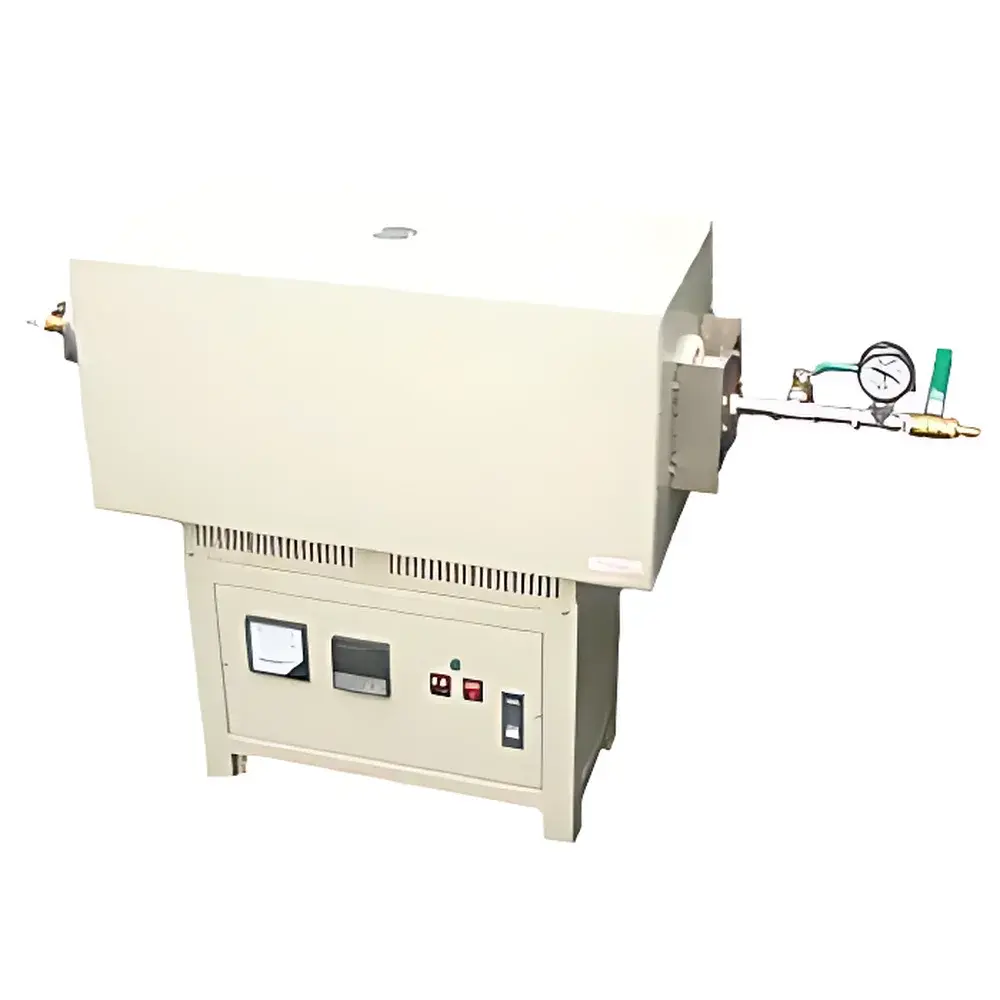
Zhuochi SK3-3-12-4 Energy-Efficient Programmable Vacuum & Atmosphere Tube Furnace
| Brand | Zhuochi |
|---|---|
| Origin | Zhejiang, China |
| Model | SK3-3-12-4 |
| Instrument Type | Horizontal Tube Furnace |
| Max Temperature | 1200 °C |
| Temperature Uniformity (at 1200 °C) | ±1 °C |
| Heating Rate (to max temp) | ≤50 °C/min (adjustable) |
| Rated Power | 3 kW |
| Internal Chamber Dimensions | Ø40 × 380 mm |
| Quartz Tube Dimensions | Ø40 × 810 mm (OD × total length) |
| Heating Zone Length | 280 mm |
| Temperature Sensor | S-type Platinum-Rhodium/Platinum Thermocouple |
| Control System | LTDE 30-segment Programmable PID Controller with SSR Output |
| Electrical Supply | 220 V, 50 Hz |
| Weight | ~35 kg |
| Compliance | Designed for GLP-compliant lab environments |
Overview
The Zhuochi SK3-3-12-4 is a horizontally oriented, programmable vacuum and atmosphere tube furnace engineered for precision thermal processing in research laboratories, materials science departments, and QC/QA facilities. It operates on the principle of resistive heating via high-purity Kanthal A1 or similar high-temperature resistance wire, embedded within a low-thermal-mass, high-radiation ceramic fiber insulation chamber. The furnace core consists of a fused quartz tube (Ø40 mm OD, 810 mm total length) sealed at both ends with stainless steel flanges and high-temperature silicone gaskets—enabling stable vacuum conditions down to 10⁻² mbar (with optional mechanical pump) or controlled inert gas atmospheres (N₂, Ar, forming gas) via dual-inlet, single-outlet mass flow–compatible ports. Its operational temperature range spans 100 °C to 1200 °C, with thermal stability maintained at ±1 °C under steady-state conditions—a specification validated per ASTM E220 calibration protocols using certified reference thermocouples. The integrated LTDE controller implements full PID+SSR closed-loop regulation, supporting multi-step ramp-hold-cool programs with user-defined time/temperature profiles, making it suitable for sintering, annealing, calcination, CVD precursor decomposition, and reduction/oxidation studies requiring strict thermal history control.
Key Features
- Energy-optimized architecture: Ultra-lightweight ceramic fiber insulation (density < 200 kg/m³) minimizes thermal inertia and reduces standby power consumption by up to 40% compared to traditional brick-lined furnaces.
- High-integrity quartz reaction zone: Optical-grade fused silica tube ensures chemical inertness toward halides, alkalis, and most metal oxides below 1200 °C; zero outgassing under vacuum after proper bake-out.
- Programmable thermal profiling: 30-segment LTDE controller supports custom ramp rates (0.1–50 °C/min), hold durations (0–9999 min), and cooling sequences—including programmable natural cool-down with real-time monitoring.
- Dual-safety thermal protection: Primary overtemperature cutoff triggered at setpoint +15 °C; secondary independent mechanical limit switch activates at 1250 °C, compliant with IEC 61000-6-2 EMC and EN 60519-2 furnace safety standards.
- Modular gas/vacuum interface: Standard configuration includes dual stainless steel inlet valves (for gas mixing), single outlet port, analog vacuum gauge (0–760 Torr), and sealing hardware rated to 200 °C—ready for integration with digital mass flow controllers or vacuum gauges (optional).
- Integrated electrical design: All wiring (heating element, thermocouple, fan, SSR) pre-terminated and tested at factory; plug-and-play operation requires only 220 V AC input and grounding—no field wiring or calibration needed upon installation.
Sample Compatibility & Compliance
The SK3-3-12-4 accommodates cylindrical samples up to Ø35 mm × 300 mm placed centrally within the 280 mm uniform heating zone. Compatible sample forms include powders, pellets, thin films on substrates, nanowire arrays, and catalytic monoliths mounted on quartz boats or alumina setters. The quartz tube permits in situ optical access for Raman or UV-Vis spectroscopy when equipped with end-viewing windows (custom option). The system meets essential requirements for ISO/IEC 17025-accredited testing labs: temperature uniformity mapping data (per ASTM E220 Annex A3), calibration certificate traceable to NIST standards, and audit-ready electronic logs (when paired with optional data acquisition module). While not FDA 21 CFR Part 11–certified out-of-the-box, its programmable controller supports ALCOA+ data integrity principles when operated with validated SOPs and external electronic lab notebook (ELN) integration.
Software & Data Management
The LTDE controller provides local display of real-time temperature, program stage, elapsed time, and error codes via a 4-digit LED interface. Optional RS485 Modbus RTU output enables bidirectional communication with third-party SCADA systems (e.g., LabVIEW, Ignition, or custom Python-based DAQ platforms) for automated data logging, remote start/stop, and alarm notification. All temperature profiles are stored internally (non-volatile memory) and can be exported via USB dongle (firmware v2.1+) for archival in LIMS or ELN environments. For regulated environments, users may configure the system to generate CSV-formatted audit trails including operator ID, timestamped setpoint changes, deviation alerts, and manual override events—supporting GLP/GMP documentation requirements when paired with procedural controls.
Applications
- Materials synthesis: Solid-state reaction of Li-ion cathode precursors (e.g., NMC, LFP), metal–organic framework (MOF) activation, and graphene oxide thermal reduction.
- Thermal analysis support: Pre-treatment of TGA/DTA/DSC samples under controlled O₂/N₂ atmospheres to eliminate adsorbed moisture or organic residues prior to measurement.
- Catalyst conditioning: Calcination of supported metal catalysts (Pt/Al₂O₃, Ni/SiO₂) and sulfidation under H₂S/N₂ mixtures.
- Electroceramic processing: Densification of BaTiO₃, ZnO varistors, and piezoelectric PZT under oxygen-controlled atmospheres to regulate stoichiometry.
- Failure analysis: Controlled oxidation of semiconductor packaging materials or metallization layers to replicate field degradation mechanisms.
- Academic research: Kinetic studies of phase transformations (e.g., martensitic transitions, polymorph interconversion) requiring precise ramp-and-quench protocols.
FAQ
What vacuum level can the SK3-3-12-4 achieve without optional pumping equipment?
The base configuration includes a mechanical vacuum gauge but no pump; ultimate vacuum depends on the connected pump—typically 10⁻² mbar with a two-stage rotary vane pump.
Is the quartz tube replaceable, and what is its typical service life under cyclic operation?
Yes, the Ø40 × 810 mm quartz tube is a field-replaceable consumable; expected lifetime exceeds 200 cycles at 1200 °C with proper thermal ramping (≤20 °C/min above 1000 °C) and avoidance of thermal shock.
Can the furnace be operated continuously at 1200 °C?
Continuous operation at maximum temperature is technically feasible but not recommended beyond 8 hours without intermediate cooldown; prolonged exposure accelerates resistance wire aging and compromises long-term temperature uniformity.
Does the LTDE controller support Ethernet or Wi-Fi connectivity?
No—native connectivity is RS485 Modbus RTU only; Ethernet/Wi-Fi requires an external protocol converter (e.g., Moxa NPort) configured as a serial server.
What maintenance is required to ensure calibration stability over time?
Annual verification using a calibrated reference thermocouple (S-type, NIST-traceable) is advised; visual inspection of quartz tube integrity, gasket elasticity, and heater terminal torque should occur before each high-temperature campaign.



