
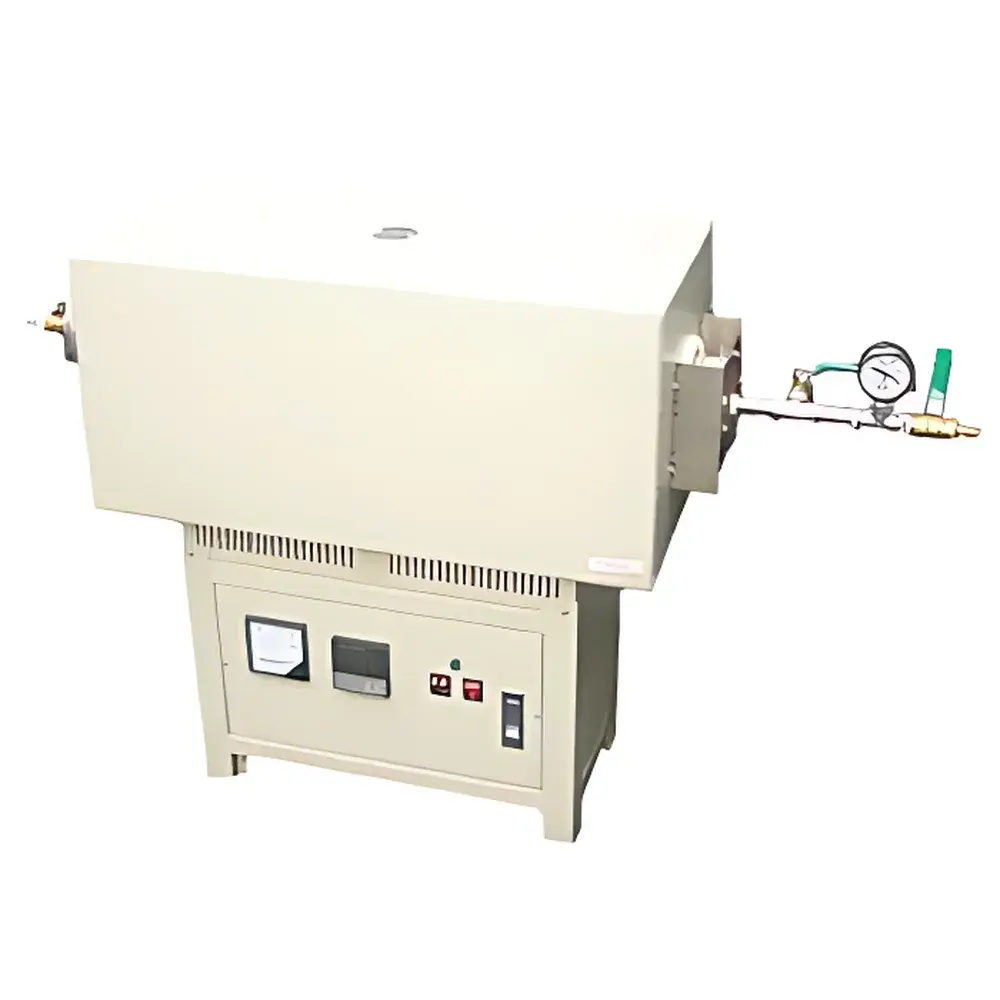
Zhuochi SK3-5-12-10 Energy-Efficient Programmable Vacuum Tube Furnace
| Brand | Zhuochi |
|---|---|
| Origin | Zhejiang, China |
| Model | SK3-5-12-10 |
| Chamber Dimensions | Ø100 × 700 mm |
| Max Operating Temperature | 1200 °C |
| Rated Power | 5 kW |
| Voltage | 220 V AC |
| Heating Rate | Adjustable from ambient to 1200 °C in 15–999 min |
| Tube Material Options | High-Purity Quartz (Ø100 × 900 mm) or Alumina Ceramic Tube |
| Vacuum System | Stainless Steel Sealed Flange, Dual-Port Inlet/Outlet with Precision Vacuum Gauge and High-Temperature Sealing Compound |
| Control System | LTDE Programmable Temperature Controller (Multi-Stage Ramp/Soak, Timer-Based Auto Start/Shutdown, Data Logging Capable) |
Overview
The Zhuochi SK3-5-12-10 is a laboratory-grade programmable vacuum tube furnace engineered for precise thermal processing under controlled atmospheric conditions. It operates on the principle of resistive heating via high-stability imported heating elements embedded within a low-thermal-mass, ultra-lightweight insulating chamber—enabling rapid thermal response and exceptional energy efficiency. Designed for applications requiring inert, reducing, or vacuum environments—including sintering, annealing, crystal growth, and precursor decomposition—the furnace integrates a sealed quartz or alumina tube assembly capable of maintaining vacuum levels down to 10⁻² mbar (with optional mechanical pump). Its maximum operating temperature of 1200 °C is sustained with ±1 °C thermal uniformity across the central 100 mm hot zone, verified per ASTM E220 calibration standards. The unit complies with IEC 61000-6-3 (EMC emission limits) and meets structural safety requirements outlined in EN 61000-6-2 for laboratory electrical equipment.
Key Features
- Energy-optimized furnace architecture featuring ultra-low heat capacity insulation—reducing standby power consumption by up to 40% versus conventional muffle designs.
- LTDE-series programmable controller supporting up to 30 segments of ramp-soak profiles, real-time temperature logging, and event-triggered outputs (e.g., vacuum pump interlock, gas flow activation).
- Robust vacuum sealing system comprising CNC-machined 316 stainless steel flanges, borosilicate O-rings rated to 300 °C, and proprietary high-temperature silicone-based sealant compatible with vacuum and inert gas service.
- Modular tube configuration: standard delivery includes a Ø100 × 900 mm fused quartz tube; optional upgrade to polycrystalline alumina (Al₂O₃, 99.7% purity) for extended service life above 1100 °C in oxidizing atmospheres.
- Integrated safety architecture including over-temperature cut-off (independent of main controller), door-open thermal shutdown, and ground-fault circuit interruption (GFCI) protection.
- Front-access design with dual cooling vents and rear-mounted terminal block for seamless integration into automated process lines or glovebox interfaces.
Sample Compatibility & Compliance
The SK3-5-12-10 accommodates cylindrical samples up to Ø90 mm × 600 mm in length within its 100 mm internal diameter quartz tube. Compatible sample materials include metals, oxides, nitrides, carbon-based precursors, and polymer-derived ceramics. The furnace supports ISO/IEC 17025-compliant validation protocols when used with NIST-traceable thermocouples (Type S or K, calibrated per ASTM E230). Vacuum integrity has been validated per ISO 2859-1 sampling plans for leak-rate verification (<5 × 10⁻³ mbar·L/s at 25 °C). For regulated environments, the LTDE controller supports audit trail generation and user-access-level configuration (Level 1–3), aligning with FDA 21 CFR Part 11 data integrity expectations when paired with optional USB data export firmware.
Software & Data Management
While the LTDE controller operates as a standalone embedded system, optional RS485 Modbus RTU interface enables integration with LabVIEW™, MATLAB®, or custom SCADA platforms. Firmware version 2.4+ supports CSV-formatted temperature/time logs exported via USB flash drive—each record timestamped with millisecond precision and annotated with active program segment ID. All parameter changes are logged with operator ID, timestamp, and pre-/post-value entries—satisfying GLP documentation requirements for thermal process traceability. No cloud connectivity or proprietary software installation is required; configuration remains fully local and deterministic.
Applications
- Controlled-atmosphere synthesis of transition metal oxides (e.g., LiCoO₂, Ni-rich NMC cathodes) under Ar/H₂ mixtures.
- Vacuum-assisted dewaxing and binder burnout in ceramic injection molding (CIM) feedstocks.
- Thermal gravimetric analysis (TGA) pre-conditioning of catalyst supports prior to BET surface area measurement.
- Low-oxygen annealing of thin-film photovoltaic absorbers (CIGS, CZTS) to minimize secondary phase formation.
- High-purity graphitization of carbon fibers under dynamic vacuum (10⁻²–10⁻¹ mbar) with in-situ pressure monitoring.
- Graduate-level materials science labs conducting solid-state reaction kinetics studies using time-resolved XRD-compatible sample holders.
FAQ
What vacuum level can the SK3-5-12-10 achieve without auxiliary pumping?
The base configuration achieves ≤5 × 10⁻² mbar using a single-stage rotary vane pump (not included); ultimate vacuum improves to ≤1 × 10⁻³ mbar with optional two-stage oil-sealed or dry scroll pump integration.
Is the quartz tube resistant to HF or strong alkali vapors?
No—fused quartz exhibits limited resistance to hydrofluoric acid and concentrated alkaline condensates; alumina tube is recommended for such chemistries.
Can the furnace be operated continuously at 1200 °C?
Yes, with proper ventilation and periodic inspection of heating element emissivity; continuous duty cycle is rated for ≥3,000 hours at 1200 °C per IEC 60519-12 thermal endurance testing.
Does the LTDE controller support PID auto-tuning?
Yes—adaptive PID tuning is available per zone (heating zone only); manual tuning parameters (P, I, D) are accessible via Level 3 password-protected menu.
What is the certified temperature uniformity specification across the working zone?
±1.5 °C over Ø90 mm × 400 mm central region at 1200 °C, measured per ASTM E220 Annex A3 using five calibrated Type S thermocouples.



