
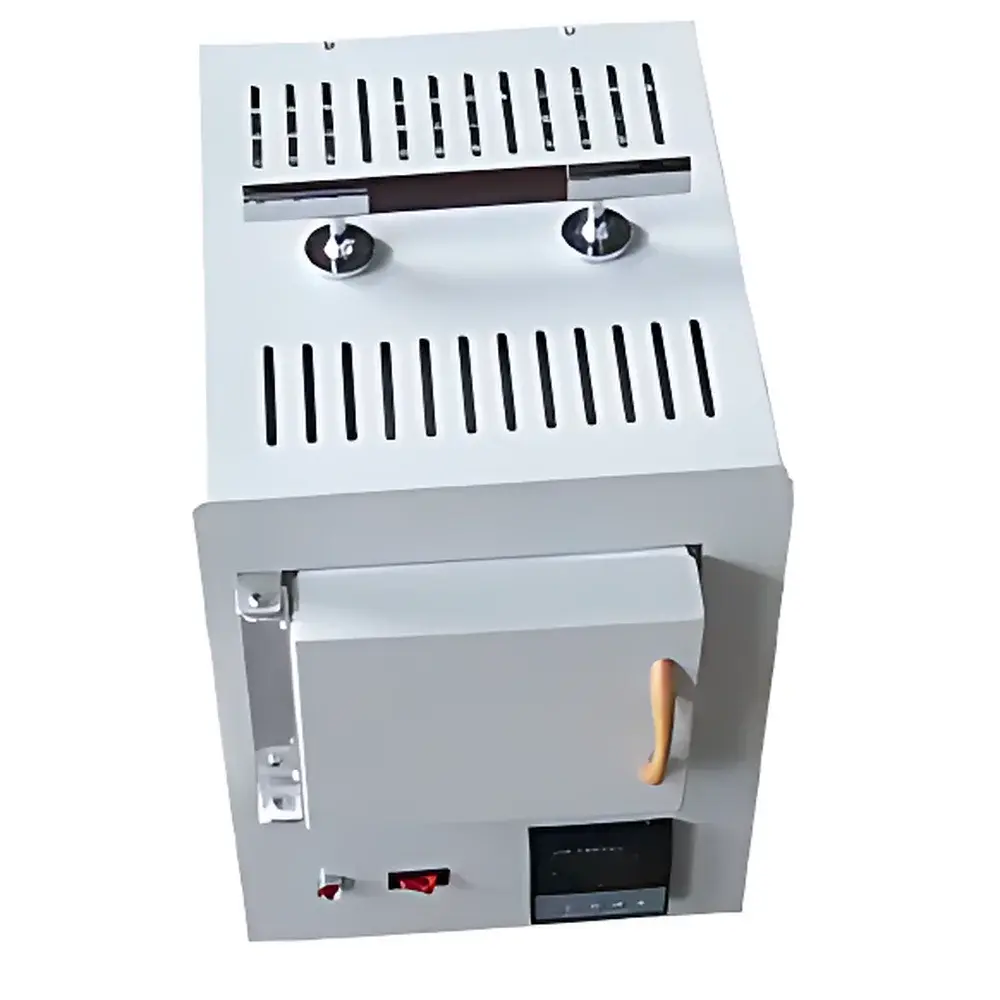
Zhuochi SX3-2-13 Ceramic Fiber Muffle Furnace
| Brand | Zhuochi |
|---|---|
| Origin | Zhejiang, China |
| Model | SX3-2-13 |
| Chamber Dimensions | 165 × 120 × 105 mm |
| Maximum Temperature | 1300 °C |
| Rated Power | 2 kW |
| Voltage | 220 V, 50 Hz |
| Heating Element | U-shaped Silicon Carbide Rods |
| Temperature Uniformity | ±1 °C |
| Programmable Controller | 30-segment LTDE PID with Ramp/Soak, Power % Output, Slope Correction, Auto Hold & Auto Shut-off |
| Weight | Approx. 48 kg (5× lighter than traditional refractory brick furnaces) |
| Typical Ramp Rate to 1000 °C | 10 min (adjustable between 1.5–12 °C/min) |
Overview
The Zhuochi SX3-2-13 Ceramic Fiber Muffle Furnace is a high-efficiency, laboratory-grade thermal processing instrument engineered for precise, repeatable heat treatment applications up to 1300 °C. Unlike conventional muffle furnaces built with dense firebrick insulation, this model employs ultra-lightweight, low-conductivity ceramic fiber modules—imported from ISO-certified suppliers—to achieve rapid thermal response and exceptional energy conservation. Its design adheres to fundamental principles of convective and radiative heat transfer within a sealed, atmosphere-controlled chamber, ensuring minimal thermal lag and high spatial temperature uniformity across the working zone. The furnace operates without requiring external gas purge or vacuum connections, making it suitable for ambient-air calcination, ashing, sintering, and pre-heating protocols in materials science, geology, environmental testing, and quality control laboratories.
Key Features
- Ultra-lightweight construction: Ceramic fiber insulation reduces total mass to ~48 kg—approximately one-fifth that of comparable brick-lined furnaces—enabling flexible benchtop placement and simplified handling.
- Rapid thermal cycling: Achieves 1000 °C in ≤10 minutes with fully adjustable ramp rates (1.5–12 °C/min), significantly reducing process downtime versus legacy systems.
- Advanced LTDE programmable controller: Supports 30-segment temperature profiles with independent ramp/soak settings, real-time power output modulation (%), slope correction for load-dependent thermal inertia, and automatic stabilization at target setpoints.
- Dual-layer housing: Outer steel casing and inner reflective aluminum foil layer minimize surface temperature rise (<55 °C at ambient), improving operator safety and reducing ambient heat load.
- U-shaped silicon carbide heating elements: Provide symmetrical radiant heating, extended service life (>3000 h at 1300 °C), and resistance to thermal shock during frequent cycling.
- High-precision temperature control: ±1 °C accuracy over full operating range (room temperature to 1300 °C), verified per ASTM E220 calibration methodology using NIST-traceable thermocouples.
Sample Compatibility & Compliance
The SX3-2-13 accommodates standard crucibles (alumina, quartz, platinum, stainless steel) and flat-bottomed sample boats up to 165 × 120 × 105 mm internal volume. It is compatible with inert, oxidizing, and mildly reducing atmospheres—though not rated for vacuum or controlled-gas operation without optional accessories. The furnace meets CE marking requirements for electrical safety (EN 61000-6-3, EN 61000-6-4) and complies with ISO 9001 manufacturing standards. Its temperature control architecture supports GLP/GMP documentation workflows through optional RS485 Modbus RTU interface for integration with LIMS or SCADA systems. While not FDA 21 CFR Part 11–certified out-of-box, audit trails and electronic signature functionality can be implemented via validated third-party software when paired with compliant data loggers.
Software & Data Management
The embedded LTDE controller features non-volatile memory retention for up to 10 user-defined programs and maintains all settings during power interruption. Real-time temperature curves and event logs (start/stop time, deviation alarms, power output history) are accessible via front-panel LCD display. For extended data capture, optional USB-to-RS485 adapters enable direct export of time-stamped CSV files to Windows-based PCs. Firmware updates are performed via secure bootloader protocol; version history and calibration coefficients are stored internally and retrievable on demand. All temperature records include timestamps traceable to system RTC (real-time clock), synchronized to UTC upon network connection where enabled.
Applications
- Residue analysis and ash content determination per AOAC 923.03, ASTM D3174, and ISO 1171.
- Thermal decomposition studies of polymers, catalysts, and pharmaceutical excipients.
- Sintering of ceramic green bodies and metal oxide powders prior to XRD or SEM characterization.
- Pre-conditioning of reference materials and calibration standards in metrology labs.
- Heat treatment of metallurgical samples for microstructural homogenization before hardness or tensile testing.
- Ignition loss measurements in soil, sludge, and fly ash per EPA Method 9040C.
FAQ
What is the maximum recommended continuous operating temperature?
The SX3-2-13 is rated for continuous operation at 1300 °C. Prolonged use above 1250 °C may accelerate silicon carbide element aging; periodic visual inspection and resistance measurement are advised.
Can this furnace be used under nitrogen or argon atmosphere?
Yes—when fitted with an optional gas inlet port and flow regulator, it supports static or low-flow inert gas purging. However, positive pressure operation beyond 0.02 MPa requires custom sealing and is not covered under standard warranty.
Is the temperature uniformity validated across the entire chamber?
Per factory verification, temperature deviation remains within ±3 °C across the usable volume at 1000 °C, measured using a 5-point thermocouple array per ISO/IEC 17025 guidelines.
Does the controller support remote monitoring via Ethernet or Wi-Fi?
No native Ethernet/Wi-Fi module is included. Remote access requires external industrial gateways supporting Modbus TCP conversion, configured per site-specific IT security policies.
What maintenance intervals are recommended for optimal performance?
Ceramic fiber insulation requires no scheduled replacement. Users should inspect heating elements quarterly for cracks or warping, clean chamber walls biannually with non-abrasive tools, and recalibrate the thermocouple annually using a certified reference source.



