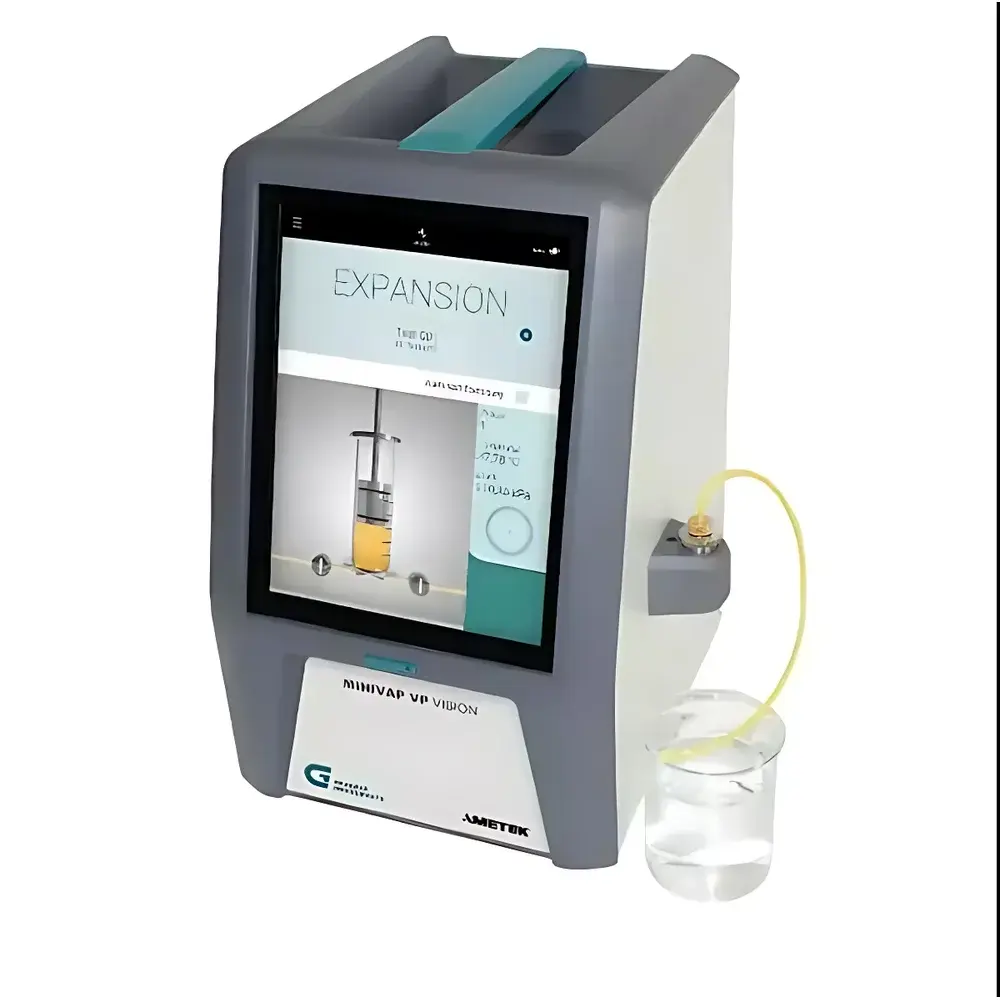
Grabner MiniVAP VPVision Crude Oil Vapor Pressure Analyzer
| Brand | Grabner |
|---|---|
| Origin | Austria |
| Manufacturer Type | Manufacturer |
| Product Category | Imported Instrument |
| Model | MiniVAP VPVision Crude Oil |
| Analysis Method | Three-Stage Expansion Method |
| Pressure Range | 0–2000 kPa |
| Temperature Range | 0–120 °C |
Overview
The Grabner MiniVAP VPVision Crude Oil Vapor Pressure Analyzer is a fully automated, portable instrument engineered for precise and reproducible determination of vapor pressure in volatile petroleum liquids—including crude oil, gasoline, jet fuel, LPG, and hydrocarbon solvents—according to internationally recognized regulatory and standard methods. It operates on the validated three-stage expansion principle, a thermodynamic equilibrium-based technique that simulates the physical behavior of volatile components under controlled temperature and volume conditions. This method enables accurate measurement of Reid Vapor Pressure (RVP), True Vapor Pressure (TVP), and Bubble Point Pressure—critical parameters for refining, transportation safety, environmental compliance, and product specification. The analyzer meets stringent requirements of EPA Method 8315A (codified in 58 Fed. Reg. 14478, March 17, 1993), and serves as the technical foundation for ASTM D6378 and D6377, as well as SH/T 0769–2005 in China. Its design supports full traceability, GLP-compliant operation, and audit-ready data integrity in regulated environments.
Key Features
- Three-stage expansion methodology with integrated piston-driven pressure equilibration for high-fidelity vapor phase sampling
- 2D-Correction™ calibration technology (273-point matrix) ensuring accuracy across the full 0–2000 kPa pressure range
- Sampling Pro™ valve system with wear-resistant piston architecture, validated for >100,000 cycles and minimal carryover between samples
- Onboard oscillation module enabling rapid phase equilibrium for crude oil and gas-oil ratio (GOR) testing
- 10-inch industrial-grade capacitive touchscreen with glove-compatible interface and application-style navigation
- Integrated temperature control system (±0.01 °C stability) eliminating need for external chillers or baths
- Centralized lubrication system—maintenance-free operation with no field disassembly required
- Fast Mode™ method combining ASTM D5191 and D5188 protocols for accelerated screening without compromising metrological rigor
- Low gas-to-liquid ratio (0.02:1 to 100:1) capability for TVP and bubble point characterization of heavy crudes
- Reusability-optimized metal filter inserts and 1 mL sample consumption per test (2.2 mL for cleaning cycle)
Sample Compatibility & Compliance
The MiniVAP VPVision accommodates a broad spectrum of petroleum matrices: light naphthas, reformulated gasoline, aviation turbine fuels (Jet A/A-1), condensates, synthetic crudes, and emulsified or waxy feedstocks. It complies with over 20 global standards, including ASTM D5191, D6377, D6378, D6897, D5188, EN 13016-1+2, IP 394/409/481, JIS K2258-2, GOST 52340, SN/T 2932, SH/T 0769, SH/T 0794, and GB/T 11509. It also satisfies REACH Annex XVII reporting obligations and GHS classification criteria for flammability hazard assessment (UN GHS Category 1–2). All firmware and calibration records adhere to FDA 21 CFR Part 11 requirements for electronic records and signatures when used in pharmaceutical or contract laboratory settings.
Software & Data Management
Cockpit™ PC software provides centralized, secure remote management of multiple MiniVAP VPVision units via encrypted LAN or VPN connections. It supports real-time instrument status monitoring, firmware updates, diagnostic logging, and configuration synchronization across geographically dispersed sites. Each test generates timestamped, user-auditable records—including raw pressure/temperature curves, equilibrium diagnostics, and metadata (operator ID, method version, calibration ID)—stored locally (>100,000 results) and exportable in CSV or PDF formats with embedded graphs. Role-based access control (RBAC) enforces user privilege tiers (Admin, Analyst, Viewer), while full backup/restore functionality preserves calibration history, method templates, and audit trails compliant with ISO/IEC 17025 and GLP Annex 3.
Applications
- Crude assay laboratories: TVP and bubble point determination for pipeline transfer specifications and custody transfer reconciliation
- Refinery process control: Real-time RVP monitoring of stabilized naphtha, reformate, and alkylate streams
- Marine bunker fuel quality assurance: Vapor pressure verification against ISO 8217 and MARPOL Annex VI limits
- Hazard classification labs: Flammability hazard assessment per UN TDG, GHS, and CLP Regulation
- Contract testing facilities: Multi-method validation studies supporting ASTM round-robin interlaboratory programs
- Field deployment units: Mobile labs operating in arctic, desert, or offshore environments (certified per EN 60068-2-1, -2-14, -2-6, -2-27)
FAQ
What vapor pressure standards does the MiniVAP VPVision support out-of-the-box?
It ships preloaded with ASTM D5191, D6377, D6378, D6897, D5188, EN 13016-1+2, IP 394, and SH/T 0769 methods—fully configurable via touchscreen or Cockpit™.
Can it measure true vapor pressure (TVP) of crude oil?
Yes—using low gas-to-liquid ratios and extrapolated temperature-pressure curves, it determines TVP per ASTM D6377 Annex A1 and API RP 2552.
Is the instrument suitable for use in hazardous areas?
It is not intrinsically safe certified; however, its robust mechanical design and IP-rated enclosure allow safe operation in non-classified zones adjacent to Class I Div 2 areas when installed per local electrical codes.
How is calibration traceability maintained?
Each unit includes NIST-traceable pressure and temperature calibration certificates, with onboard 2D-Correction™ matrix referencing primary standards at 273 discrete points across the operational envelope.
Does it require vacuum pump infrastructure?
No—its sealed, piston-driven expansion chamber eliminates dependency on external vacuum sources or purge gases, reducing footprint and operational complexity.