
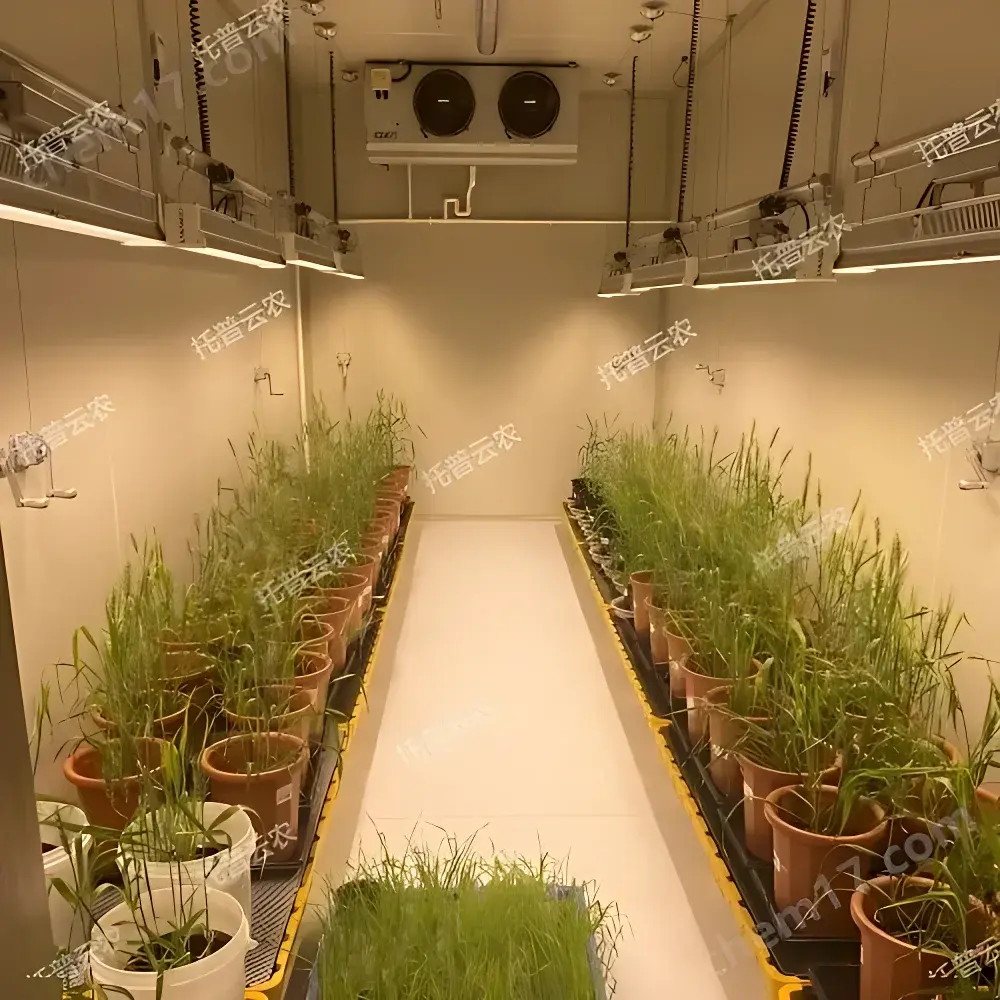
Top Cloud-agri Vernalization Chamber Model VC-Series
| Brand | Top Cloud-agri |
|---|---|
| Origin | Zhejiang, China |
| Manufacturer Type | Direct Manufacturer |
| Product Origin | Domestic (China) |
| Model | VC-Series |
| Pricing | Upon Request |
| Temperature Control Range | –10 to 35 °C |
| Humidity Control Range | ≤80 %RH |
| Light Intensity Options | 0–2000 / 0–5000 / 0–10000 lux (customizable) |
| Lighting System | High-efficiency full-spectrum plant growth lamps |
| Air Exchange | Motorized fresh-air intake with CO₂ concentration modulation |
| Remote Control | IoT-enabled cloud platform with mobile app interface |
| Energy Efficiency | Integrated thermal insulation, variable-speed fan control, and LED lighting optimization |
Overview
The Top Cloud-agri VC-Series Vernalization Chamber is a purpose-engineered environmental simulation system designed specifically for controlled cold exposure of photoperiod- and temperature-sensitive plant species. It operates on the physiological principle of vernalization—the epigenetic process by which prolonged exposure to low, non-freezing temperatures induces floral transition in obligate or facultative winter annuals. Unlike general-purpose growth chambers, the VC-Series delivers precise, stable, and reproducible sub-zero to mild-cool thermal regimes (–10 to 35 °C), enabling researchers to replicate natural overwintering conditions under laboratory-controlled settings. Its architecture integrates thermodynamic stability, spectral fidelity, and gas-phase regulation—critical parameters for studying gene expression dynamics (e.g., VRN1, VRN2, FT homologs), chromatin remodeling, and developmental phase transitions in cereals, Brassicaceae, and other vernalization-responsive taxa.
Key Features
- Programmable dual-stage temperature control with ±0.3 °C stability across the full –10 to 35 °C range, supported by PID-regulated refrigeration and resistive heating modules;
- Relative humidity maintenance up to 80 %RH via ultrasonic humidification and condensate recovery, with real-time dew-point monitoring;
- Modular full-spectrum LED lighting system delivering uniform irradiance (0–10,000 lux, selectable intensity tiers), with spectral output optimized for phytochrome photoequilibrium (red:far-red ratio ≥1.8) and cryptochrome activation;
- Multi-tier adjustable shelving with independent per-layer lighting control, stainless-steel or powder-coated aluminum frame options, and vertical clearance from 250 mm to 600 mm per tier;
- Intelligent ventilation subsystem featuring programmable air exchange rates (0.5–6 air changes per hour), integrated CO₂ sensors (400–2000 ppm range), and particulate filtration (HEPA-grade prefilter);
- Cloud-connected control interface compliant with MQTT 3.1.1 and HTTPS RESTful API protocols, supporting remote parameter scheduling, alarm notifications (SMS/email), and audit-trail logging;
- Energy-conserving design incorporating vacuum-insulated panels (VIPs), brushless DC circulation fans, and adaptive lighting dimming based on occupancy and photoperiod phase.
Sample Compatibility & Compliance
The VC-Series accommodates standard plant growth vessels—including Petri dishes, Magenta boxes, hydroponic trays, and 10-L pots—without spatial interference. Its chamber volume (standard configurations: 300 L, 600 L, 1200 L) supports both seedling-stage vernalization assays and mature vegetative-stage cold acclimation studies. The system conforms to ISO 17025 calibration traceability requirements for environmental monitoring instruments and meets mechanical safety standards per IEC 61000-6-2 (EMC immunity) and IEC 60335-1 (household and similar electrical appliances). While not certified for GLP/GMP production environments, its data integrity features—including time-stamped parameter logs, user-access controls, and exportable CSV/JSON datasets—support compliance with OECD Test Guidelines 208 (Terrestrial Plant Toxicity) and ASTM E2927-22 (Standard Practice for Environmental Chambers Used in Plant Science).
Software & Data Management
The embedded firmware runs on a Linux-based real-time OS with dual redundancy: local touchscreen HMI (7″ capacitive display) and cloud-hosted dashboard accessible via iOS/Android apps or desktop browsers. All environmental setpoints, sensor readings, and actuator states are timestamped with NTP-synchronized UTC and stored locally on encrypted microSD (72-hour buffer) and remotely on AWS S3 (configurable retention: 3–24 months). Audit trails include operator ID, parameter change history, and system event codes (e.g., “THERMAL_OVERLOAD_WARNING”, “LIGHT_ARRAY_FAULT”). Data exports support FAIR principles (Findable, Accessible, Interoperable, Reusable) and integrate natively with common lab informatics platforms including LabArchives ELN and Thermo Fisher SampleManager LIMS via ODBC drivers.
Applications
- Vernalization requirement validation for breeding lines of Triticum aestivum, Raphanus sativus, Brassica napus, and Avena sativa;
- Quantitative assessment of cold-induced gene expression kinetics using qRT-PCR or RNA-seq workflows;
- Phenotyping of frost tolerance and deacclimation responses under controlled warming ramps;
- Testing of epigenetic inheritance patterns across generations following defined cold exposures;
- Calibration and validation of field-based chilling accumulation models (e.g., Utah Chill Units, Dynamic Model) under replicated lab conditions;
- Supporting regulatory submissions for novel trait registration where vernalization response is a key phenotypic endpoint (e.g., USDA APHIS, EFSA GMO dossiers).
FAQ
What is the minimum achievable temperature, and how is sub-zero stability maintained without ice accumulation?
The chamber achieves –10 °C using a cascade refrigeration system with R290/R744 dual-circuit design; frost formation is mitigated via periodic hot-gas defrost cycles synchronized with humidity setpoint modulation.
Can light spectra be customized beyond standard white + red/blue LEDs?
Yes—OEM spectral tuning is available upon request, including narrowband UV-A (365 nm), far-red (730 nm), and green-gap (525 nm) supplementation for advanced photomorphogenesis studies.
Is the system compatible with third-party data loggers or SCADA integration?
All analog/digital I/O ports (4–20 mA, 0–10 V, RS-485 Modbus RTU) are exposed via terminal block; detailed protocol documentation and register maps are provided with purchase.
How does the IoT platform ensure data security and GDPR/CCPA compliance?
Data transmission uses TLS 1.3 encryption; user accounts enforce role-based access control (RBAC); personal data is pseudonymized at ingestion, and EU-hosted deployments are available upon contractual agreement.
What maintenance intervals are recommended for long-term operational reliability?
Compressor oil and refrigerant charge verification every 24 months; LED driver calibration and sensor drift validation annually; HEPA filter replacement every 6 months under continuous operation.




