
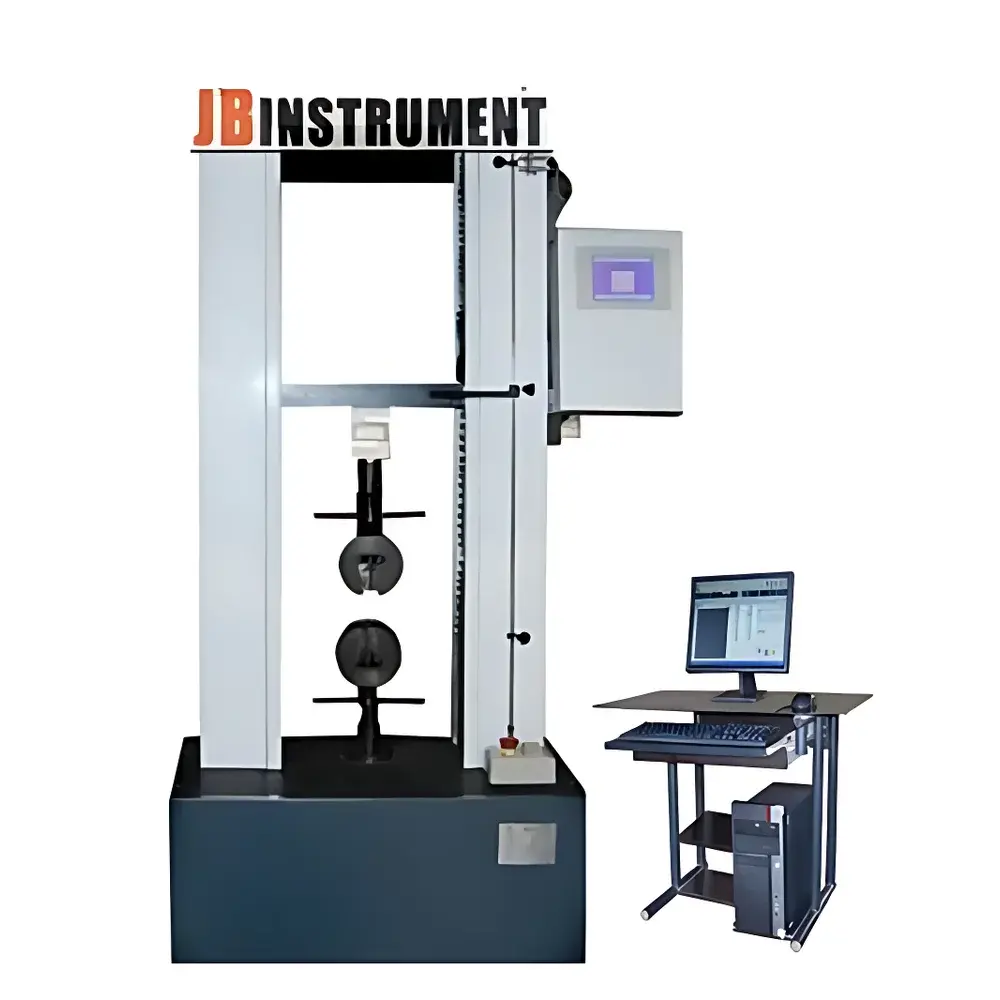
Jiubin JB-120B Electronic Universal Testing Machine
| Brand | Jiubin |
|---|---|
| Origin | Shanghai, China |
| Manufacturer Type | Authorized Distributor |
| Country of Origin | China |
| Model | JB-120B |
| Instrument Type | Electronic Universal Testing Machine |
| Maximum Test Load | 100 kN |
| Load Accuracy | ±0.05% |
| Displacement Resolution | 0.001 mm |
| Speed Range | 0.01–500 mm/min |
| Effective Stroke | ~1000 mm |
| Control System | Full-digital triple-closed-loop (force, displacement, strain) |
| Compliance | ISO 7500-1, ASTM E4, ASTM E8/E21, GB/T 228.1 |
| Power Supply | 380 V AC |
| Weight | 780 kg |
| Dimensions (W×D×H) | 1200 × 650 × 1800 mm |
Overview
The Jiubin JB-120B Electronic Universal Testing Machine is an electromechanically integrated materials testing system engineered for precision mechanical characterization of metallic and non-metallic specimens under tension, compression, bending, peel, shear, and flexural loading conditions. It operates on the principle of servo-controlled force application via a high-rigidity load frame, coupled with real-time digital feedback from calibrated load cells, optical encoders, and extensometers. Designed to meet international metrological standards—including ISO 7500-1 (static calibration of force-proving instruments), ASTM E4 (verification of force-measuring systems), and ASTM E8/E21 (tensile testing of metallic materials)—the JB-120B delivers traceable, repeatable, and auditable test data suitable for R&D laboratories, quality control departments, and third-party certification facilities. Its modular architecture supports seamless integration of optional accessories—such as environmental chambers, video extensometry, or high-temperature grips—without hardware modification.
Key Features
- Triple-closed-loop digital control system based on adaptive neural PID algorithms, enabling synchronized regulation of force, displacement, and strain with automatic inter-loop switching and zero-transition shock.
- High-resolution data acquisition: 1/300,000 internal resolution with ±0.05% full-scale load accuracy and ±0.005% displacement linearity (per JIS B 7741).
- Dual-display operation mode: Independent control and monitoring via industrial-grade touchscreen panel and Windows-based PC software—both capable of initiating, pausing, and finalizing tests without cross-dependency.
- Motorized crosshead drive powered by a Taiwan-sourced AC servo motor and matched frequency inverter, delivering smooth, programmable speed profiles from 0.01 to 500 mm/min.
- Standard USB 2.0 interfaces for all peripheral connections—load cell, encoder, grip actuation, and printer—ensuring electromagnetic compatibility and field-serviceable modularity.
- Comprehensive safety architecture: dual mechanical limit switches, overload emergency stop, leakage current protection, auto-return-to-initial-position post-test, and programmable break-point recovery.
- User-configurable decimal precision (2 or 3 digits), multi-unit support (N, kN, lbf, kgf, g), and password-protected parameter editing to maintain GLP/GMP integrity.
Sample Compatibility & Compliance
The JB-120B accommodates a broad spectrum of specimen geometries and material classes—including ductile metals (e.g., stainless steel, aluminum alloys, bearing steels), brittle ceramics, polymeric films, elastomeric compounds, fiber-reinforced composites, geotextiles, adhesives, and biomedical polymers. Standard test configurations comply with ASTM D638 (tensile properties of plastics), ASTM D790 (flexural properties), ISO 527-2, ISO 178, GB/T 1040.1–1040.5, and EN 10002-1. Optional fixtures—including pneumatic wedge grips, hydraulic vise clamps, 90°/180° peel fixtures, and custom-designed tooling—enable validation against industry-specific protocols such as UL 94 (flammability), IPC-TM-650 (PCB mechanical reliability), or ISO 11927 (fire performance). All hardware and firmware are designed to support audit-ready documentation per FDA 21 CFR Part 11 requirements when paired with validated software configuration.
Software & Data Management
The JB-120B runs on a native Windows application supporting bilingual (English/Chinese) UI, automated report generation, and structured data export (CSV, XML, PDF). The software implements real-time curve overlay, hysteresis loop analysis, yield point detection via offset methods (0.2% strain), modulus calculation using initial linear region fitting, and user-defined breakpoint logic (e.g., “stop at 5% elongation” or “hold at 80% max load for 60 s”). All test parameters—including operator ID, sample ID, environmental notes, and calibration timestamps—are embedded into metadata headers. Data backups are stored in configurable local directories with SHA-256 checksum verification; historical test records remain accessible for retrospective re-analysis, including dynamic curve replay and comparative statistical summaries (mean, SD, CV%). Audit trails log every parameter change, test execution, and export event—fully compliant with ISO/IEC 17025 documentation requirements.
Applications
Typical use cases include mechanical validation of structural components (e.g., automotive fasteners, aerospace sheet metal, medical device substrates), regulatory submission testing for CE/UL/FDA clearance, incoming raw material inspection per supplier agreements, failure mode analysis (fractography correlation), and process optimization studies (e.g., heat treatment effect on tensile strength). In academic settings, the system supports graduate-level instruction in solid mechanics, constitutive modeling, and fracture mechanics—particularly when combined with digital image correlation (DIC) add-ons. Industrial users routinely deploy it for batch release testing of polymer extrusions, wire rope certifications, textile tear resistance, and packaging seal integrity assessments—all traceable to NIST-traceable reference standards.
FAQ
What standards does the JB-120B comply with for calibration and verification?
It conforms to ISO 7500-1 (Class 1), ASTM E4, and GB/T 16825.1, with factory calibration certificates issued against accredited reference machines.
Can the system be upgraded to support high-temperature or sub-zero testing?
Yes—via optional environmental chamber integration (−70°C to +300°C), requiring compatible high-temp load cells and extensometers.
Is the software validated for regulated environments (e.g., pharmaceutical QC)?
The base software supports 21 CFR Part 11 compliance when installed on locked-down domain-joined workstations with electronic signatures and role-based access control.
What is the warranty coverage and service response time?
Standard 24-month parts-and-labor warranty; onsite technical support available within 5 business days in major Asia-Pacific metropolitan areas.
Does the JB-120B support automated test sequence programming?
Yes—the software includes macro scripting (VBScript-compatible) for multi-step protocols, such as cyclic loading, creep hold, or staircase fatigue pre-conditioning.



