
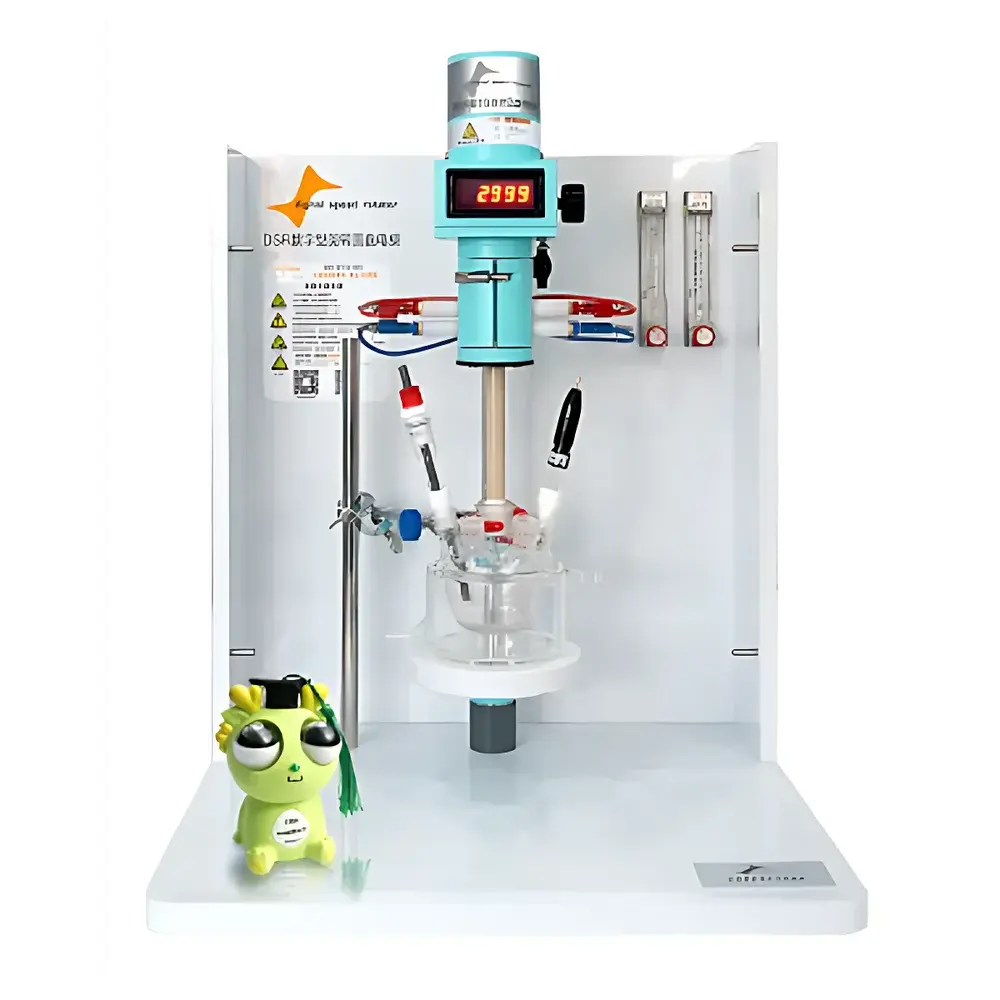
DC-Energies DSR-M Rotating Disk Electrode (RDE) and Rotating Ring-Disk Electrode (RRDE) System
| Brand | DC-Energies |
|---|---|
| Origin | Hubei, China |
| Manufacturer Type | Authorized Distributor |
| Model | DSR-M |
| Rotation Speed Range | 0–10,000 rpm |
| Motor Power | 20 W |
| Disk Electrode Material | Glassy Carbon |
| Ring Electrode Material | Platinum |
| Disk Diameter | 5.61 mm |
| Ring Inner Diameter | 6.25 mm |
| Ring Outer Diameter | 7.92 mm |
| Ring-Disk Gap | ≤320 µm |
| Collection Efficiency | 37% |
| Disk-Ring Dimensional Tolerance | ±0.01 mm |
| Electrode Housing Material | PTFE |
| Rotating Shaft Length | 170 mm |
| Shaft Outer Diameter | 15 mm |
| Base Material | Polypropylene |
| Signal Interface | Analog voltage input/output (0–10 V), TTL-compatible speed control |
| Compliance | Designed for inert-atmosphere operation (glovebox-compatible), explosion-resistant enclosure |
Overview
The DC-Energies DSR-M Rotating Disk Electrode (RDE) and Rotating Ring-Disk Electrode (RRDE) System is an engineered electrochemical hydrodynamic measurement platform designed for quantitative kinetic and mechanistic studies in heterogeneous electrocatalysis. Based on the principles of controlled-convection electrochemistry, the DSR-M enables precise modulation of mass transport rates at electrode surfaces via rotational hydrodynamics—governed by the Levich and Koutecký–Levich equations. Its dual-mode capability supports both RDE configuration for diffusion-controlled current analysis and RRDE operation for real-time detection of short-lived intermediates (e.g., H₂O₂ during ORR, O₂ during CO₂RR). The system integrates seamlessly with commercial potentiostats and waveform generators, supporting external analog or digital speed modulation—including sinusoidal, square, and arbitrary waveforms—for transient hydrodynamic perturbation experiments. All mechanical and electrical components are constructed to minimize contact resistance (<1 mΩ typical), electromagnetic interference, and thermal drift, ensuring high reproducibility across repeated scans and long-duration stability tests.
Key Features
- Wide-speed range operation: 0–10,000 rpm with <1% speed accuracy at 1 rpm (calibrated output: 1 mV per rpm)
- Low-noise silver-plated carbon brush interface ensures stable current collection and extended service life (>10⁶ rotations under standard load)
- Modular, glovebox-compatible design: detachable rotating shaft (170 mm length, 15 mm OD, internal thread M4) and PP base enable safe handling in inert or hazardous atmospheres
- Integrated analog I/O: 0–10 V speed command input; tachometric voltage output for synchronization with oscilloscopes, DAQ systems, or auxiliary controllers
- Explosion-resistant housing compliant with IEC 60079-0 general requirements for non-sparking enclosures in laboratory environments
- Interchangeable disk electrodes via U-CUP mounting system—supports user-defined materials (e.g., Pt, Au, Ni, NiFeOx) and facilitates post-reaction product capture for offline analysis
- High-precision RRDE geometry: disk (5.61 mm Ø, glassy carbon), ring (Pt, 6.25–7.92 mm ID/OD), inter-electrode gap ≤320 µm, dimensional tolerance ±0.01 mm, theoretical collection efficiency 37%
Sample Compatibility & Compliance
The DSR-M accommodates standard three-electrode electrochemical cells (e.g., 50–200 mL volume) and interfaces directly with common cell stands, Luggin capillaries, and reference electrode holders. Its PTFE-insulated electrode head and polypropylene base resist corrosion from aqueous electrolytes (pH 0–14), organic solvents (acetonitrile, DMF, THF), and molten salt media. The system meets functional safety expectations for Class II laboratory equipment per IEC 61010-1 and is compatible with GLP-compliant workflows when paired with 21 CFR Part 11–enabled potentiostats (e.g., BioLogic SP-300, Pine Research WaveDriver). While not certified to ATEX or UL standards, its intrinsic spark mitigation and low-energy drive architecture support use in nitrogen- or argon-purged gloveboxes (O₂ < 1 ppm) for air-sensitive catalysis research.
Software & Data Management
The DSR-M operates as a hardware-peripheral device—no proprietary software required. Speed control and monitoring integrate natively with major electrochemical platforms (Gamry Framework, EC-Lab, NOVA) via analog voltage signaling. For time-resolved hydrodynamic experiments, users may log tachometer output alongside current/potential data using third-party DAQ systems (e.g., National Instruments USB-6211) or oscilloscopes with CSV export. All mechanical specifications—including disk/ring dimensions, gap tolerances, and collection efficiency—are traceable to NIST-traceable calibration reports supplied with each unit. Firmware-free architecture eliminates version lock-in and ensures long-term compatibility with evolving instrumentation ecosystems.
Applications
- Oxygen reduction reaction (ORR) kinetics and peroxide yield quantification in PEMFC catalyst screening
- Oxygen evolution reaction (OER) and hydrogen evolution reaction (HER) mechanism elucidation under rotating conditions
- CO₂ electroreduction (CO2RR) intermediate trapping and Faradaic efficiency validation via ring detection
- Electrocatalyst stability assessment through accelerated degradation protocols (ADT) with periodic rotation-rate stepping
- Corrosion science: determination of critical pitting potentials and passivation behavior in chloride-containing media
- Electroanalytical method development for redox-active species with coupled homogeneous chemical steps (EC’, ECE mechanisms)
- Fundamental studies of mass transport limitations in battery electrode slurries and solid-electrolyte interphases (SEI)
FAQ
Is the DSR-M compatible with my existing potentiostat?
Yes—the system accepts standard 0–10 V analog speed commands and outputs a proportional tachometer signal, enabling bidirectional integration with all major potentiostats featuring analog I/O ports.
Can I replace the disk electrode with custom materials?
Yes—U-CUP modular mounting allows rapid exchange of disk inserts (M4 thread); users may fabricate or source disks in Pt, Au, Ni, IrO₂, or doped metal oxides.
What is the maximum recommended operating temperature?
The PTFE housing and silver-carbon brush assembly are rated for continuous operation up to 60°C ambient; for elevated-temperature studies, optional high-temp shaft seals and ceramic insulators are available upon request.
Does the system include calibration documentation?
Each unit ships with a factory calibration certificate verifying rotational accuracy, disk/ring dimensional metrology (CMM-measured), and collection efficiency verification against standardized ferrocyanide/ferricyanide redox couples.
Is technical support available for experimental protocol development?
DC-Energies provides application engineering support—including Koutecký–Levich data fitting templates, RRDE collection efficiency correction guides, and glovebox integration checklists—as part of the standard installation and training package.




