
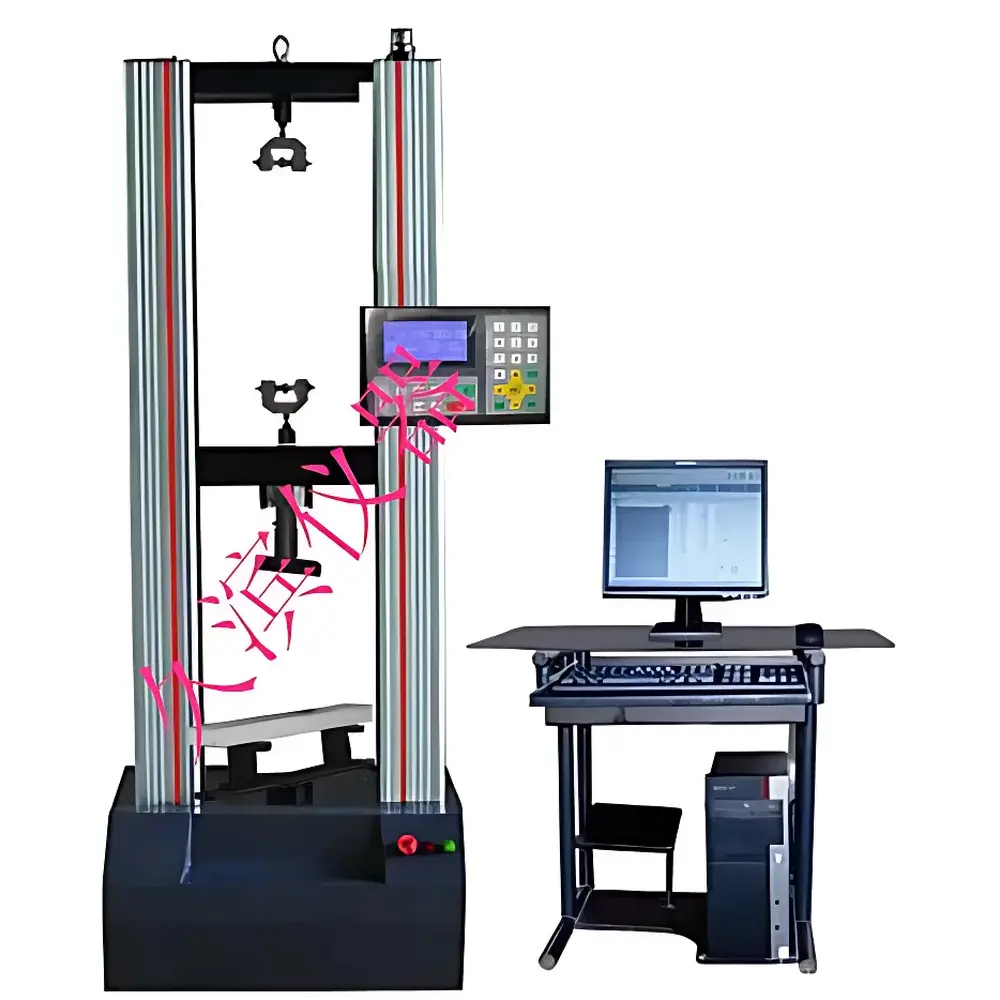
Jiubin JB-117A-B Universal Bending Strength Tester for Wood-Plastic Composites (WPC) and Engineered Wood Panels
| Brand | Jiubin |
|---|---|
| Model | JB-117A-B |
| Origin | Shanghai, China |
| Load Capacity | 20 kN / 50 kN (selectable) |
| Effective Test Height | 1000 mm |
| Effective Test Width | 380 mm (customizable) |
| Force Accuracy | ±0.5% FS |
| Displacement Resolution | 0.001 mm |
| Speed Range | 0.001–500 mm/min |
| Force Resolution | 1/500,000 |
| Power Supply | AC 220 V, 50 Hz |
| Machine Weight | ~350 kg |
| Load Cell | Transcell (USA) |
| Actuator | Panasonic AC Servo Motor (Japan) |
| Lead Screw | ABBA Precision Ball Screw (Taiwan) |
| Dust Protection | ABBA Telescopic Dust Cover (Taiwan) |
| Control Interface | Dual-mode — LCD Touchscreen + PC-based Software |
Overview
The Jiubin JB-117A-B Universal Bending Strength Tester is a high-precision electromechanical testing system engineered for standardized mechanical evaluation of wood-plastic composites (WPC), laminated veneer lumber (LVL), medium-density fiberboard (MDF), particleboard, plywood, and other engineered wood-based panels. It operates on the principle of three-point or four-point bending per ASTM D1037, ISO 16978, EN 310, and GB/T 17657—applying controlled quasi-static load via a servo-driven crosshead to determine critical structural parameters including modulus of rupture (MOR), modulus of elasticity (MOE), surface bonding strength, internal bond strength, and tensile strength perpendicular to the plane. The system integrates a closed-loop force-displacement control architecture with real-time digital signal processing, enabling traceable, repeatable, and compliant mechanical characterization under laboratory or quality assurance environments.
Key Features
- High-fidelity dual-control interface: Synchronized operation via industrial-grade LCD touchscreen and Windows-based PC software—ensuring redundancy, accessibility, and audit-ready session logging.
- Modular load frame with interchangeable load cells (20 kN / 50 kN), supporting wide-range testing from thin decorative veneers to structural WPC decking profiles.
- Panasonic AC servo motor coupled with ABBA precision ground ball screw and anti-backlash preloading—delivering sub-micron positioning repeatability and low-noise, high-stiffness actuation.
- Transcell-certified load cell (USA-manufactured) with integrated temperature compensation and factory calibration traceability to NIST standards.
- Automatic range switching during test execution—seamlessly transitions between high-sensitivity (e.g., surface bond measurement) and high-load (e.g., static bending failure) regimes without manual intervention.
- Comprehensive safety architecture: Overload cut-off, over-speed protection, limit switch hard stops, voltage/frequency monitoring, and ABBA telescopic dust shielding to extend lead screw service life beyond 100,000 cycles.
- Real-time dynamic visualization of force–displacement curves, elastic region slope calculation, yield point detection, and post-yield plastic deformation tracking.
Sample Compatibility & Compliance
The JB-117A-B accommodates specimens up to 1000 mm in height and 380 mm in width—compatible with standard specimen dimensions defined in ASTM D1037 (for WPC), ISO 16978 (for structural timber products), EN 310 (for board flexural properties), and GB/T 17657 (Chinese national standard for人造板). Support fixtures include adjustable roller supports for three-point bending, fixed-end clamps for four-point configurations, and auxiliary jigs for edge-wise tensile or surface shear tests. All hardware and firmware comply with CE electromagnetic compatibility (EMC) directives and meet mechanical safety requirements per ISO 12100. Data acquisition and reporting functions are designed to support GLP/GMP-aligned workflows, including user authentication, electronic signature readiness, and audit trail generation per FDA 21 CFR Part 11 guidelines when deployed with validated software configuration.
Software & Data Management
The proprietary Jiubin TestSuite™ software is developed in-house using C#/.NET framework and features full source code availability—enabling seamless customization for industry-specific protocols (e.g., JIS A 5908, DIN EN 312) or internal QA procedures. It provides guided test setup wizards, automated parameter derivation (MOR, MOE, IB, SB), multi-curve overlay comparison, statistical batch analysis (mean, SD, CV%), and customizable report templates exportable as PDF, Excel, or XML. Raw data files (.jts) retain timestamped metadata—including operator ID, environmental conditions (optional sensor integration), calibration history, and instrument configuration snapshots—to ensure full data integrity and regulatory traceability. Software updates—including new standard implementations and bug fixes—are provided free of charge for the lifetime of the instrument.
Applications
This system serves as a core metrology platform across R&D laboratories, third-party certification bodies (e.g., CNAS-accredited labs), and in-house QC departments of WPC extruders, composite panel manufacturers, and building material distributors. Typical use cases include: qualification of recycled-content WPC formulations under varying moisture conditioning; comparative MOE/MOR assessment of co-extruded vs. mono-layer decking profiles; validation of adhesive performance in hybrid bamboo–polypropylene laminates; routine surveillance testing per ISO 13967 for structural floor panel compliance; and root-cause analysis of premature flexural failure in outdoor cladding applications. Its adaptability to non-standard geometries (via custom fixture design) also supports emerging applications in bio-based hybrid composites and fire-retardant treated panels.
FAQ
Does the JB-117A-B support ASTM D1037-compliant WPC bending testing?
Yes—it includes preconfigured test methods, fixture geometry definitions, and calculation algorithms aligned with Section 7.2 (Flexural Properties) of ASTM D1037-22.
Can the software generate reports compliant with ISO/IEC 17025 documentation requirements?
Yes—test reports include instrument identification, calibration status, environmental notes, uncertainty estimates (per GUM), and digitally signed operator verification fields.
Is remote diagnostics and software update capability available?
Yes—secure remote access (with client authorization) enables firmware health checks, log file retrieval, and over-the-air software deployment.
What is the recommended maintenance interval for the ABBA ball screw and dust cover?
Inspection every 6 months; lubrication and seal integrity check per ABBA TS-800 technical bulletin—no replacement required before 5 years under typical lab usage.
Can the system be integrated into a LIMS environment?
Yes—via optional OPC UA or RESTful API module (available upon request), supporting bidirectional data exchange with major laboratory information management systems.



