
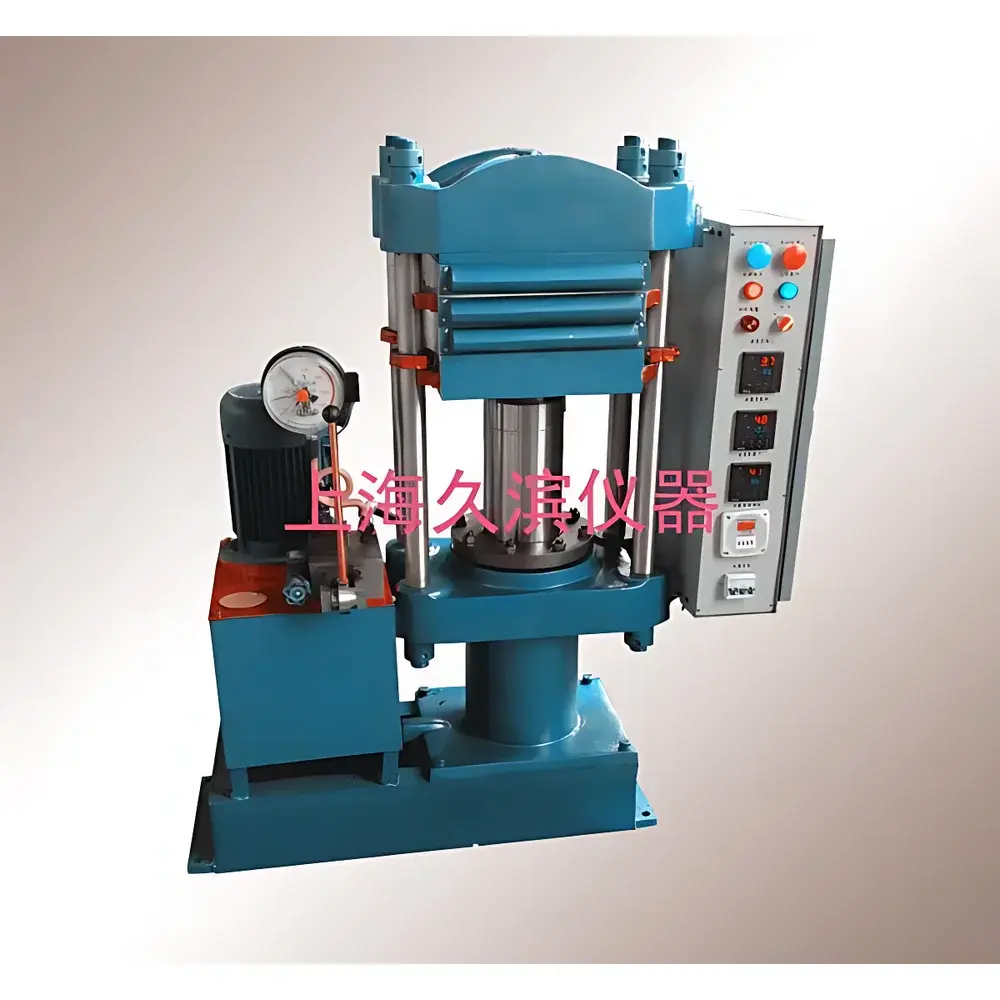
JB-25T-2 Semi-Automatic平板 Vulcanizing Press
| Brand | Jiubin Instruments |
|---|---|
| Origin | Shanghai, China |
| Model | JB-25T-2 |
| Type | Semi-Automatic Two-Platen Hydraulic Vulcanizing Press |
| Nominal Clamping Force | 250 kN |
| Platen Size | 300 mm × 300 mm |
| Heating Method | Electric Cartridge Heaters |
| Temperature Control Range | Ambient to 200 °C |
| Temperature Uniformity | ±1.5 °C across platen surface |
| Cycle Time (typical) | 3–8 min (dependent on compound and thickness) |
| Control System | PLC with HMI touchscreen interface |
| Safety Compliance | CE-marked per EN 692:2014 (mechanical presses), ISO 13857 guarding requirements |
Overview
The JB-25T-2 Semi-Automatic Two-Platen Vulcanizing Press is an industrial-grade laboratory press engineered for precise, repeatable vulcanization of rubber, elastomer, and thermoset polymer compounds under controlled temperature, pressure, and time conditions. Based on the fundamental principle of compression molding—where uncured material is placed between heated platens and subjected to sustained hydraulic clamping force—the JB-25T-2 delivers consistent crosslinking kinetics essential for R&D validation, quality control batch testing, and ASTM D3182/D5300-compliant sample preparation. Its dual-platen architecture ensures uniform heat transfer and minimal thermal gradient across the 300 mm × 300 mm working area, enabling reliable fabrication of standardized test specimens—including dumbbells (ASTM D412), tensile bars (ISO 37), hardness pads (ASTM D2240), and die-cut sheets for dynamic mechanical analysis.
Key Features
- Hydraulic clamping system delivering a nominal force of 250 kN with real-time pressure feedback and adjustable hold-pressure maintenance
- Electric cartridge heating elements embedded within both upper and lower platens, enabling rapid thermal stabilization and minimizing overshoot
- High-resolution PID temperature controller (±0.5 °C setpoint accuracy) with independent zone monitoring and auto-tuning capability
- PLC-based control unit with 7-inch color HMI touchscreen interface supporting multi-step curing profiles (preheat → close → cure → vent → post-cure → release)
- Mechanically interlocked safety guards and dual-channel emergency stop circuitry compliant with EN ISO 13850 and EN 692:2014
- Stainless-steel platen surfaces with precision-ground flatness (≤10 µm deviation over full area) to ensure specimen dimensional fidelity
- Integrated mold alignment pins and T-slot grooves compatible with standard ISO 2720/ASTM D3182 mold bases
Sample Compatibility & Compliance
The JB-25T-2 accommodates a broad range of elastomeric formulations—including natural rubber (NR), styrene-butadiene rubber (SBR), ethylene propylene diene monomer (EPDM), silicone (VMQ), fluorocarbon (FKM), and thermoplastic vulcanizates (TPVs)—as well as phenolic resins and epoxy pre-pregs. Specimen thickness ranges from 0.5 mm to 12 mm, with optimal performance observed between 2–6 mm for conventional sulfur-cured systems. All operational parameters—including temperature ramp rate, dwell time, and pressure profile—are fully configurable to align with ISO 22865 (rubber vulcanization characterization), ASTM D5300 (curing cycle specification), and internal GLP protocols. The system supports audit-ready documentation when paired with optional RS-232/RS-485 data logging modules compliant with FDA 21 CFR Part 11 requirements for electronic records.
Software & Data Management
While the base JB-25T-2 operates via standalone HMI control, optional Ethernet-enabled firmware upgrades allow integration into centralized lab management systems. Real-time process data—including platen temperature (upper/lower), actual clamping force, elapsed cycle time, and alarm status—is timestamped and exportable in CSV or XML format. Historical run logs are retained onboard for ≥10,000 cycles and support traceability down to individual operator ID (when configured with external LDAP authentication). For regulated environments, optional software packages provide electronic signature workflows, change-control tracking, and automated report generation aligned with ISO/IEC 17025 clause 7.8 and ICH Q7 Annex 19 requirements.
Applications
- Rubber compound development: screening accelerator systems, filler dispersion effects, and scorch safety margins
- Quality assurance of incoming raw materials (e.g., compounded rubber sheets, masterbatches)
- Preparation of test specimens for tensile, tear, hardness, compression set, and rebound resilience testing
- Small-batch prototyping of molded seals, gaskets, dampers, and automotive NVH components
- Educational use in polymer engineering laboratories for hands-on instruction in vulcanization kinetics and rheological behavior
- Validation of cure schedules prior to transfer to production-scale hydraulic or autoclave systems
FAQ
What is the maximum recommended mold height for the JB-25T-2?
The maximum open-height clearance is 180 mm; molds exceeding 160 mm in total height require custom platen spacers and must be evaluated for thermal mass impact on cycle time.
Does the press support vacuum-assisted degassing during closure?
No—vacuum functionality is not integrated; however, optional external vacuum chambers (e.g., VACU-BOX series) can be synchronized via dry-contact I/O signals.
Can the temperature profile be programmed with multiple ramps and holds?
Yes—the HMI supports up to 8 programmable segments per cycle, including ramp rates (°C/min), dwell times (s), and conditional logic triggers.
Is calibration certification included with shipment?
A factory-issued NIST-traceable temperature calibration report (per ASTM E74) is provided; force calibration requires third-party verification using certified load cells.
What maintenance intervals are recommended for hydraulic oil and heater elements?
Hydraulic oil replacement every 2,000 operating hours; cartridge heaters inspected annually for resistance drift (>5% deviation from nominal indicates replacement).



