
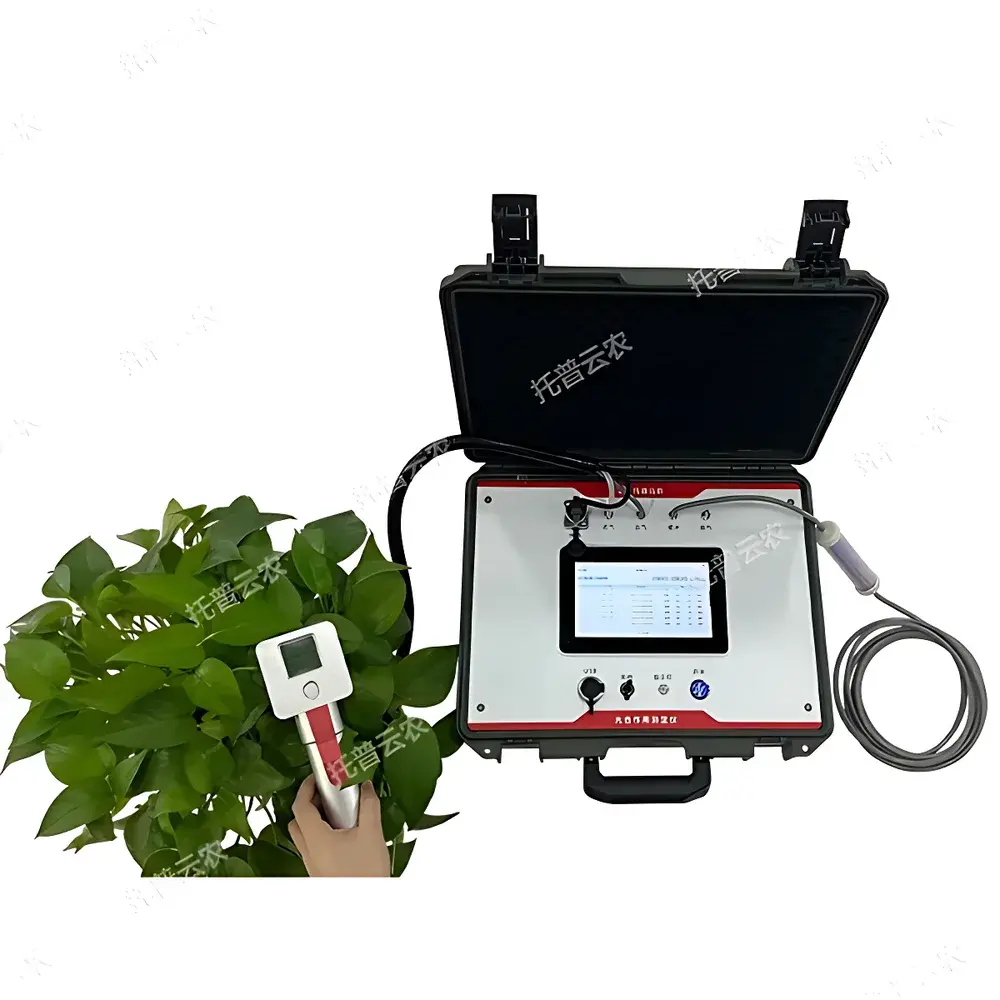
Top Cloud-agri TP-3051D Portable Photosynthesis Measurement System
| Brand | Top Cloud-agri |
|---|---|
| Origin | Zhejiang, China |
| Manufacturer Type | OEM/ODM Manufacturer |
| Country of Origin | China |
| Model | TP-3051D |
| CO₂ Range | 0–2000 µmol/mol (ppm), Resolution: 0.01, Accuracy: ≤3% FS |
| Ambient Temp | 0–50 °C, Res: 0.01 °C, Acc: ±0.3 °C |
| Leaf Chamber Temp | 0–50 °C, Res: 0.01 °C, Acc: ±0.3 °C |
| Ambient RH | 0–100% RH, Res: 0.01% RH, Acc: ±5% RH |
| Chamber RH | 0–100% RH, Res: 0.01% RH, Acc: ±5% RH |
| Leaf Surface Temp | 0–50 °C, Res: 0.01 °C, Acc: ±0.2 °C |
| PAR | 0–2500 µmol·m⁻²·s⁻¹, Res: 0.01, Acc: ±5 µmol·m⁻²·s⁻¹ |
| Pn, Gs, Tr, Ci, WUE | Resolution 0.01 |
| Operating Environment | 0–40 °C, ≤75% RH (non-condensing) |
| Power | DC 8.4 V Li-ion battery, 7–9 h continuous operation |
| Data Storage | 2 GB SD card |
| Dimensions | 260 × 260 × 130 mm |
Overview
The Top Cloud-agri TP-3051D Portable Photosynthesis Measurement System is a field-deployable, open- or closed-path gas exchange instrument engineered for quantitative assessment of plant physiological performance under natural or controlled conditions. It operates on the principle of infrared gas analysis (IRGA) for real-time CO₂ concentration differential measurement across a leaf chamber, combined with simultaneous monitoring of environmental and biophysical parameters—including photosynthetically active radiation (PAR), leaf surface temperature, chamber and ambient humidity, and air temperature. By integrating these variables into standardized gas exchange equations (e.g., Farquhar-von Caemmerer-Berry model derivatives), the system computes key ecophysiological metrics: net photosynthetic rate (Pn), stomatal conductance (gs), transpiration rate (E), intercellular CO₂ concentration (Ci), and instantaneous water-use efficiency (WUE). Designed for rigorous fieldwork in agronomy, forestry, horticulture, and ecological research, the TP-3051D supports both intact (in vivo) and excised (ex situ) measurements—enabling longitudinal studies across diverse species, growth stages, and stress treatments without laboratory dependency.
Key Features
- Compact, handheld form factor (260 × 260 × 130 mm) with ergonomic front-panel interface—optimized for single-operator deployment in remote or canopy-access-limited environments.
- High-resolution 320 × 240 dot-matrix LCD with intuitive Chinese-language menu navigation and on-screen cursor guidance for rapid protocol setup and real-time feedback.
- Dual-mode gas exchange configuration: selectable open-path (flow-through) or closed-loop (recirculating) measurement modes, each supported by an integrated electronic mass flow controller for precise, drift-compensated airflow regulation.
- Multi-sensor synchronization: simultaneous acquisition of CO₂, H₂O vapor, PAR, and dual-point temperature (ambient + leaf surface) at user-defined intervals (1–600 s), ensuring temporal coherence critical for diurnal or stress-response kinetics.
- Configurable operational parameters—including leaf area input, chamber volume, measurement interval, operator ID, and timestamp—stored persistently in non-volatile memory for traceable data provenance.
- Front-mounted physical interfaces: unified connector panel for data cable, CO₂/H₂O sampling lines, and power input—minimizing cable management complexity during repeated field setups.
- Extended environmental sensing suite: adds dedicated ambient relative humidity measurement to complement chamber RH, enabling decoupled assessment of atmospheric demand versus leaf boundary layer conditions.
Sample Compatibility & Compliance
The TP-3051D accommodates a broad spectrum of biological specimens through interchangeable leaf chambers—including standard rectangular, conifer needle, and micro-chambers for small leaves, seedlings, mosses, lichens, and even arthropods (e.g., insect respiration assays). Its modular design permits rapid chamber swaps without recalibration. All sensor calibrations adhere to manufacturer-specified traceability protocols; CO₂ sensors are factory-calibrated against NIST-traceable standards, and temperature/humidity modules undergo ISO/IEC 17025-aligned verification. While not certified for GLP or FDA 21 CFR Part 11 compliance out-of-the-box, the system’s audit-ready data structure—timestamped raw values, metadata headers, and uneditable binary storage on SD card—supports integration into validated workflows when paired with validated third-party data management software. It meets general requirements for field-based ecological monitoring per ISO 14001 environmental management frameworks and ASTM E2799-21 guidelines for portable plant physiology instrumentation.
Software & Data Management
Data are stored in a proprietary but openly documented binary format on a removable 2 GB SD card, with automatic time-stamped file segmentation (max 10,000 records per file). The included PC software (Windows-compatible) provides lossless import, visualization of time-series plots (Pn, gs, E vs. PAR or time), batch calculation of derived indices, and export to CSV, Excel, or text formats for downstream statistical analysis in R, Python, or SAS. The software enforces read-only access to original files—preserving raw integrity—and maintains a local log of all user-initiated actions (e.g., file export, parameter edits) for audit trail reconstruction. No cloud connectivity or remote telemetry is embedded; all data remain under full user control, satisfying institutional data sovereignty policies.
Applications
- Field phenotyping of crop genotypes under drought, heat, or elevated CO₂ exposure.
- Evaluation of stomatal responsiveness to abscisic acid (ABA) or light intensity gradients.
- Comparative ecophysiology of invasive vs. native plant species across soil moisture gradients.
- Post-harvest physiology studies of horticultural produce (e.g., leafy greens, berries) under modified atmosphere storage.
- Microclimate-driven photosynthetic modeling for precision irrigation scheduling in orchards and vineyards.
- Education and training in plant ecophysiology labs—supporting hands-on instruction in gas exchange theory and experimental design.
FAQ
What calibration procedures are required before field use?
The TP-3051D requires zero-point calibration using CO₂-free air (e.g., soda lime-scrubbed ambient air) and span calibration with a certified 400 ppm CO₂ standard gas prior to each day’s measurements. Temperature and RH sensors are factory-calibrated and do not require user recalibration under normal operating conditions.
Can the system operate continuously for multi-day deployments?
Yes—when powered via external DC 8.4 V supply (e.g., solar-charged power bank), the unit supports unattended logging for up to 72 hours at 30-second intervals. Battery life is reduced to 7–9 hours under internal Li-ion operation.
Is leaf area measurement integrated or manual?
Leaf area must be entered manually prior to measurement; the system does not include built-in imaging or planimetry. Users typically determine area using a leaf area meter or digital calipers and input the value directly into the device interface.
Does the instrument support automated light-response curve generation?
No—the TP-3051D does not include programmable LED light sources or automated PAR ramping. Light-response curves require external PAR control (e.g., neutral density filters or variable-intensity lamps) and manual stepwise adjustment.
Are firmware updates available, and how are they applied?
Firmware updates are distributed annually via Top Cloud-agri’s technical support portal and installed via SD card—requiring no proprietary hardware or subscription service.



