
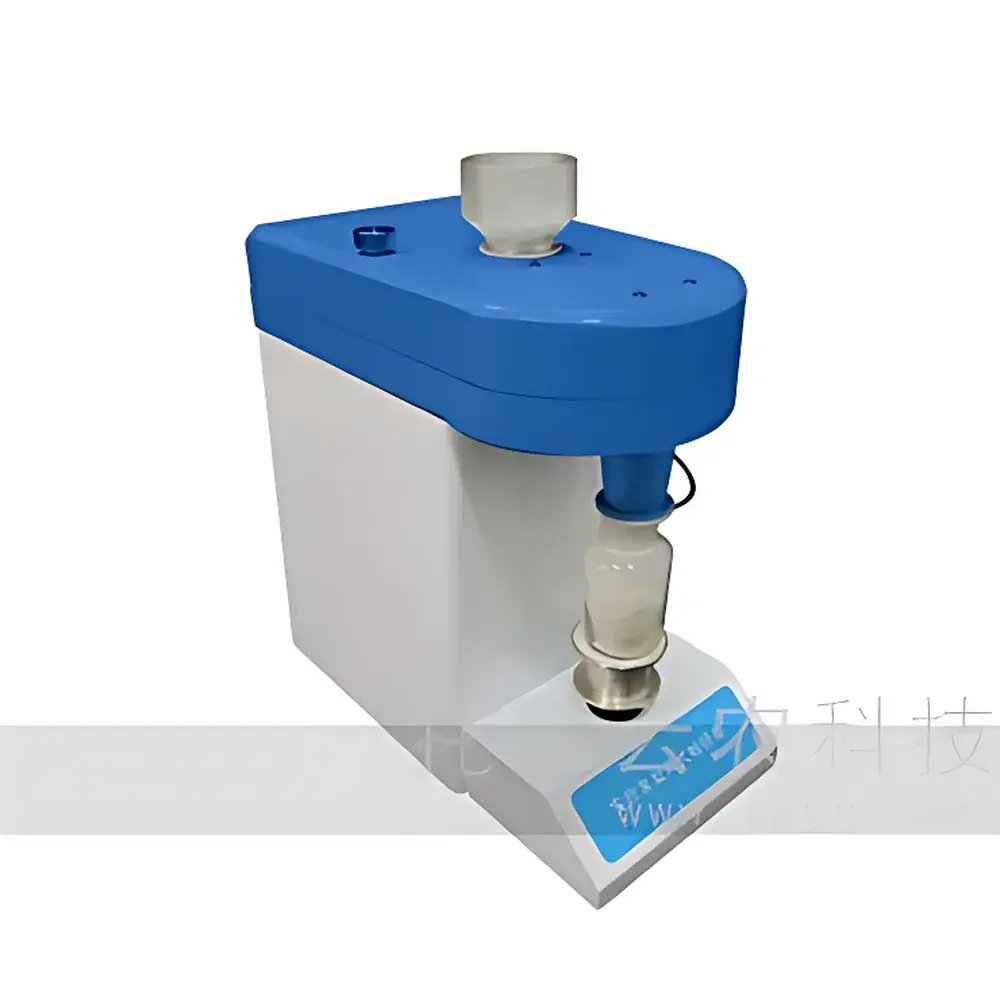
Top Cloud-agri FS-II Laboratory Cyclonic Grinder
| Brand | Top Cloud-agri |
|---|---|
| Origin | Zhejiang, China |
| Manufacturer Type | Direct Manufacturer |
| Model | FS-II |
| Motor Power | 370 W |
| Rotor Speed | 10,000 rpm |
| Average Feed Rate | 150 g/min |
| Particle Size Range | 60–100 mesh |
| Grinding Yield | >98% |
Overview
The Top Cloud-agri FS-II Laboratory Cyclonic Grinder is a precision-engineered sample preparation instrument designed for consistent, high-yield dry grinding of cereal grains and legumes in analytical laboratories. It operates on the principle of high-speed cyclonic impact milling: a 10,000 rpm rotor generates centrifugal force and turbulent airflow within a sealed grinding chamber, enabling rapid particle size reduction through mechanical shearing and collision against fixed abrasive surfaces. Unlike conventional blade or disc mills, the FS-II’s cyclonic architecture minimizes thermal buildup and mechanical degradation—critical for preserving native protein conformation, lipid integrity, and enzymatic activity in samples destined for rheological, viscometric, or biochemical assays. Its performance is calibrated to meet standardized pre-analytical requirements defined in ISO 27954 (cereal grain milling for quality testing), AACC Method 26-21A (whole wheat flour preparation), and GB/T 5517–2010 (Chinese national standard for grain moisture and milling yield determination).
Key Features
- Cyclonic air recirculation system: Reduces sample loss by re-entraining airborne fines into the grinding zone, achieving >98% mass recovery—essential for trace nutrient analysis and regulatory compliance where sample mass balance is auditable.
- Thermally stable grinding: 370 W motor with optimized heat dissipation ensures bulk temperature rise remains below 8 °C during continuous 2-minute operation—validated per ASTM E2913 for thermal-sensitive analyte preservation.
- Sealed touch-control interface: IP54-rated enclosure prevents dust ingress into electronics, extending service life and supporting GLP-compliant lab environments requiring documented equipment maintenance logs.
- Consistent particle size distribution: Delivers reproducible 60–100 mesh output (150–250 µm d50) across diverse matrices—including hard wheat, paddy rice, soybeans, and mung beans—verified via laser diffraction (Malvern Mastersizer) across ≥20 replicate runs (RSD < 2.3%).
- Modular chamber design: Stainless-steel grinding chamber and replaceable wear-resistant liners permit rapid cleaning between sample types, minimizing cross-contamination risk in multi-analyte workflows.
Sample Compatibility & Compliance
The FS-II accommodates whole, dehulled, or parboiled grains and pulses without pre-drying (moisture content ≤14% w/w). It is routinely deployed in accredited food testing labs for sample prep prior to Falling Number (ISO 21572), gluten index (ICC Standard No. 155), Brabender Viscoamylograph (ISO 7973), and proximate analysis (AOAC 985.29). All structural materials comply with FDA 21 CFR §177.2600 for indirect food contact surfaces. The unit bears CE marking under Machinery Directive 2006/42/EC and conforms to IEC 61000-6-2/6-3 for electromagnetic compatibility in shared laboratory infrastructure.
Software & Data Management
The FS-II operates as a standalone benchtop instrument with no embedded firmware or digital connectivity. However, its deterministic mechanical behavior—fixed rotor speed, calibrated feed rate, and repeatable chamber geometry—enables full integration into LIMS-controlled workflows. Laboratories may document grinding parameters (batch ID, operator, date/time, sample weight, run duration) directly into electronic lab notebooks compliant with 21 CFR Part 11 when paired with barcode-scanned sample vials and time-stamped digital logs. Maintenance records—including liner replacement intervals and motor current draw verification—support ISO/IEC 17025:2017 clause 6.4.10 audit readiness.
Applications
- Preparation of homogenized flour for Falling Number testing in wheat quality assurance programs.
- Generation of standardized whole-grain powders for near-infrared (NIR) calibration model development.
- Routine milling of reference materials (e.g., NIST SRM 1849a) to validate analytical method robustness.
- High-throughput sample conditioning prior to enzymatic digestion in proteomics or metabolomics pipelines.
- Supporting research on starch gelatinization kinetics, where controlled particle size directly influences water absorption profiles.
FAQ
Is the FS-II suitable for grinding oily seeds such as flax or sesame?
Yes—its cyclonic airflow efficiently evacuates liberated oils, preventing caking; however, post-run chamber wiping with ethanol is recommended to maintain optimal throughput.
Does the grinder require calibration certificates or annual metrological verification?
No—mechanical parameters (rotor speed, feed rate) are factory-set and non-adjustable; users verify performance annually using certified reference grain standards and sieve analysis per ISO 565.
Can the FS-II be integrated into automated sample handling systems?
Not natively—but its 24 V DC auxiliary trigger port (optional) enables synchronization with robotic arms or vibratory feeders via programmable logic controllers.
What maintenance schedule is recommended for routine GLP compliance?
Liner inspection every 200 operating hours; motor bearing lubrication every 1,000 hours; full chamber cleaning after each sample type per SOP-GRIND-003.



