
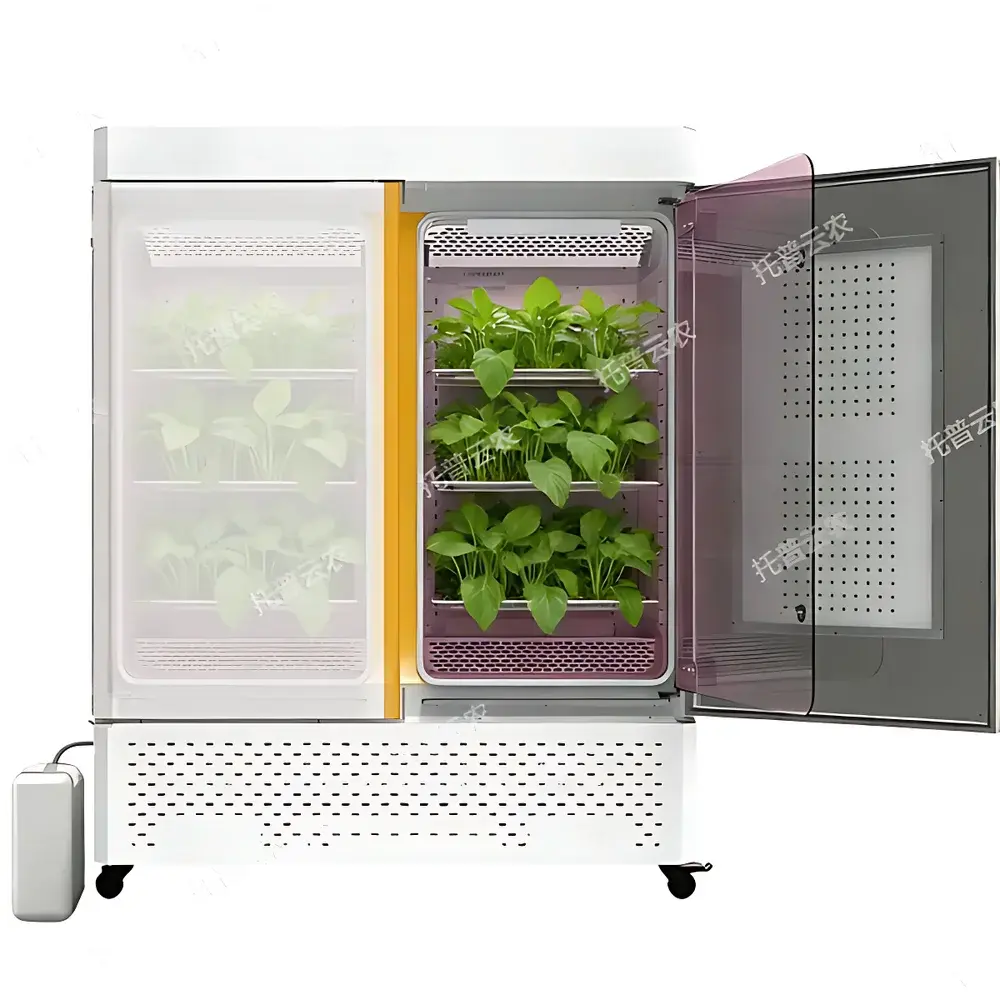
Top Cloud-agri TP-R-G Series Spectral Accelerated Plant Breeding Chamber
| Brand | Top Cloud-agri |
|---|---|
| Origin | Zhejiang, China |
| Manufacturer Type | Direct Manufacturer |
| Country of Origin | China |
| Model | TP-R-G Series |
| Price | Upon Request |
| Illuminance Range | 0–70,000 lx (measured at 15 cm vertical distance from LED panel) |
| Spectral Channels | White/Red/Blue/NIR LED array, 1,004 programmable spectral combinations |
| Temperature Control Range | 0–65°C |
| Temp. Uniformity | ±0.1°C to ±0.3°C (at 25.0°C, 50% RH) |
| Humidity Control Range | 50–95% RH |
| Humidity Uniformity | ±2% RH to ±3% RH (at 25.0°C, 50% RH) |
| Airflow Adjustment | 30–100% in discrete steps |
| Internal Volume | 420 L or 1000 L (model-dependent) |
| Display | ≥7″ capacitive touchscreen (1024×600) |
| Data Logging | Auto-generated experiment ID + QR code, USB export, cloud-sync via web & WeChat |
| Compliance Support | GLP-compliant audit trail (operator log, parameter change history), FDA 21 CFR Part 11-ready configuration (role-based access, electronic signature optional) |
Overview
The Top Cloud-agri TP-R-G Series Spectral Accelerated Plant Breeding Chamber is an advanced artificial climate incubator engineered for high-fidelity environmental simulation in plant science research and breeding programs. It operates on the principle of dynamic spectral photobiology—leveraging independently controllable white, red, blue, and near-infrared (NIR) LED channels to replicate natural and optimized light regimes across developmental stages. Coupled with precision thermohygrometric control (0–65°C; 50–95% RH), uniform laminar airflow distribution, and programmable multi-segment environmental profiles, the chamber enables reproducible acceleration of plant life cycles—from seed germination and tissue culture to flowering, seed set, and phenotyping under defined photoperiodic and stress conditions. Designed for compliance-critical environments, its architecture supports traceable operation, secure data integrity, and seamless integration into GLP- and GMP-aligned workflows.
Key Features
- Precision spectral tuning: 1,004 discrete light spectra generated via four-channel LED driver system (white: 4000K CCT; red: 660 nm peak; blue: 450 nm peak; NIR: 730 nm peak), enabling stage-specific photomorphogenic control without mechanical filters or external lamps.
- High-intensity illumination: 0–70,000 lx output (measured at 15 cm perpendicular distance), calibrated per IEC 62471 for photobiological safety, with linear dimming resolution ≤1% of full scale.
- Thermohygrometric stability: Dual PID-controlled heating/cooling and ultrasonic humidification deliver ±0.1°C temperature uniformity (TP-R420DK-G) and ±2% RH humidity uniformity under steady-state 25°C/50% RH reference conditions—validated per ISO 16770 Annex B protocols.
- Intelligent airflow management: Back-mounted matrix perforated duct + internal recirculation fan system ensures horizontal air velocity homogeneity (<±5% variation across working volume); adjustable fan speed (30–100%) accommodates low-wind-sensitive cultures (e.g., callus) and high-transpiration crops (e.g., tomato seedlings).
- Secure human-machine interface: 7-inch industrial-grade touchscreen with role-based access control (operator/administrator), password-protected parameter editing, timestamped audit logs, and automatic power-loss recovery preserving active program state and sensor history.
- Modular physical design: Mirror-finish 304 stainless steel interior with radius-corner welds; double-wall insulation using cyclopentane-blown polyurethane foam (λ = 0.018 W/m·K); 6-mm tempered glass inner door with electromagnetic lock and auto-fan shutoff upon opening.
Sample Compatibility & Compliance
The TP-R-G series accommodates a broad range of biological specimens—including Arabidopsis thaliana, rice, wheat, maize, soybean, tobacco, lettuce, and model microalgae—across standard tissue culture vessels (e.g., Magenta boxes, Petri dishes), hydroponic trays, and insect rearing cages. Its UV-C sterilization cycle (254 nm, 30-min automated sequence) meets ISO 14644-1 Class 7 cleanroom pre-use validation requirements for sterile culture initiation. The system’s embedded logging engine records all critical parameters (temperature, RH, irradiance, fan status, door events) with immutable timestamps and operator IDs—fully compatible with GLP documentation standards (OECD 1998) and preparatory alignment with FDA 21 CFR Part 11 when deployed with optional digital signature modules and network authentication servers.
Software & Data Management
Each experimental run generates a unique alphanumeric experiment ID and scannable QR code, linked to time-stamped sensor data stored locally on embedded flash memory (≥1 year at 1-min intervals). Data export is supported via USB 2.0 port (CSV/Excel format) or encrypted HTTPS upload to the Top Cloud-agri Web Platform—a responsive HTML5 dashboard accessible from desktop and mobile browsers. Real-time monitoring and remote command execution (program start/stop, segment override, alarm acknowledgment) are enabled through WeChat Mini Program integration with TLS 1.2 encryption and push notifications for out-of-spec alerts. Firmware updates occur via secure OTA protocol with SHA-256 signature verification, ensuring regulatory continuity during long-term deployments.
Applications
- Rapid generation advancement in photoperiod-sensitive crops (e.g., wheat vernalization + accelerated flowering under controlled R:FR ratios)
- High-throughput screening of drought-tolerant genotypes via synchronized moisture-stress ramping combined with NDVI-capable spectral profiling
- In vitro propagation optimization for orchids and medicinal plants under species-specific blue/red photon flux densities
- Seed dormancy release studies using precise far-red pulses (730 nm) to modulate phytochrome photoequilibrium
- Pharmaceutical stability testing of botanical extracts under oxidative stress simulated by elevated light + temperature + low-humidity profiles
- Entomological rearing of Drosophila melanogaster or Tribolium castaneum under circadian-light entrainment protocols
FAQ
What spectral ranges does the LED system cover, and how is spectral accuracy verified?
The system delivers narrowband peaks at 450 nm (blue), 660 nm (red), and 730 nm (NIR), plus broad-spectrum white light (4000K CCT). Spectral output is factory-calibrated using NIST-traceable spectroradiometry and documented in the Certificate of Conformance supplied with each unit.
Can the chamber maintain stable conditions during door opening?
Yes—the electromagnetic lock disables fan operation immediately upon door unlatching, minimizing thermal and humidity perturbation. Internal sensors trigger rapid recovery algorithms post-closure, typically restoring setpoints within 4–6 minutes.
Is CO₂ enrichment supported?
A dedicated CO₂ inlet port (¼” BSP) is provided; integration with external mass-flow controllers and gas analyzers requires third-party calibration but is mechanically and electrically compatible.
How is data integrity ensured for regulatory submissions?
All parameter changes, user logins, alarm events, and environmental readings are written to a write-once audit log with cryptographic hash chaining. Optional 21 CFR Part 11 compliance packages include electronic signatures, biometric login, and centralized log server synchronization.
What maintenance intervals are recommended for long-term reliability?
Ultrasonic humidifier transducers require descaling every 3 months under continuous operation; LED panels are rated for 50,000 hours L70 lifetime; HEPA-grade air filter (optional accessory) should be replaced quarterly in high-dust environments.
Related Products




