
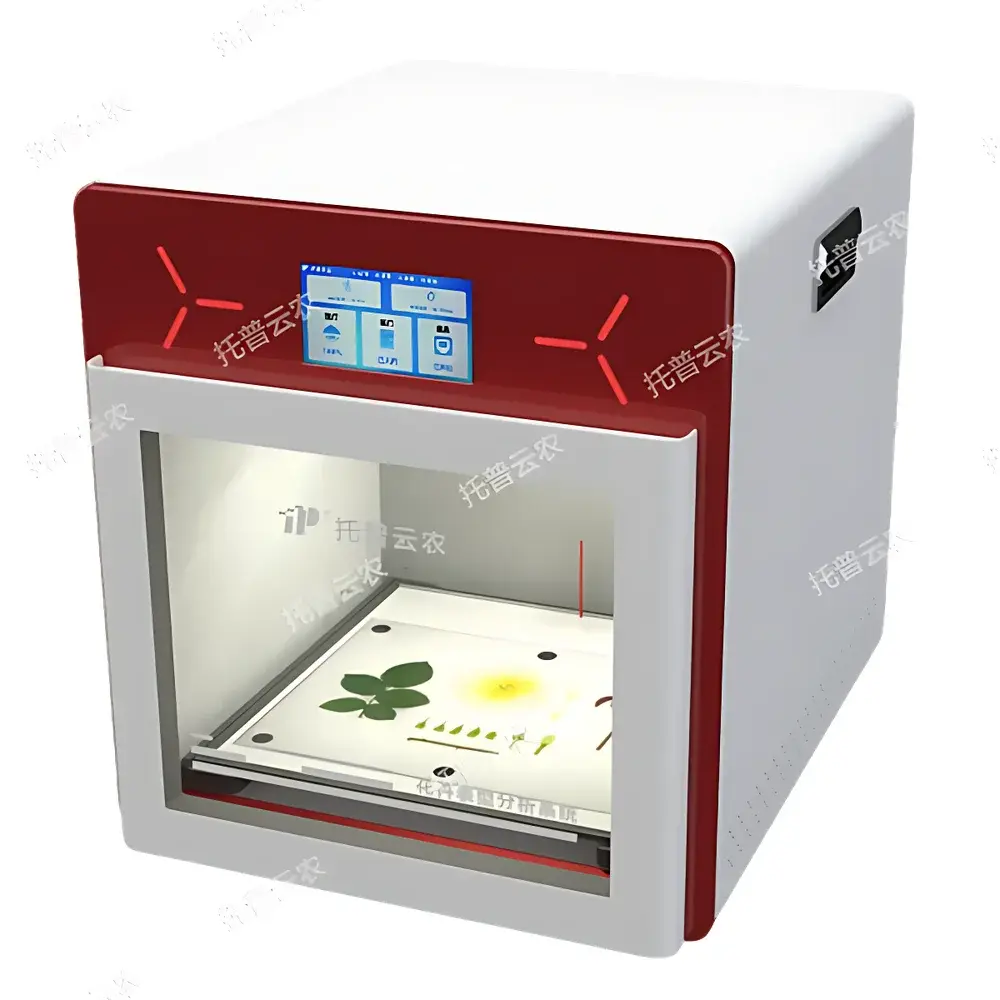
Top Cloud-agri TP-PhenoMS-VL2 Portable Visible-Light Plant Phenotyping System
| Brand | Top Cloud-agri |
|---|---|
| Origin | Zhejiang, China |
| Manufacturer Type | OEM/ODM Manufacturer |
| Country of Origin | China |
| Model | TP-PhenoMS-VL2 |
| Pricing | Upon Request |
| Power Supply | AC 220 V, 50 Hz or External Mobile Power (≥8 h continuous operation) |
| Dimensions (L×W×H) | 700 × 585 × 688 mm |
| Weight | ≤40 kg |
| Operating Temperature | 0–40 °C |
| Relative Humidity | 40–80 % RH |
| IP Rating | IP53 |
| Imaging Sensor | 26 MP industrial RGB CMOS |
| Resolution | 5120 × 5120 pixels |
| Pixel Size | 2.5 µm × 2.5 µm |
| Frame Rate | 4.5 fps |
| Bit Depth | 8/12-bit |
| Illumination | Uniform diffused LED panel |
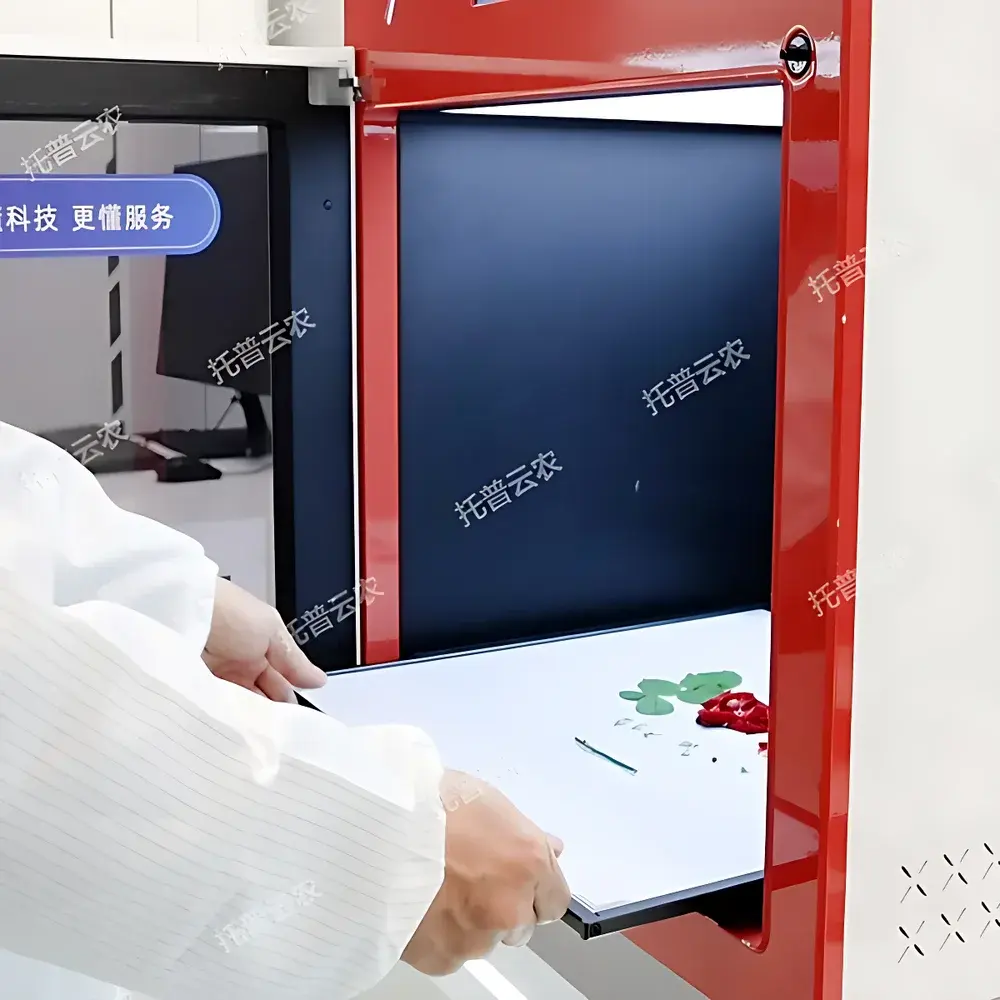
| Background Plate | Push-out 450 × 450 mm modular board (multi-color options) |
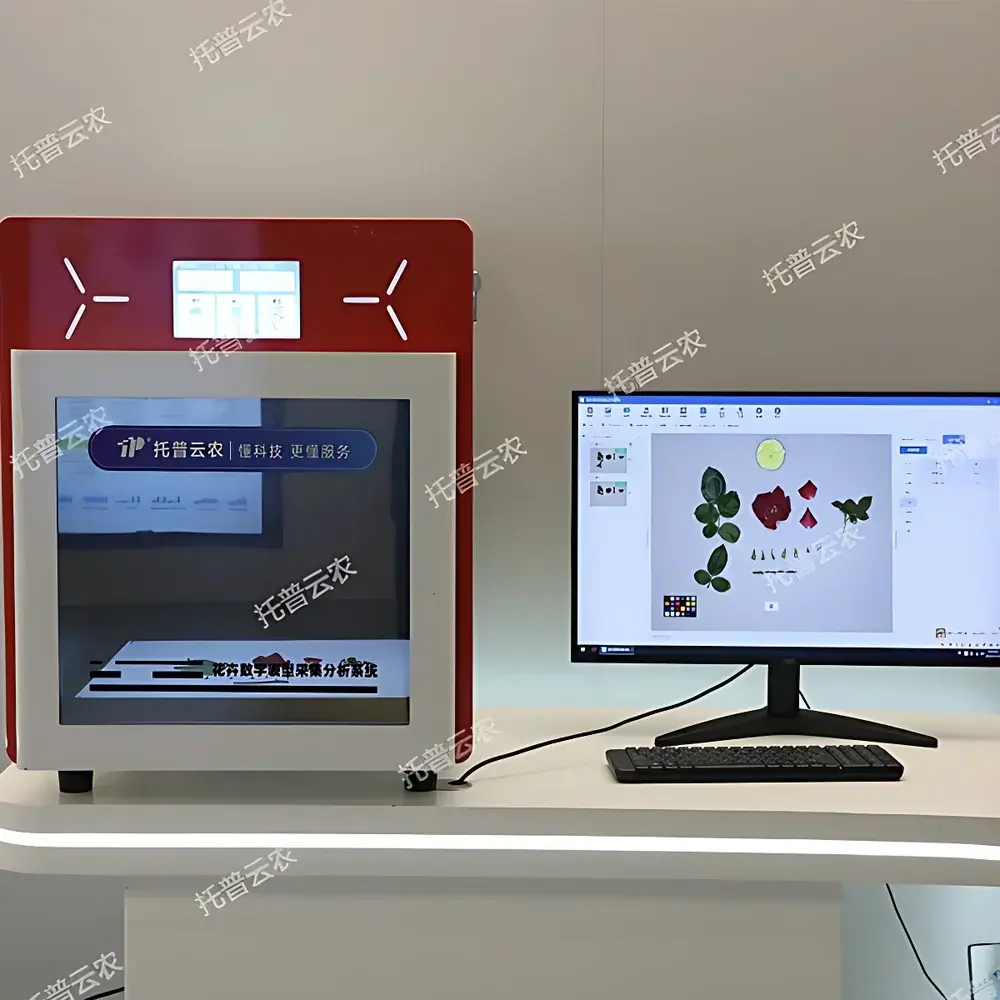
| Display | 7-inch color touch screen |
| Data Interface | USB 3.0 |
| Onboard AI Engine | Integrated deep learning pipeline for real-time segmentation, morphological quantification, and RHS color mapping |
Overview
The Top Cloud-agri TP-PhenoMS-VL2 is a portable, vertically integrated visible-light plant phenotyping system engineered for high-fidelity 2D morphometric and chromatic analysis of small-scale botanical specimens—including flowers, leaves, fruits, mushrooms, and seedlings. Unlike conventional manual measurement or static imaging rigs, the TP-PhenoMS-VL2 implements a standardized, repeatable acquisition workflow within a controlled optical environment. Its core methodology relies on calibrated RGB imaging under uniform diffuse illumination, coupled with embedded convolutional neural networks (CNNs) trained on annotated botanical datasets to perform pixel-level semantic segmentation and geometric feature extraction. Designed for deployment across heterogeneous environments—from climate-controlled growth chambers and greenhouse bays to field-based mobile labs—the system delivers traceable, operator-independent phenotypic data without requiring specialized imaging expertise. It addresses critical bottlenecks in plant science: low throughput, inter-observer variability, subjective color assessment, and fragmented data pipelines between image capture and statistical interpretation.
Key Features
- Integrated hardware-software architecture with onboard 7-inch touchscreen for real-time preview, camera control, and immediate post-capture analysis.
- Automated image metadata tagging: files are timestamped and auto-named using taxonomic hierarchy (family/genus/species), sample ID, and acquisition date—enabling FAIR-compliant data organization.
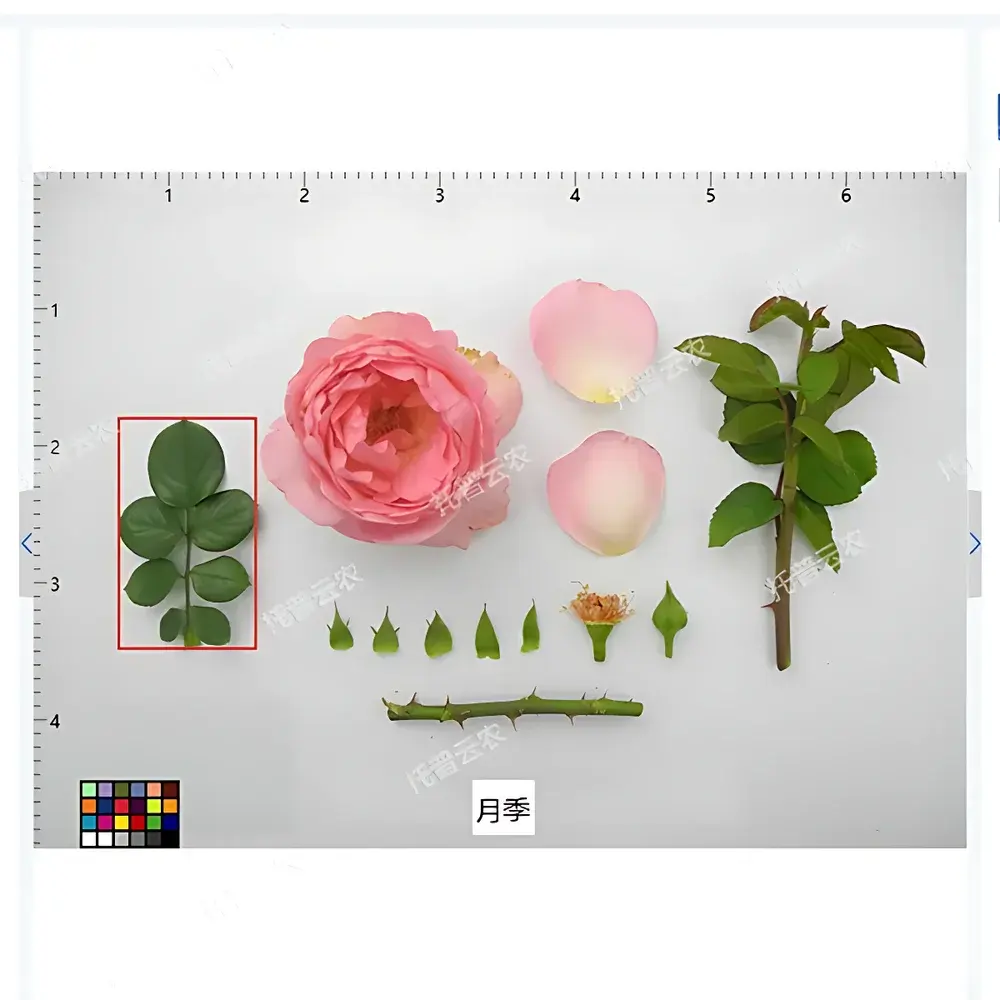
- Batch processing engine supporting concurrent analysis of ≥40 morphological and chromatic parameters per specimen, including area, perimeter, major/minor axis length, circularity, convex hull ratio, petal count, corolla diameter, sepal morphology, spine density, and RGB-to-RHS color conversion.
- Deep learning–driven object recognition: pretrained models classify input regions as flower, leaf, fruit, stem, or calyx, then apply context-specific segmentation masks and metric calculators.
- AI-assisted calibration protocol: one-click spatial and chromatic normalization using reference charts, ensuring cross-session and cross-device reproducibility (CV < 3.2% for area measurements, per internal validation under ISO 9001–certified QA procedures).
- Modular push-out background plate (450 × 450 mm) with interchangeable matte surfaces (white, black, gray, green) to optimize contrast for diverse sample types and pigmentation profiles.
- Local storage + cloud synchronization: raw images, processed feature vectors, and analysis logs sync automatically to user-designated cloud endpoints via TLS 1.2–secured API, eliminating manual export/import steps.
- Region-of-interest (ROI) color interrogation: users define arbitrary polygons; system returns mean RGB, HSV, CIELAB values, dominant hue, and nearest match from the Royal Horticultural Society Colour Chart (RHS CC 2015 edition).
Sample Compatibility & Compliance
The TP-PhenoMS-VL2 accommodates specimens up to 40 cm in height and 35 cm in lateral span, making it suitable for herbaceous angiosperms, rosette-forming species, cut floral stems, detached leaves, immature fruits (e.g., cherry tomatoes, strawberries), and macrofungi caps. Its enclosed optical chamber minimizes ambient light interference, satisfying requirements for consistent illumination stipulated in ASTM E308–22 (Standard Practice for Computing the Colors of Objects by Using the CIE System) and ISO 11664–4:2019 (Colorimetry — Part 4: CIE 1976 L*a*b* Colour Space). All software modules comply with ALCOA+ principles for data integrity: attributable, legible, contemporaneous, original, accurate, complete, consistent, enduring, and available. Audit trails record every user action—including ROI selection, parameter adjustment, and report generation—with timestamps and operator IDs, supporting GLP and GMP-aligned workflows per FDA 21 CFR Part 11 Annex 11 readiness.
Software & Data Management
The proprietary PhenotypeStudio™ software suite runs natively on Windows-based laptops (pre-installed on included high-performance unit) and provides a unified interface for acquisition, annotation, computation, visualization, and reporting. Data structures adhere to MIAPPE v1.1 (Minimum Information About a Plant Phenotyping Experiment) metadata standards. Export formats include CSV (for statistical packages such as R or Python pandas), JSON-LD (for semantic web integration), and structured PDF/DOCX reports containing embedded thumbnails, numerical tables, trend graphs (growth-stage comparisons), and side-by-side variety heatmaps. All image derivatives retain EXIF and XMP metadata, enabling downstream integration with digital herbarium platforms or breeding management systems (e.g., BreedBase, FieldBook).
Applications
- Floral breeding programs: Quantifying varietal differences in petal symmetry, color stability under stress, or senescence-related hue shifts.
- Abiotic stress phenotyping: Monitoring leaf chlorosis, anthocyanin accumulation, or floral abortion rates across drought, salinity, or temperature gradient trials.
- Germplasm characterization: High-throughput screening of ex situ collections for morphological diversity indices (e.g., Shannon–Wiener on shape descriptors).
- Horticultural quality control: Objective assessment of cut-flower grade criteria (stem straightness, bloom openness, petal integrity) per UNECE FFV-28 standards.
- Educational labs: Teaching digital plant morphology, computer vision fundamentals, and reproducible experimental design in undergraduate botany curricula.
FAQ
Does the system require external PCs or can it operate standalone?
The TP-PhenoMS-VL2 includes an integrated Windows laptop preloaded with PhenotypeStudio™; no external computing hardware is needed for full functionality.
Can I import legacy images taken with other cameras for analysis?
Yes—batch analysis supports drag-and-drop import of TIFF, PNG, or JPEG files, provided they meet minimum resolution (≥2048 × 2048 px) and lighting consistency guidelines outlined in the User Manual.
How is color accuracy validated across devices?
Each unit ships with NIST-traceable grayscale and color target cards; the AI calibration module uses these to compute device-specific gamma and white-balance correction matrices prior to any scientific measurement.
Is raw image data accessible for third-party algorithm development?
All unprocessed sensor frames (Bayer RAW or linear RGB) are stored in lossless format and available via file system access or REST API for custom model training or integration with TensorFlow/PyTorch pipelines.
What regulatory documentation is provided for audit readiness?
A complete validation package is supplied, including IQ/OQ protocols, calibration certificates, cybersecurity assessment summary (NIST SP 800-53 Rev. 4 aligned), and electronic signature configuration guide compliant with 21 CFR Part 11 §11.200.







