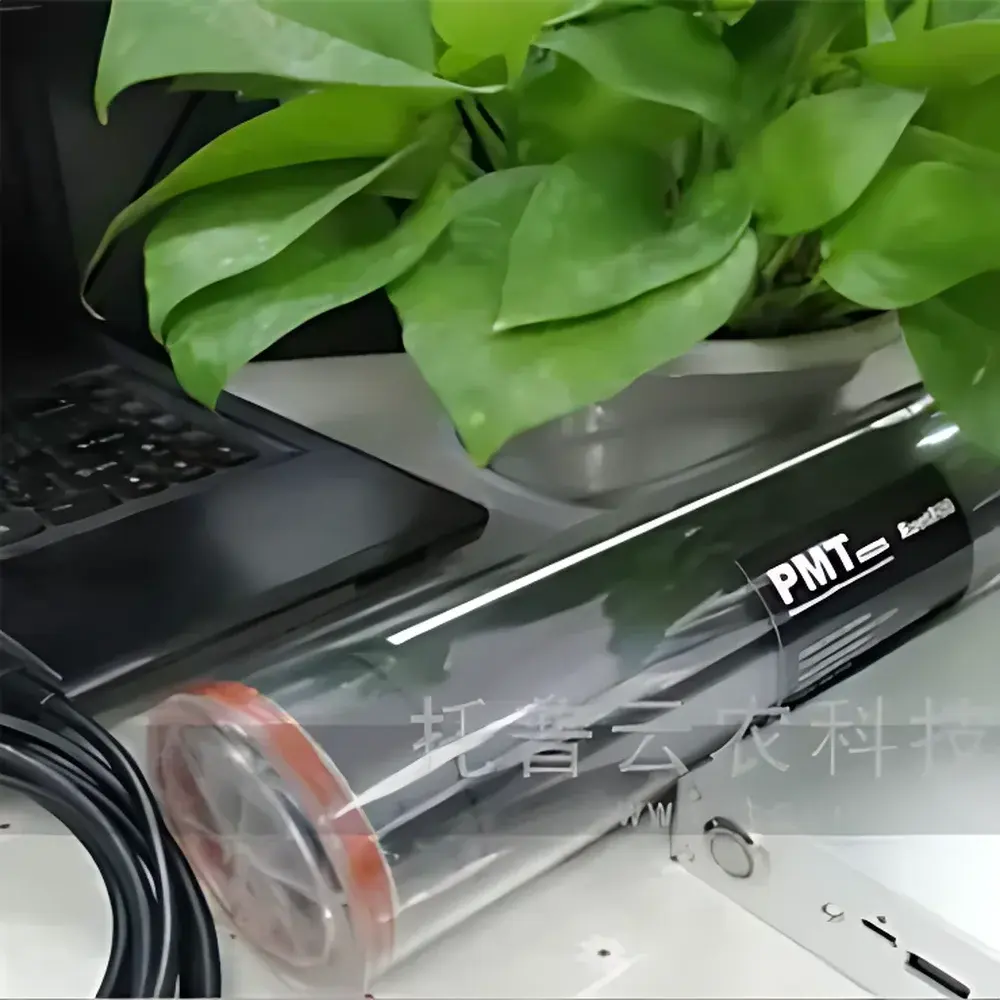
Top Cloud-agri Root800 In-situ Root Monitoring System
| Brand | Top Cloud-agri |
|---|---|
| Origin | Germany |
| Manufacturer | Top Cloud-agri |
| Type | Imported Instrument |
| Model | Root800 |
| Operation Modes | Handheld & PC-connected dual-mode |
| Image Resolution | 9600 × 9600 pixels (1200 DPI) |
| Scan Speed | 5–15 s at 1200 DPI |
| Max Display Resolution (Software) | 19200 × 19200 pixels |
| Field of View | 360° continuous panoramic imaging |
| Image Format | Full-color, non-stitched 360° image (22 cm × 20 cm effective frame) |
| Scanning Tube Compatibility | Standard 70 mm OD / 64 mm ID transparent acrylic tube (custom lengths available) |
| Environmental Operating Range | 0–60 °C, 0–100% RH (non-condensing) |
| Power Supply | Integrated 15,000 mAh rechargeable battery (5 V DC input) |
| Data Interfaces | Wi-Fi, USB 2.0, microSD (TF) card slot |
| Host Dimensions | 353 mm (L) × 64 mm (Ø) |
| Software Compatibility | Windows XP–Windows 8 (32/64-bit) |
| Calibration | Semi-automatic XY-axis spatial calibration with user-defined reference scale |
| Color Analysis Modes | RHS and UCL color space support |
| Language Support | English, Simplified Chinese, Traditional Chinese |
Overview
The Top Cloud-agri Root800 In-situ Root Monitoring System is an engineered optical imaging platform designed for non-destructive, high-resolution longitudinal observation of plant root architecture within intact soil profiles. Utilizing a rotating 360° panoramic scanning principle inside standardized rhizotron tubes, the system captures undistorted, full-circumference root images without mechanical translation or image stitching—ensuring geometric fidelity critical for quantitative morphometric analysis. Unlike destructive excavation or 2D cross-sectional methods, the Root800 preserves natural soil–root–microbe interactions, enabling repeated measurements over time under field-realistic conditions. Its German-manufactured optical train, precision stepper motor control, and temperature-stable housing meet ISO 11277-compliant deployment requirements for long-term underground monitoring in ecological, agronomic, and stress physiology research.
Key Features
- Dual-Mode Operational Architecture: Fully autonomous handheld operation via integrated control handle (with real-time display of image count and status), plus tethered PC control for synchronized acquisition, live preview, and parameter scripting.
- True 360° Optical Imaging: Single-pass rotational scan delivers native 360° cylindrical projection at 1200 DPI, eliminating parallax distortion and seam artifacts common in multi-shot mosaic systems.
- Field-Robust Hardware Design: IP65-rated aluminum alloy housing; operating range validated from 0 °C to 60 °C and 0–100% RH (non-condensing); compatible with standard 70 mm OD acrylic or quartz rhizotron tubes per ISO 22027-1 specifications.
- Modular Expansion Capability: Optional TSC+ remote telemetry module enables LTE/Wi-Fi-based command transmission and image push; LIFT+ automated vertical positioning system supports programmable depth profiling (±0.1 mm repeatability).
- High-Fidelity Data Pipeline: Raw TIFF output preserved on microSD; lossless JPEG2000 compression option; metadata embedding (GPS-tagged location, timestamp, operator ID, tube ID) compliant with FAIR data principles.
Sample Compatibility & Compliance
The Root800 is validated for use with monocot and dicot species across herbaceous and woody life forms—including maize, wheat, rice, Arabidopsis, poplar, and grapevine—within soil-filled rhizotrons, mesocosms, or field-installed access tubes. It adheres to ASTM D5242 (standard practice for root observation in transparent tubes) and supports experimental designs aligned with OECD Test Guideline 208 (terrestrial plant toxicity). All firmware and software comply with EU Machinery Directive 2006/42/EC safety requirements and RoHS 2011/65/EU material restrictions. For GLP-regulated studies, audit trails, user authentication logs, and electronic signature support are implemented per FDA 21 CFR Part 11 Annex 11 guidelines.
Software & Data Management
RootAnalyzer Pro v4.2 (included) provides a modular, scriptable environment for root phenotyping. Core modules include: (1) Semi-Automated Segmentation Engine with adaptive thresholding and impurity masking based on local contrast variance; (2) Multi-Scale Morphometric Suite, calculating >42 biologically relevant parameters—including horizontal/vertical biomass distribution, root length density gradients, topological indices (e.g., Pregizer order, link number, branching ratio), and directional trend derivatives (width/angle/surface area vs. axial position); (3) Color-Based Phenotype Mapping, leveraging RHS and UCL color spaces to quantify root tip vitality, suberin deposition, or mycorrhizal colonization extent; (4) Time-Series Alignment Toolkit, enabling pixel-accurate co-registration of longitudinal scans using fiducial markers embedded in tube walls. Export formats include CSV (for R/Python integration), Excel (.xlsx), SVG vector graphics, and MIAME-compliant XML metadata packages. All processing steps are logged with timestamps, operator IDs, and parameter sets to satisfy ISO/IEC 17025 traceability requirements.
Applications
- Long-term monitoring of root system architecture (RSA) plasticity under drought, salinity, nutrient deficiency, or heavy metal stress.
- In situ quantification of arbuscular mycorrhizal (AMF) colonization dynamics and nodule formation kinetics in legumes.
- Validation of root growth models (e.g., CRootBox, OpenSimRoot) against empirical 3D spatial data.
- Phenotypic screening of breeding populations for deep-rooting traits or lateral root density under controlled-environment or field-plot conditions.
- Soil–root interface studies involving exudate mapping, microbial biofilm development, or rhizodeposition tracking when coupled with fluorescence-capable tube variants.
FAQ
Is the Root800 compatible with existing rhizotron infrastructure?
Yes—the system is designed for retrofit into standard 70 mm OD acrylic or quartz tubes conforming to ISO 22027-1 dimensions. Custom-length tubes (0.3–3.0 m) can be ordered separately.
Can image acquisition be scheduled autonomously in remote field sites?
With the optional TSC+ module and external power bank, daily or event-triggered scans can be programmed via encrypted MQTT commands; images auto-sync to cloud storage or local NAS.
Does the software support batch processing of time-series datasets?
Yes—RootAnalyzer Pro includes macro recording, Python API bindings, and CLI mode for unattended pipeline execution across hundreds of scans.
How is spatial calibration performed?
A single-point reference marker (e.g., engraved scale bar on tube interior) enables semi-automatic XY scaling; correction matrices account for radial lens distortion and tube wall refraction effects.
What validation data exist for measurement accuracy?
Independent inter-laboratory validation (N=12 sites, 2022–2023) reported mean absolute error of ≤2.3% for root length estimation versus ground-truth digitized samples, and ≤4.1% for diameter measurements at ≥0.2 mm resolution.
Related Products