
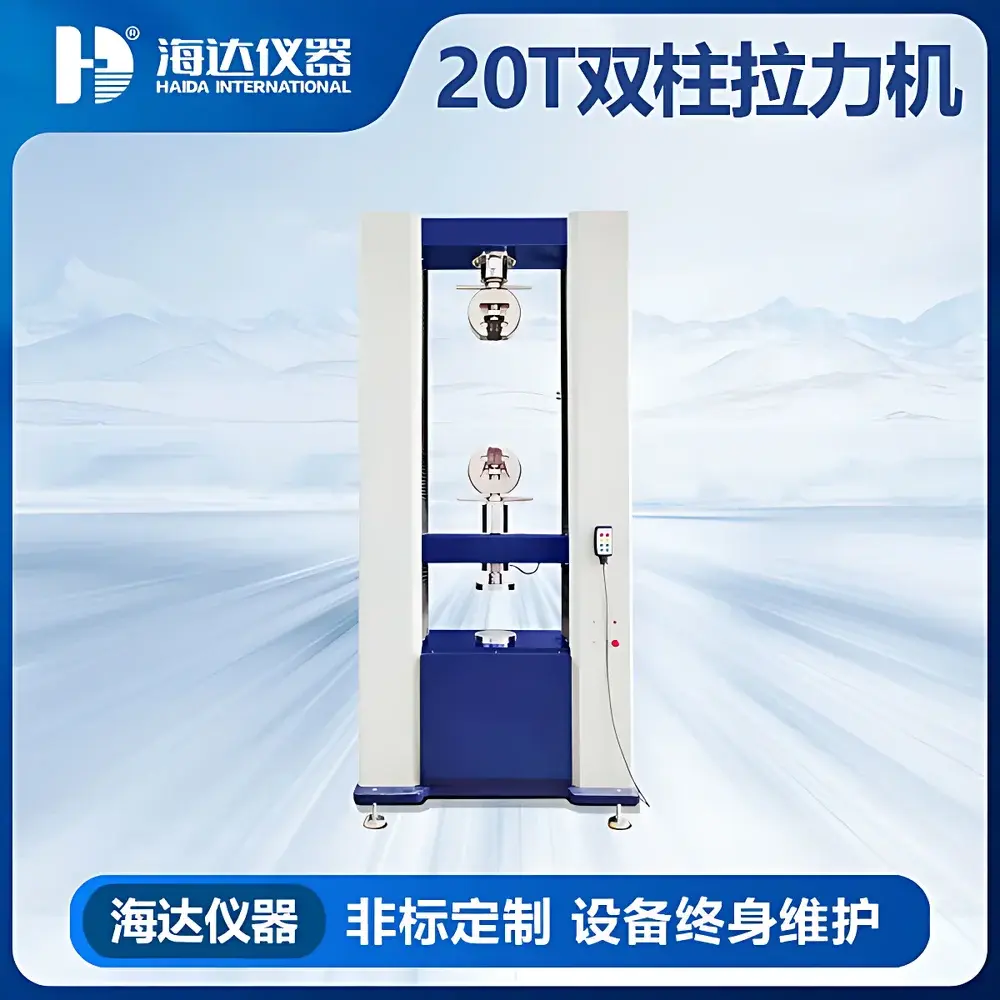
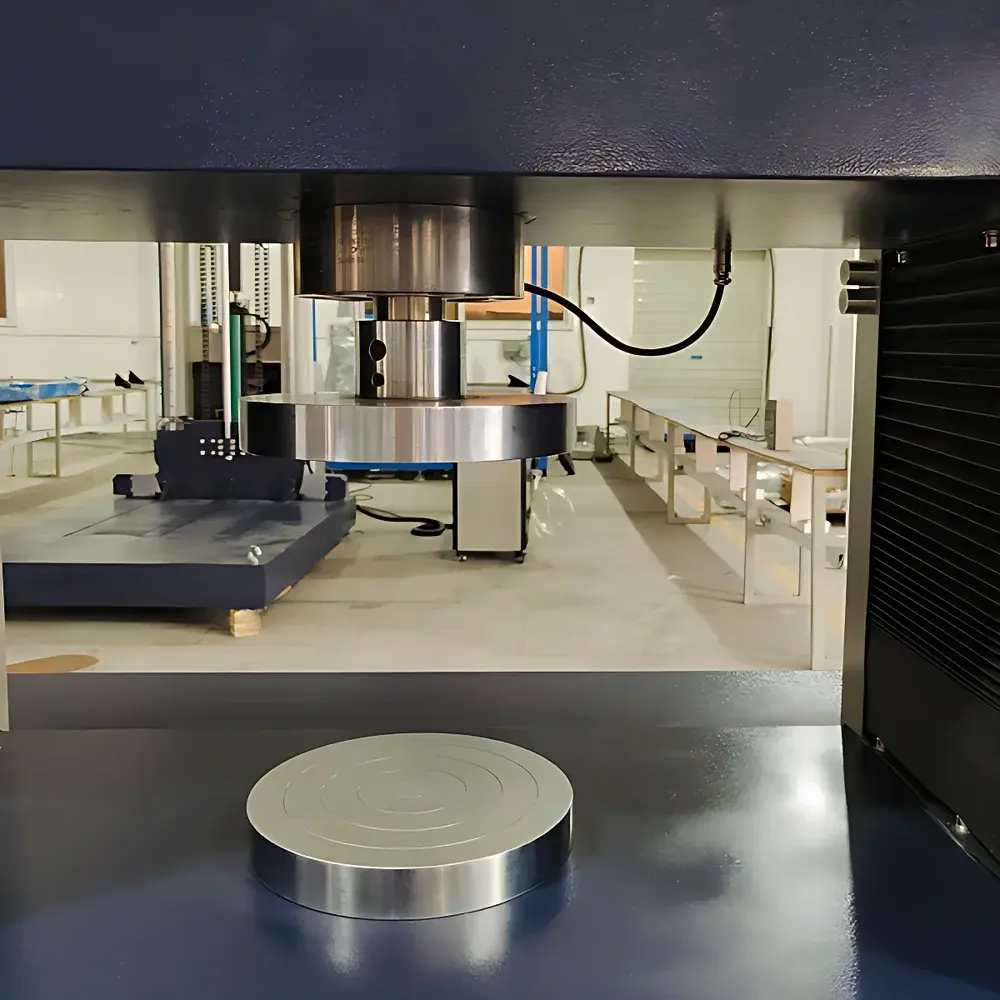
HAIDA HD-B618-S Computer-Controlled Dual-Column Servo Tensile Testing Machine
| Brand | HAIDA INTERNATIONAL |
|---|---|
| Origin | Guangdong, China |
| Manufacturer Type | Direct Manufacturer |
| Product Category | Domestic (China-Made) |
| Model | HAIDA HD-B618-S Computer-Controlled Dual-Column Servo Tensile Testing Machine |
| Instrument Type | Electromechanical Tensile Tester |
| Maximum Test Load | 100 kN (standard sensor) |
| Force Measurement Range | 0.1 N to 5 kN |
| Force Accuracy | ≤0.05% of full scale |
| Test Stroke | ~0.1–600 mm (with wedge grips) or ~0.1–970 mm (without wedge grips) |
| Drive Motor | 2.0 kW servo motor |
| Drive Controller | 2.0 kW servo drive |
| Control Mode | PC-based Windows operation |
| Display & Output | Real-time data on PC |
| Lead Screw | Precision recirculating ball screw |
| Speed Range | 0.1–500 mm/min (adjustable) |
| Load Resolution | 1/250,000 FS |
| Effective Test Width | ~450 mm |
| Dimensions (L×W×H) | ~850 × 600 × 1980 mm |
| Weight | ~550 kg |
| Power Supply | 1-phase AC 220 V |
| Total Power Consumption | ~2.2 kW |
Overview
The HAIDA HD-B618-S is a high-precision, computer-controlled dual-column electromechanical tensile testing machine engineered for rigorous mechanical property evaluation across diverse material classes. It operates on the principle of controlled uniaxial force application via a servo-driven ball-screw actuation system, enabling precise displacement control and high-fidelity load measurement. The system complies with fundamental metrological requirements defined in ISO 7500-1 (static calibration of force-proving instruments) and ISO 5893 (tensile testing machines—requirements for static testing), forming the foundational architecture for traceable mechanical testing. Designed for laboratory and quality control environments, the HD-B618-S delivers stable, repeatable performance under variable loading conditions—critical for R&D validation, production lot release, and regulatory submission workflows.
Key Features
- Dual-column rigid frame with four-column ball-screw transmission ensures minimal deflection and superior axial alignment during high-load testing (up to 100 kN), minimizing parasitic bending moments and enhancing test reproducibility.
- High-resolution load measurement system featuring ≤0.05% FS accuracy and 1/250,000 internal resolution, meeting Class 0.5 requirements per ISO 7500-1 for force verification.
- Full-range speed control from 0.1 to 500 mm/min, supporting both quasi-static and moderate-rate mechanical characterization—essential for ASTM D638, ISO 527, and GB/T 228.1 compliant testing protocols.
- Multi-mode closed-loop control: constant rate of crosshead displacement, constant rate of force application, constant strain rate, and constant stress rate—enabling seamless transition between ASTM E8, ISO 6892-1, and GB/T 1040 test methodologies.
- Integrated hardware safety mechanisms including mechanical stroke limit switches, electronic overload cutoff, and emergency stop circuitry compliant with IEC 60204-1 (safety of machinery—electrical equipment).
- Standardized USB 2.0 interface and optional Ethernet connectivity support secure, audit-ready data transfer and remote system integration within LIMS or MES environments.
Sample Compatibility & Compliance
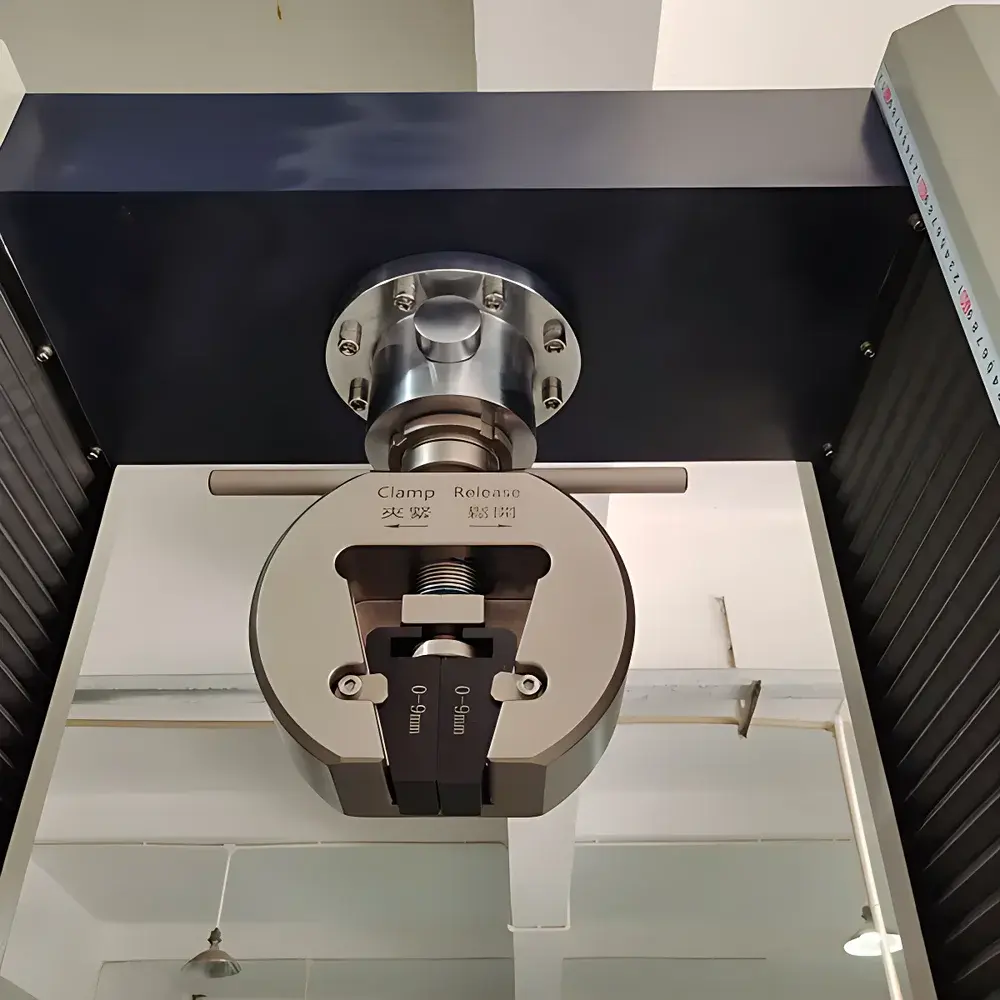
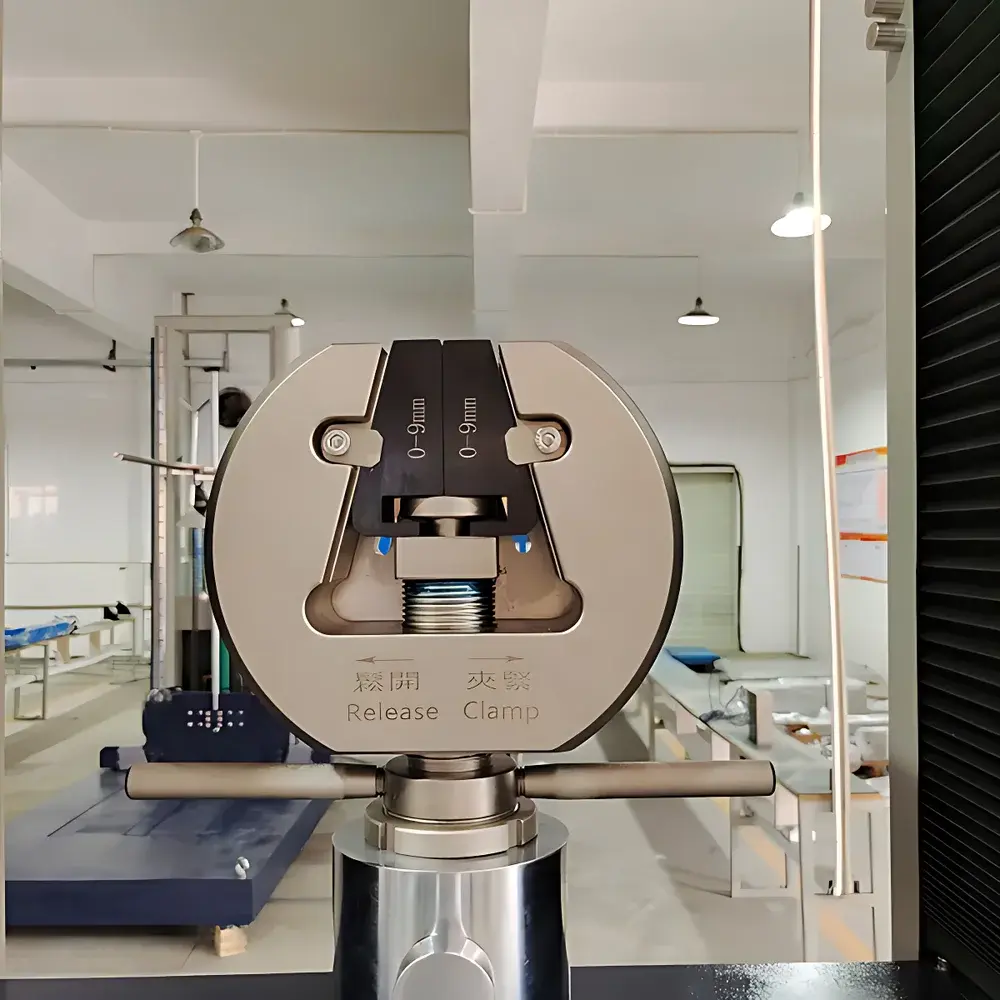
The HD-B618-S accommodates a broad spectrum of specimen geometries and mechanical behaviors—from brittle ceramics and thermoset composites to ductile metallic wires and viscoelastic elastomers. Its modular grip system supports wedge-type, pneumatic, hydraulic, and custom fixtures (e.g., peel, shear, puncture, compression platens), facilitating compliance with standardized test configurations. The instrument meets essential national and international regulatory frameworks: GB/T 16491–2008 (Chinese standard for universal testing machines), JJG 475–2018 (verification regulation for tensile testers), and GB/T 16825.1–2008 (verification of force measurement systems). For pharmaceutical packaging, it supports ASTM F88 (seal strength), ASTM F1140 (burst testing), and ISO 11607-2 (package integrity). In medical device testing, it aligns with ISO 7198 (vascular prostheses) and ISO 10993-12 (sample preparation for biocompatibility studies). All firmware and software modules are designed to support GLP-compliant audit trails when deployed with validated PC configurations.
Software & Data Management
The proprietary HAIDA TestMaster™ software (v4.x, Windows 10/11 compatible) provides full test method definition, real-time curve visualization (load vs. displacement, stress vs. strain), and automated calculation of key mechanical parameters—including Young’s modulus, yield strength, ultimate tensile strength, elongation at break, and secant modulus. Data export conforms to ASTM E1434 (digital data exchange for mechanical testing) and supports CSV, XLSX, and PDF formats with embedded metadata (operator ID, timestamp, calibration certificate ID, environmental conditions). The software includes built-in statistical analysis tools for group comparison (ANOVA, t-test), pass/fail thresholding, and multi-unit conversion (N, kN, lbf, kgf, gf). When configured with digital signature and user role management, the system satisfies FDA 21 CFR Part 11 requirements for electronic records and signatures in regulated environments.
Applications
- Mechanical validation of structural composites (CFRP, GFRP) per ASTM D3039 and ISO 527-4.
- Tensile and flexural characterization of polymer films, laminates, and adhesives per ASTM D882, ASTM D1002, and GB/T 2792.
- Compression testing of concrete cores and foams per ASTM C39 and ISO 844.
- Puncture resistance assessment of medical packaging per ASTM F1306 and ISO 11607-2.
- Peel and shear strength evaluation of pressure-sensitive adhesives per ASTM D903 and ISO 8510-2.
- Mechanical qualification of orthopedic implants, sutures, and catheter tubing per ISO 5832-1, ISO 10555-1, and USP <87> / <88>.
- Quality conformance testing for wire, cable, and fastener components per ASTM B695 and GB/T 232.
FAQ
What load cell options are available for the HD-B618-S?
The system ships standard with a 100 kN load cell. Optional calibrated transducers include 20 kN, 30 kN, and 50 kN units—each supplied with individual calibration certificates traceable to CNAS-accredited standards.
Is the software compliant with FDA 21 CFR Part 11?
Yes—when deployed with password-protected user roles, electronic signatures, and audit-trail logging enabled, the TestMaster™ software meets core Part 11 requirements for electronic records and signatures in pharmaceutical and medical device QA/QC labs.
Can the HD-B618-S perform cyclic or fatigue testing?
No—the HD-B618-S is optimized for static and quasi-static mechanical tests only. For dynamic or high-cycle fatigue applications, HAIDA recommends the HD-F series electrodynamic fatigue testing systems.
What is the maximum specimen width supported without modification?
The effective test width is 450 mm, accommodating standard ASTM and ISO specimen widths for flat materials; wider specimens require custom side-mounted fixtures.
Does the system support third-party software integration?
Yes—via TCP/IP or DLL API interfaces, the controller supports integration with LabVIEW, MATLAB, and custom Python-based automation scripts for high-throughput lab environments.



