Top Cloud-agri TPKZ-1 Automated Seed Characterization Analyzer with Thousand-Kernel Weight System
| Brand | Top Cloud-agri |
|---|---|
| Origin | Zhejiang, China |
| Manufacturer Type | Direct Manufacturer |
| Instrument Type | Benchtop |
| Sample Types | Corn kernels, rice, wheat, soybean, rapeseed, vegetable seeds |
| Counting Speed | 1,500–3,000 kernels/min (corn), 1,200–20,000 kernels/min (other grains) |
| Throughput Capacity | Up to 10 corn ears, 35 corn cross-sections, or ~1,000 corn kernels per imaging session |
| Imaging Scan Rate | 10 ears/minute |
| Resolution | 4896 × 3672 pixels (22 MP) |
| Weight Range | 0–5 kg |
| Counting Accuracy | ≤ ±0.5% (correctable to 100% via interactive verification) |
| TKW Accuracy | ≤ ±0.5% |
| Compliance | Supports GLP-compliant data audit trails via cloud platform synchronization and encrypted software licensing |
Overview
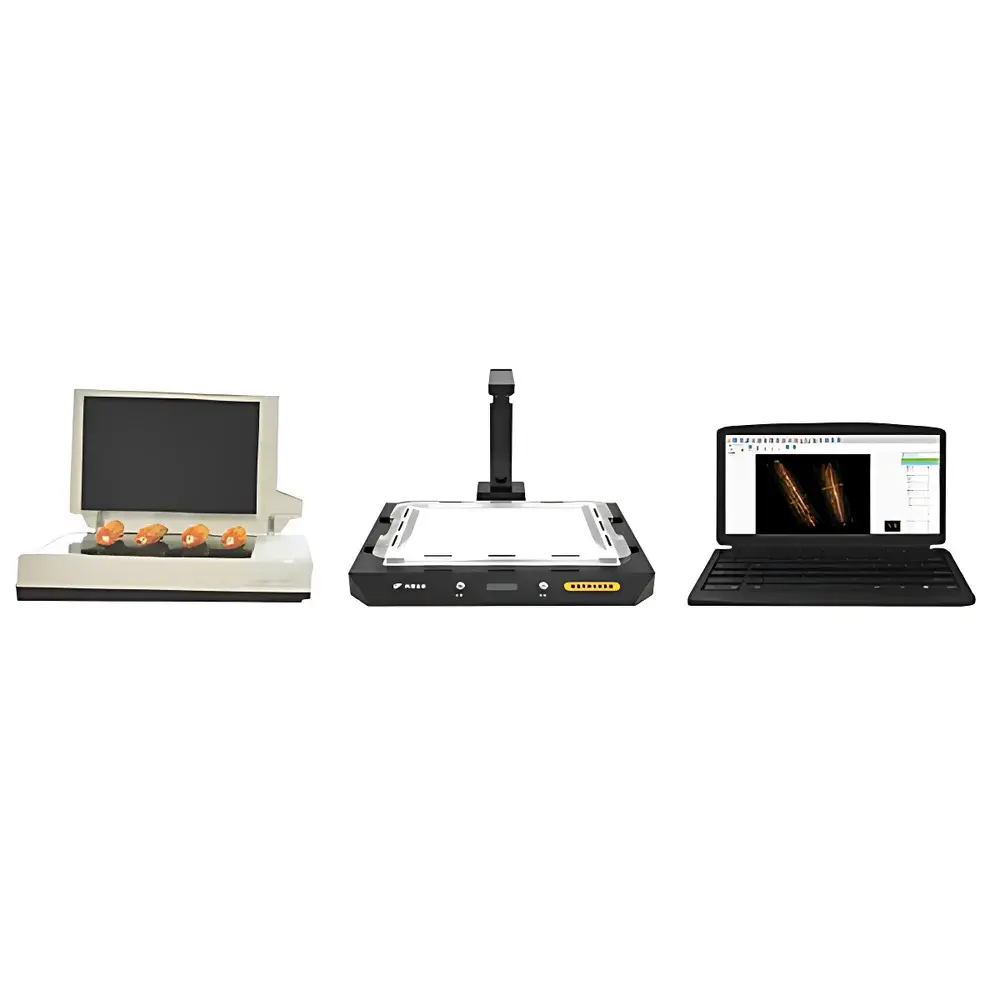
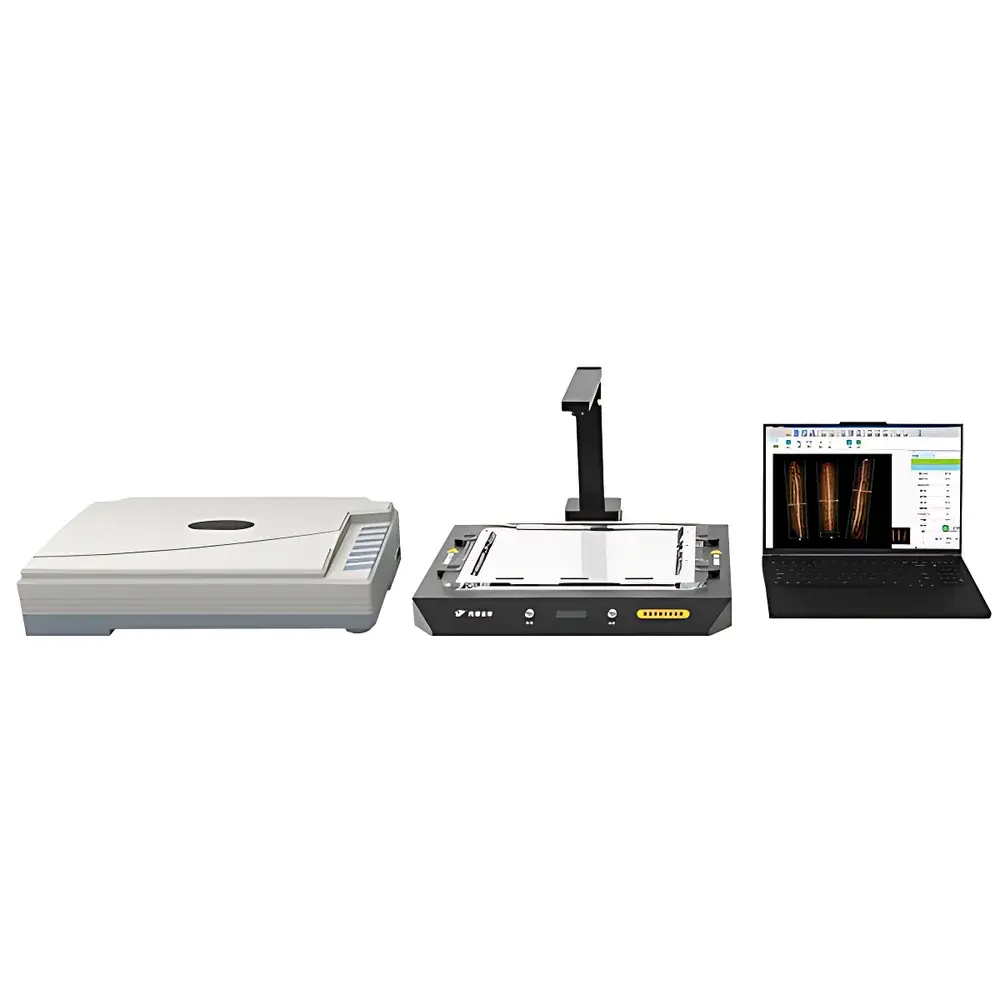
The Top Cloud-agri TPKZ-1 Automated Seed Characterization Analyzer is a benchtop digital phenotyping instrument engineered for high-throughput, non-destructive morphometric analysis of agricultural seeds and maize reproductive structures. It employs high-resolution digital imaging coupled with computer vision algorithms—based on convolutional neural networks (CNNs) and adaptive threshold segmentation—to quantify morphological, dimensional, and colorimetric traits across diverse crop species. The system operates on the principle of top-down backlight imaging under controlled illumination, enabling precise pixel-based measurement of seed contours, area, perimeter, length, width, aspect ratio, and chromatic distribution. Designed for integration into breeding programs, quality control labs, and seed certification facilities, the TPKZ-1 delivers traceable, repeatable metrics aligned with international seed testing standards including ISTA Rules and ISO 20753:2022 (Seed Quality Assessment – Morphological Analysis).
Key Features
- High-Fidelity Imaging Architecture: Equipped with a 22-megapixel A3-format overhead imager (4896 × 3672 px) and ultra-thin LED-backlit transmissive stage featuring auto-calibration reference grid and shadow-free illumination—optimized for consistent contrast across heterogeneous seed batches.
- Integrated Weighing Module: Dual-function seed tray combines precision load cell (0–5 kg, ±0.01 g resolution) with uniform backlight source; weight data synchronizes automatically with image capture to compute thousand-kernel weight (TKW), hundred-kernel weight (HKW), and bulk density proxies.
- Real-Time Visual Feedback: 2.1-inch OLED display embedded in weighing platform provides live mass readout during sample loading—enabling dynamic adjustment of kernel count prior to analysis initiation.
- Multi-Scale Structural Analysis: Supports concurrent quantification across three biological scales: individual kernels (morphometrics), corn cross-sections (ear architecture: row number, cob diameter, kernel dimensions), and whole ears (ear length, tip exposure, ear curvature, row angle).
- Interactive Correction & Validation: Pixel-level manual editing tools—including split/merge, region-of-interest (ROI) boxing, and contour refinement—ensure 100% analytical fidelity; all corrections are logged with timestamp and operator ID.
- Cloud-Enabled Data Governance: On-device encryption (dynamic QR + hardware dongle) secures software access; all images, metadata, and derived parameters synchronize to a TLS-encrypted cloud platform supporting role-based access, version-controlled exports, and FDA 21 CFR Part 11–compliant audit trails.
Sample Compatibility & Compliance
The TPKZ-1 accommodates a broad spectrum of agronomic samples without physical modification: intact maize ears (up to 30 cm length), transverse ear slices (5–10 mm thickness), and loose kernels from cereals (rice, wheat, barley), legumes (soybean, pea), oilseeds (rapeseed, sunflower), and horticultural species (tomato, lettuce). All analyses adhere to standardized protocols referenced in ISTA Handbook Chapter 5 (Seed Morphology), AOAC Method 992.12 (Digital Image Analysis of Seeds), and GB/T 3543.7–1995 (Chinese National Standard for Seed Testing—Morphological Identification). The system supports dual-mode operation: fully automated batch processing or semi-automated mode for validation-critical applications requiring human-in-the-loop oversight.
Software & Data Management
The proprietary TPKZ-Analysis Suite (v4.2+) runs on Windows 10/11 and features modular workflow design: acquisition → segmentation → feature extraction → statistical aggregation → reporting. Each session generates a structured dataset containing raw TIFF images, annotated binary masks, tabular trait matrices (CSV/Excel), and summary PDF reports with embedded thumbnails. Data export options include Excel (.xlsx), CSV, and XML formats compliant with Breeding Management System (BMS) APIs. Cloud synchronization enables remote monitoring, longitudinal cohort comparison, and cross-site data harmonization. Audit logs record every user action—including parameter edits, manual corrections, and export events—with cryptographic hashing to ensure data integrity under GLP/GMP environments.
Applications
- Accelerated phenotyping in maize hybrid development programs targeting ear architecture and kernel density traits.
- Regulatory seed lot certification for purity, varietal identity, and uniformity assessments per national seed laws.
- Post-harvest quality grading of cereal and oilseed lots based on morphometric consistency and color homogeneity.
- QTL mapping studies requiring high-resolution, quantitative seed morphology endpoints.
- Educational use in plant science curricula for digital morphology training and machine learning–based classification exercises.
- Seed storage viability monitoring via longitudinal tracking of surface area-to-volume ratio changes over time.
FAQ
What calibration standards are supported for traceable measurements?
The system includes NIST-traceable calibration targets embedded in the seed tray; users may also import custom scale references via calibrated ruler images.
Can the software distinguish between damaged and healthy kernels?
Yes—via configurable morphological filters (e.g., circularity < 0.6, convexity < 0.85) and optional RGB/HSL-based defect segmentation trained on user-supplied exemplars.
Is offline operation possible without internet connectivity?
Full local functionality is retained; cloud sync resumes automatically upon reconnection, with conflict resolution handled via timestamped versioning.
How does the system handle overlapping or touching kernels?
Uses watershed-based separation guided by gradient magnitude maps and user-defined minimum separation distance (default: 2 pixels), with optional deep-learning-assisted boundary prediction.
Are API integrations available for LIMS or BMS platforms?
RESTful JSON APIs support bidirectional data exchange with major agricultural informatics systems; documentation and sandbox access provided under enterprise licensing.
Related Products