
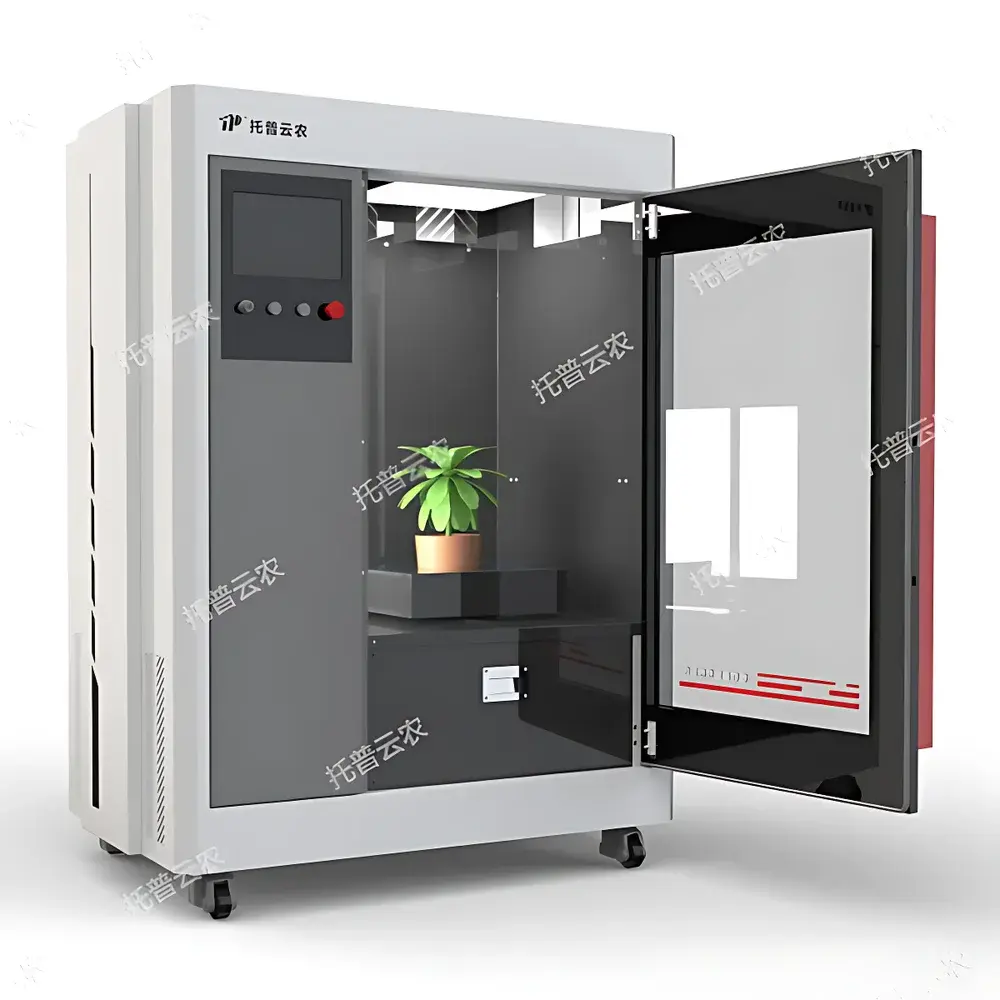
Top Cloud-agri TP-plant-HIPS Hyperspectral Plant Digital Phenotyping System
| Brand | Top Cloud-agri |
|---|---|
| Origin | Zhejiang, China |
| Manufacturer Type | Direct Manufacturer |
| Country of Origin | China |
| Model | TP-plant-HIPS |
| Pricing | Upon Request |
Overview
The Top Cloud-agri TP-plant-HIPS Hyperspectral Plant Digital Phenotyping System is a benchtop, top-view hyperspectral imaging platform engineered for non-destructive, quantitative plant phenotyping under controlled laboratory or greenhouse conditions. It operates on the principle of push-broom hyperspectral imaging in the visible–near-infrared (VNIR) spectral range (400–1000 nm), capturing contiguous spectral bands (≥1200 bands) at high spatial and spectral resolution to reconstruct reflectance spectra for every pixel across the plant canopy. This enables pixel-wise spectral unmixing, biochemical parameter mapping, and multivariate trait extraction—critical for genotype–phenotype association studies, stress response quantification, and functional genomics validation. The system integrates a motorized vertical translation stage with precise height control, ensuring consistent working distance and illumination geometry across heterogeneous plant architectures, including seedlings, rosettes, and mature potted specimens.
Key Features
- Top-view VNIR hyperspectral imaging (400–1000 nm) with ≥1200 spectral bands for high-fidelity spectral signature acquisition
- Automated vertical positioning stage enabling repeatable, standardized imaging geometry across variable plant heights
- Low-flicker, spectrally stable halogen illumination optimized for photosynthetic pigment and nitrogen-sensitive band detection
- End-to-end acquisition-to-analysis workflow completed in ≤70 seconds per potted plant (40 s acquisition + 30 s processing)
- Integrated full-color capacitive touchscreen interface for real-time preview, lighting adjustment, stage control, and live progress monitoring
- Modular, mobile enclosure (1400 × 935 × 1840 mm; <1 kW power draw) designed for flexible deployment in growth chambers, phytotrons, or shared lab spaces
- QR-code-based sample tracking for audit-ready linkage between physical specimens, experimental metadata, and derived phenotypic datasets
Sample Compatibility & Compliance
The TP-plant-HIPS accommodates a broad taxonomic range of potted plants—including monocots (e.g., rice, wheat, maize), dicots (e.g., Arabidopsis, tomato, soybean, Brassica), and perennial horticultural species—without mechanical contact or leaf clipping. Its optical design supports both rosette-stage and upright-growth morphologies up to 120 cm tall. All spectral calibrations are traceable to NIST-traceable reflectance standards, and raw data files adhere to HDF5-based FAIR (Findable, Accessible, Interoperable, Reusable) principles. The system supports GLP-compliant operation through timestamped, user-logged acquisition sessions and immutable metadata embedding (e.g., operator ID, protocol version, environmental chamber settings). While not FDA 21 CFR Part 11-certified out-of-the-box, its software architecture permits integration with validated LIMS environments for regulated breeding programs.
Software & Data Management
The proprietary HIPS-Analyze Suite provides a unified graphical interface for spectral preprocessing (dark current subtraction, flat-field correction, radiometric calibration), region-of-interest (ROI) definition, spectral curve extraction, and multivariate modeling. Core analytical modules include: (i) interactive spectral viewer with overlay-enabled cross-sample curve comparison; (ii) automated vegetation index computation (NDVI, RVI, GVI, WBI, CCCI, NRI); (iii) embedded empirical inversion models for chlorophyll-a concentration, canopy nitrogen content, and water index mapping; (iv) supervised machine learning tools (e.g., PLSR, RF) supporting custom model training using user-provided ground-truth datasets; and (v) export pipelines compliant with MIAPPE (Minimum Information About a Plant Phenotyping Experiment) metadata standards. All processed outputs—including false-color distribution maps, ASCII-spectral matrices, and CSV-index tables—are timestamped, versioned, and exportable without proprietary lock-in.
Applications
- Mutation screening and validation via spectral divergence metrics in TILLING or CRISPR-edited populations
- Quantitative assessment of abiotic stress responses: thermal injury (heat/cold), osmotic stress (drought/salinity), and nutrient deficiency (N/P/K limitation)
- Early-pathogen detection through spectral shift analysis in pre-symptomatic tissue (e.g., fungal elicitation, viral systemic movement)
- Nutrient use efficiency (NUE) phenotyping for breeding programs targeting high-nitrogen-use-efficiency germplasm
- Dynamic canopy development tracking—including LAI estimation, senescence onset timing, and heteroblasty profiling—across time-series experiments
- Cross-species comparative phenomics leveraging transferable spectral features across Brassicaceae, Solanaceae, Poaceae, and Fabaceae lineages
FAQ
What spectral resolution does the TP-plant-HIPS achieve across its 400–1000 nm range?
Spectral sampling interval is hardware-defined by the imaging spectrometer; exact FWHM (Full Width at Half Maximum) is vendor-specified and provided upon technical consultation.
Can the system be integrated with existing greenhouse automation or climate control systems?
Yes—via TCP/IP and Modbus RTU protocols, enabling synchronized triggering with environmental loggers, irrigation events, or LED lighting schedules.
Is spectral data compatible with third-party analysis platforms such as ENVI, MATLAB, or Python (scikit-learn, hylite)?
All raw and processed data are exported in open formats (HDF5, TIFF, CSV, JSON), fully interoperable with standard scientific computing toolchains.
Does the system support kinetic time-series imaging over multiple days or weeks?
The modular enclosure and low-heat illumination allow repeated daily imaging without thermal stress artifacts; ROI-based batch acquisition mode supports longitudinal experiment workflows.
How is calibration stability maintained over extended operational periods?
Daily dark/white reference acquisition is recommended; built-in drift compensation algorithms correct for minor lamp intensity fluctuations using internal photodiode feedback.
Related Products



