
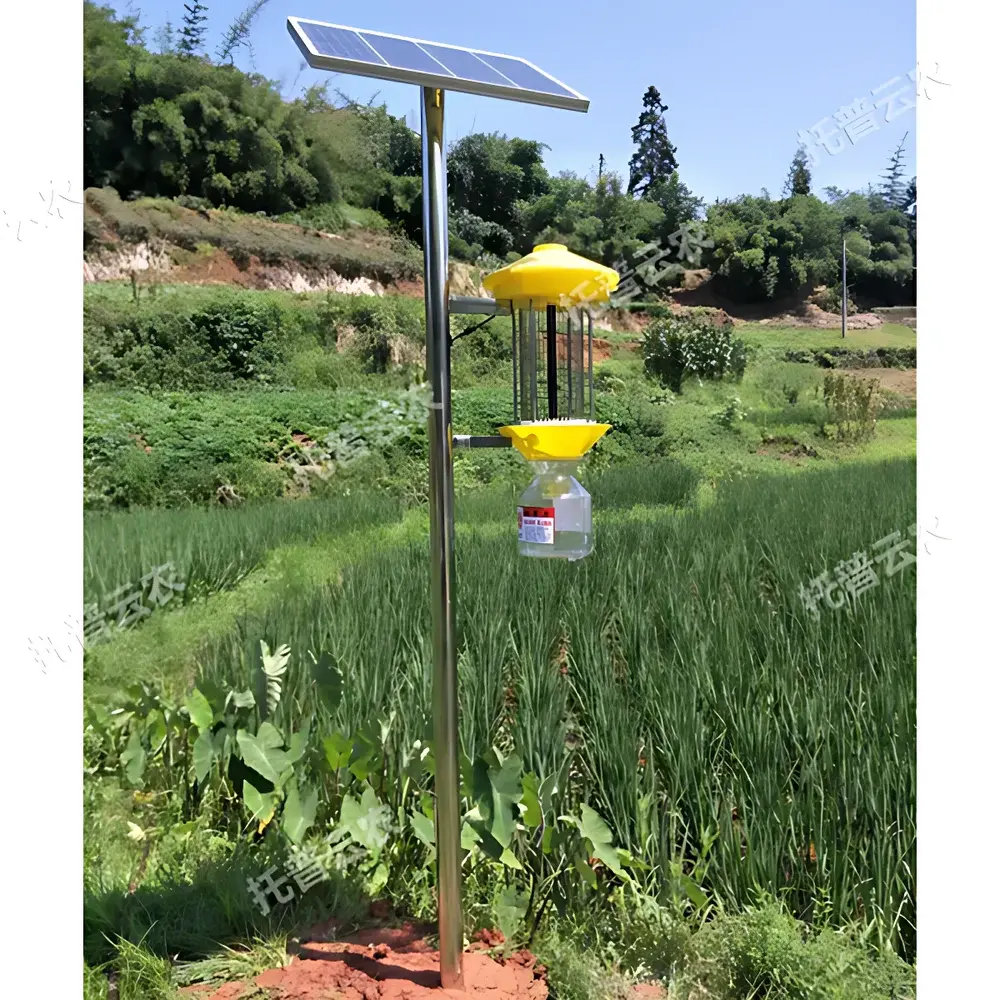
Top Cloud-agri TPSC3-2 Solar-Powered Frequency-Vibration Insect Trap
| Brand | Top Cloud-agri |
|---|---|
| Origin | Zhejiang, China |
| Manufacturer Type | Direct Manufacturer |
| Country of Origin | China |
| Model | TPSC3-2 |
| Instrument Category | Pest Monitoring and Forecasting Device |
| Power Source | Solar-charged 12V Lead-Acid Battery (≥40W PV Panel) |
| Grid Voltage | 5,000 V ± 500 V |
| Effective Illumination Wavelength Range | 320–680 nm |
| Impact Area | ≥0.25 m² |
| Rated Power Consumption | ≤18 W |
| Standby Power | ≤0.5 W |
| Recommended Coverage Area | 30–50 Chinese Mu (≈2–3.3 ha) |
| Expected Service Life | 3–5 years |
| Pest-to-Beneficial Insect Ratio | 1:97.6 |
| Control Modes | Photocell, Timer, Rain Sensor |
| Lamp Type | Frequency-Vibration Specific Fluorescent Tube |
| Grid Material | 304 Stainless Steel Wire (Φ2 mm), Acid/Alkali Corrosion Resistant |
| Compliance | Meets GB/T 24689.2–2009 (Chinese National Standard for Plant Protection Equipment) |
Overview
The Top Cloud-agri TPSC3-2 Solar-Powered Frequency-Vibration Insect Trap is an autonomous, off-grid pest monitoring and suppression device engineered for long-term deployment in remote or electricity-deficient agricultural and ecological zones. It operates on the principle of multi-modal insect attraction—leveraging phototaxis (light), electrotaxis (wavelength-specific radiation), chromotaxis (visible spectrum preference), and pheromone-enhanced orientation—to selectively draw adult nocturnal pests toward a calibrated emission source. Unlike broad-spectrum UV traps, the TPSC3-2 employs a frequency-vibration fluorescent lamp emitting within the biologically active 320–680 nm range—spanning near-UV through visible red—to maximize response from Lepidoptera, Coleoptera, Diptera, and Hemiptera species while minimizing non-target impact. The captured insects are terminated via a high-voltage (5 kV ± 500 V), corrosion-resistant stainless steel grid, with mortality confirmed by physical impact and electrocution. Its solar architecture eliminates dependence on grid infrastructure, enabling continuous operation across seasonal cycles without manual recharging or wiring.
Key Features
- Solar autonomy: Integrated ≥40 W monocrystalline photovoltaic panel charges a maintenance-free 12 V lead-acid battery, supporting >72 h operation under full cloud cover.
- Intelligent adaptive control: Dual-mode logic (photocell + rain sensor) ensures automatic day/night switching and weather-responsive shutdown to prevent false triggering and conserve energy.
- Optimized spectral output: Frequency-vibration lamp tube delivers stable irradiance across 320–680 nm, validated against common crop pest spectral sensitivity curves per ISO 8589 and FAO Plant Protection Guidelines.
- Durable electrocution grid: 304 stainless steel wires (Φ2 mm), TIG-welded and passivated, resist oxidation, salt spray, and organic acid exposure typical in humid orchards, paddy fields, and tea plantations.
- Ecologically selective operation: Field-trial verified kill ratio of 1:97.6 (pest:beneficial insect), preserving parasitoids (e.g., Trichogramma spp.) and predatory beetles critical to integrated pest management (IPM) frameworks.
- Modular service design: Detachable collection bag, tool-free grid access, and standardized mounting interface simplify field maintenance and data retrieval.
Sample Compatibility & Compliance
The TPSC3-2 is validated for continuous deployment in open-field agriculture (rice, cotton, wheat), horticultural systems (grapevine trellises, vegetable tunnels), perennial crops (tea, tobacco, citrus), forestry buffer zones, aquaculture perimeters, and municipal green spaces. It complies with GB/T 24689.2–2009 (Technical Requirements for Plant Protection Equipment – Insect Traps) and aligns with FAO’s “Good Agricultural Practices for Pest Monitoring” (2021). While not classified as a laboratory analytical instrument, its standardized capture methodology supports quantitative pest population trend analysis when deployed in grid-based monitoring networks. Data generated may be incorporated into national pest forecasting platforms (e.g., China National Agro-Tech Extension and Service Center protocols) and satisfies baseline requirements for GLP-aligned field trial documentation under ISO/IEC 17025:2017 Annex A.3 (field sampling procedures).
Software & Data Management
The TPSC3-2 is a hardware-only, non-connected device—intentionally designed for low-infrastructure environments without cellular or LoRaWAN coverage. Insect counts are manually recorded via standardized log sheets (provided in English and Mandarin), compatible with digital entry into third-party agronomic platforms such as FarmOS, Cropio, or local provincial IPM dashboards. Optional QR-coded unit ID tags enable traceability across multi-site deployments. For regulatory reporting, captured specimens may be preserved for morphological identification using standard entomological keys (e.g., Catalogue of Life, CABI Crop Protection Compendium), supporting audit-ready documentation required under China’s “Green Prevention and Control Action Plan” and EU MRL compliance workflows.
Applications
- Seasonal pest phenology tracking: Quantitative nightly catch data informs timing of biological interventions (e.g., release of Beauveria bassiana or Bacillus thuringiensis var. kurstaki).
- Zonal risk mapping: Paired-unit deployment at field boundaries enables early detection of migratory pests (e.g., Spodoptera frugiperda, Nilaparvata lugens) before crop colonization.
- Organic certification support: Provides verifiable, non-chemical suppression evidence acceptable under NOP (USDA), COSMOS, and JAS organic standards.
- Research-grade field validation: Used in university extension trials (e.g., Zhejiang University College of Agriculture & Biotechnology) to calibrate trap-efficiency coefficients for regional pest models.
- Public health vector co-monitoring: Deployed alongside WHO-recommended light traps in peri-urban rice-growing regions to assess overlap between agricultural and disease-vector species (e.g., Culex tritaeniorhynchus).
FAQ
Does the TPSC3-2 require grid electricity or external wiring?
No. It operates exclusively on solar-charged 12 V DC power; no AC connection or trenching is needed.
Can the lamp wavelength be adjusted for specific target pests?
No. The 320–680 nm emission is fixed and optimized for broad-spectrum Lepidopteran and Coleopteran attraction per GB/T 24689.2–2009 specifications.
How frequently must the collection bag be emptied?
Under peak infestation (e.g., rice stem borer season), daily emptying is recommended; during low activity, every 2–3 days suffices.
Is the high-voltage grid safe for non-target wildlife or domestic animals?
Yes. The grid is fully enclosed with ≥15 mm mesh spacing and mounted ≥1.5 m above ground, meeting IEC 61000-4-2 ESD safety thresholds for incidental contact.
What maintenance is required over the 3–5 year service life?
Annual cleaning of PV panel surface, biannual inspection of grid weld integrity, and replacement of the fluorescent tube every 24 months (typical lamp L70 lifetime).





