
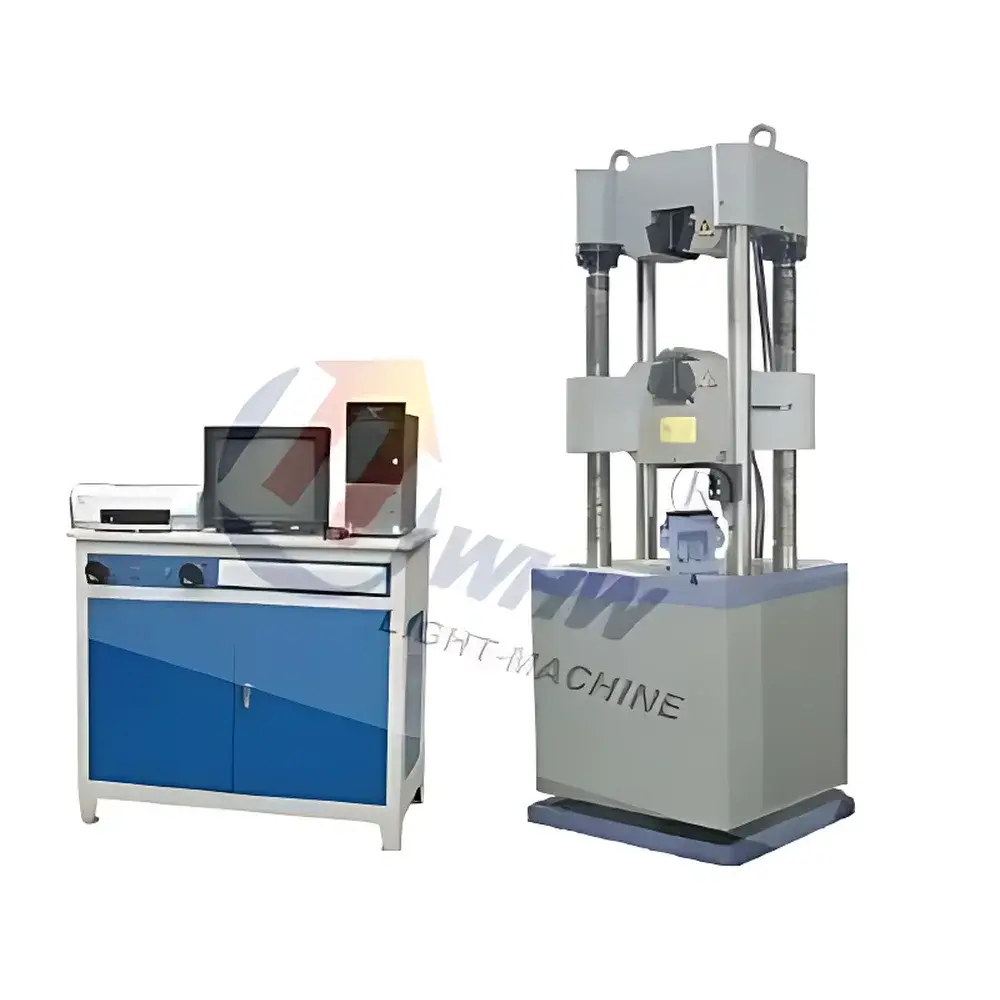
MC009-WEW-600B Microcomputer-Controlled Hydraulic Universal Testing Machine
| Origin | Shanghai, China |
|---|---|
| Manufacturer Type | Authorized Distributor |
| Origin Category | Domestic (China) |
| Model | MC009-WEW-600B |
| Max. Test Load | 600 kN |
| Force Measurement Range | 50–600 kN |
| Force Accuracy | ≤ ±1% of reading |
| Force Resolution | 0.01 kN |
| Displacement Resolution | 0.01 mm |
| Deformation Accuracy | 0.01 mm |
| Max. Tensile Space | 650 mm |
| Max. Compression Space | 380 mm |
| Piston Stroke | 150 mm |
| Round Specimen Grip Range | Φ13–Φ40 mm |
| Flat Specimen Thickness Capacity | 0–15 mm |
| Flat Specimen Max. Width | 75 mm |
| Compression Platen Diameter | φ160 mm |
| Bend Span (Two-Point) | 450 mm |
| Bend Roller Width | 120 mm |
| Bend Roller Diameter | Φ30 mm |
| Max. Deflection for Bending | 150 mm |
| Max. Piston Speed | 50 mm/min |
| Gripping Method | Hydraulic Auto-Clamping |
| Host Dimensions (W×D×H) | 720 × 580 × 2100 mm |
| Control Cabinet Dimensions (W×D×H) | 1000 × 700 × 1400 mm |
Overview
The MC009-WEW-600B Microcomputer-Controlled Hydraulic Universal Testing Machine is a robust, load-frame-based mechanical testing system engineered for high-force static tensile, compression, and flexural testing of metallic and non-metallic materials. It operates on a proven hydraulic actuation principle—utilizing a bottom-mounted servo-controlled oil cylinder to apply precisely regulated axial loads up to 600 kN. The machine’s dual-test-space architecture separates the upper tensile zone (650 mm clearance) from the lower compression/bending zone (380 mm between lower crosshead and base), enabling rapid reconfiguration without realignment. Force measurement relies on a calibrated load cell with ≤ ±1% indication error per ISO 7500-1 Class 1 compliance, while displacement is tracked via high-resolution optical encoder (0.01 mm resolution) and optional extensometer (YYU-25/50, sold separately) for strain-sensitive modulus determination. Designed for structural integrity verification and material property certification, it meets core requirements of ASTM E4, ASTM E8/E9, ISO 6892-1, ISO 37, and GB/T 228.1—making it suitable for QA/QC labs, R&D centers, and third-party testing facilities operating under GLP or ISO/IEC 17025 frameworks.
Key Features
- Bottom-mounted hydraulic actuator with integrated overload and stroke-limit safety interlocks (automatic pump shutdown at >103% full scale or piston top-out)
- Dual-zone test space: 650 mm vertical clearance above upper crosshead for tension; 380 mm working gap below for compression and three-point bending
- Hydraulic auto-clamping grips with adjustable jaw profiles for round specimens (Φ13–Φ40 mm) and flat specimens (0–15 mm thick, up to 75 mm wide)
- Motor-driven crosshead positioning via precision ball screw and chain-reduction transmission, enabling repeatable preload and gap setup
- Real-time force-displacement, stress-strain, and time-based curve acquisition across six configurable plot types
- Modular software architecture supporting ASTM, ISO, and GB standard-compliant test methods—including automatic yield point detection, offset yield (Rp0.2), ultimate tensile strength (Rm), and elastic modulus (E)
Sample Compatibility & Compliance
The MC009-WEW-600B accommodates standardized tensile bars (ASTM E8, ISO 6892-1), cylindrical compression specimens (ASTM C39, ISO 7500-1), and beam-type flexure samples (ASTM D790, ISO 178). Its φ160 mm compression platen, 450 mm bend span, and Φ30 mm support rollers satisfy geometric requirements for most metallic and polymer-based structural tests. All force and displacement transducers are traceably calibrated in accordance with ISO/IEC 17025-accredited procedures. The system supports audit-ready data integrity through timestamped test logs, user-access-level permissions, and exportable ASCII-formatted raw data files—facilitating FDA 21 CFR Part 11 readiness when paired with validated software configuration and electronic signature protocols.
Software & Data Management
The embedded Windows-based control software provides a unified interface for test setup, execution, analysis, and reporting. It features hierarchical user management (Operator, Technician, Administrator), ensuring parameter modification rights are restricted by role. All test parameters—including loading rate, hold duration, and failure criteria—are stored as editable XML templates. Raw data (force, displacement, time, strain) is saved in plain-text CSV format, enabling post-processing in MATLAB, Excel, or statistical analysis platforms. The software includes built-in calculation modules aligned with ISO 6892-1 Annex A (engineering stress-strain), ASTM E111 (modulus of elasticity), and GB/T 228.1 Annex B (non-proportional elongation). Print drivers support all industry-standard PCL and PostScript printers, generating PDF-ready reports with embedded curves, metadata, and digital signatures.
Applications
This system is routinely deployed in metallurgical laboratories for characterizing hot-rolled steel plates, aluminum extrusions, and weld joints per ASTM A370 or EN 10002-1. In civil engineering contexts, it validates concrete cylinder compressive strength (ASTM C39) and asphalt mixture stability (ASTM D6927). Polymer composites labs use its bending module to determine flexural modulus and strength (ISO 178), while quality assurance departments in automotive suppliers rely on its repeatability (CV < 1.2% for Rm on certified reference samples) for incoming material verification. Its modular design also permits integration with environmental chambers (not included) for elevated-temperature mechanical testing up to 200 °C.
FAQ
What standards does this machine comply with for force calibration?
It conforms to ISO 7500-1 Class 1 accuracy requirements for static force measurement, verified using NIST-traceable deadweight standards.
Is the extensometer included in the base configuration?
No—the YYU-25/50 clip-on extensometer is an optional accessory for high-precision strain measurement during modulus and yield testing.
Can test data be exported for regulatory submission?
Yes—raw ASCII output, metadata-rich PDF reports, and audit trail logs (user actions, timestamps, parameter changes) are fully exportable for FDA 21 CFR Part 11 or ISO/IEC 17025 documentation.
What maintenance intervals are recommended for the hydraulic system?
Oil filtration and replacement every 1,500 operating hours or annually (whichever occurs first); pressure relief valve verification every 6 months per OEM service schedule.
Does the system support custom test sequences with multiple load steps?
Yes—the software allows multi-stage programming including ramp-hold-ramp profiles, cyclic loading (with optional add-on controller), and conditional termination based on force, displacement, or time thresholds.



