
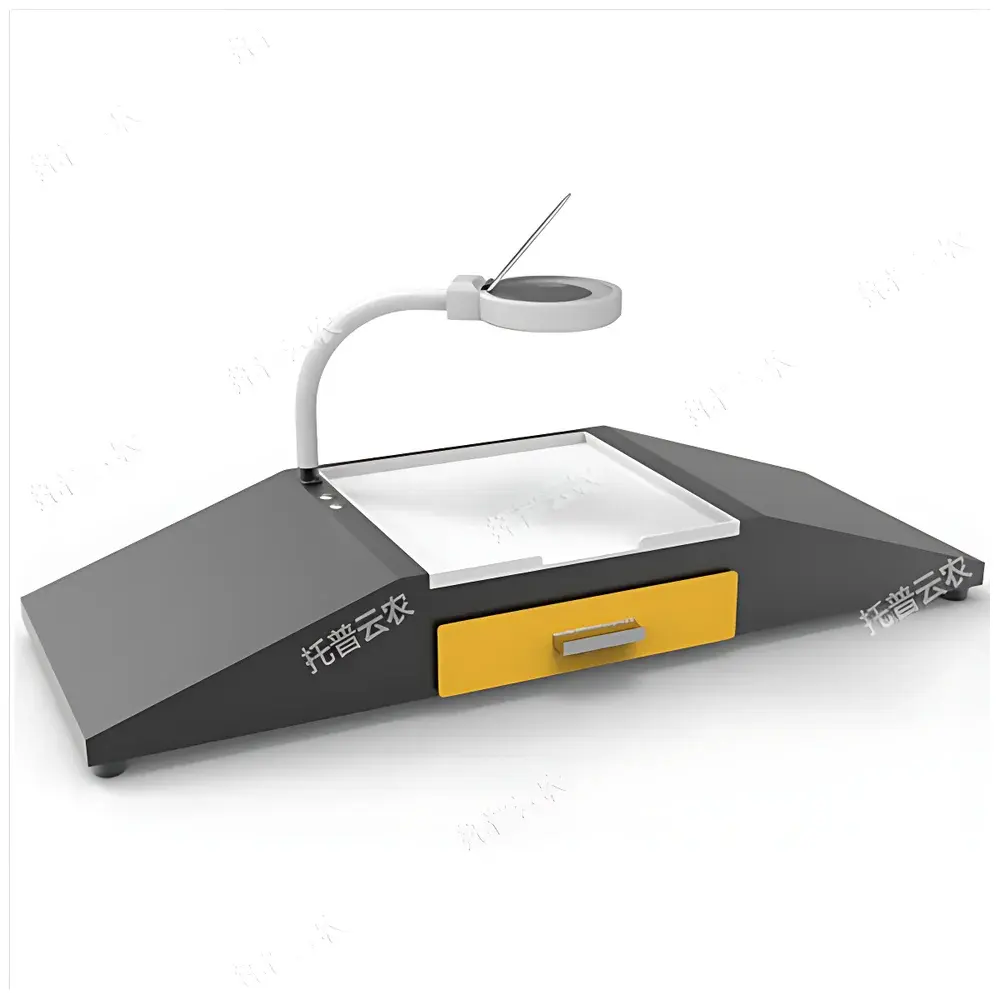
Top Cloud-agri TJD-900 Seed Purity Analysis Workstation
| Brand | Top Cloud-agri |
|---|---|
| Origin | Zhejiang, China |
| Manufacturer Type | Direct Manufacturer |
| Product Category | Horizontal Laminar Flow Clean Bench |
| Cleanliness Class | ISO Class 5 (100-level) |
| Noise Level | <58 dB(A) |
| User Capacity | Single Operator |
| Airflow Pattern | Horizontal Unidirectional Flow |
| Primary Magnification | 5× (main lens), 10× (auxiliary lens) |
| Viewing Window/Table Surface | 320 mm × 320 mm |
| Base Dimensions | 930 mm × 330 mm |
| Illuminated Panel Size | 260 mm × 260 mm |
| LED Illumination Power | 18 W |
| Input Voltage/Frequency | 220 V AC / 50 Hz |
| Integrated Imaging Support | Smartphone-coupled image capture with seed-counting algorithm and 1000-seed weight calculation |
| Data Export | CSV/Excel-compatible reports via companion software |
Overview
The Top Cloud-agri TJD-900 Seed Purity Analysis Workstation is a purpose-built horizontal laminar flow clean bench engineered specifically for standardized seed purity testing in accordance with international seed testing protocols—including ISTA (International Seed Testing Association) Rules and GB/T 3543.3–1995 (China National Standard for Seed Purity Analysis). Unlike general-purpose biosafety cabinets or vertical laminar flow hoods, the TJD-900 integrates optical, ergonomic, and workflow-optimized features to support manual and semi-automated seed separation, identification, and quantification under controlled particulate-free conditions. Its ISO Class 5 (100-level) cleanliness ensures minimal airborne contamination during delicate morphological assessment of pure seeds, other crop seeds, and inert matter—critical for regulatory compliance in seed certification, variety registration, and quality assurance labs.
Key Features
- Ergonomic sloped side panels reduce operator fatigue during prolonged visual inspection sessions, aligning with ISO 9241-5 human factors guidelines for laboratory workstations.
- Integrated dual-mode illumination: uniform white-light transmissive backlight (260 mm × 260 mm electroluminescent panel) combined with adjustable 18 W LED coaxial top lighting—designed to minimize glare and chromatic distortion for accurate color-based seed classification (e.g., distinguishing viable vs. shriveled wheat kernels).
- Dual-magnification optical system: fixed 5× main lens embedded in the ultra-thin observation platform, plus a swiveling 10× auxiliary lens mounted on a flexible gooseneck arm—enabling rapid switching between gross morphology screening and fine-feature verification (e.g., embryo integrity, coat texture, or fungal hyphae detection).
- Containment-optimized mechanical design: raised peripheral lips on left, right, and rear edges prevent lateral seed displacement; a centrally located drop-through aperture allows unobstructed removal of sorted fractions into labeled containers without breaking laminar airflow integrity.
- Modular storage: built-in drawer beneath the work surface provides dedicated, dust-protected storage for classified seed fractions—supporting traceable segregation per ISTA Section 5.2.2 requirements.
- Digital augmentation interface: supports synchronized smartphone imaging via calibrated focal distance markers; captured images are processed using validated computer vision algorithms for species-agnostic seed counting, outlier rejection, and automatic 1000-seed weight extrapolation based on user-defined calibration curves.
Sample Compatibility & Compliance
The TJD-900 accommodates a broad spectrum of agricultural seeds—including but not limited to maize (Zea mays), rice (Oryza sativa), wheat (Triticum aestivum), soybean (Glycine max), rapeseed (Brassica napus), peanut (Arachis hypogaea), sesame (Sesamum indicum), mung bean (Vigna radiata), adzuki bean (Vigna angularis), and diverse forage and cover crop species. Its horizontal airflow architecture eliminates turbulence-induced particle resuspension, preserving sample integrity during manual winnowing, panning, or brush-assisted separation. The workstation meets structural and performance criteria outlined in ISO 14644-1:2015 (cleanroom classification), EN 12464-1:2021 (lighting for indoor workplaces), and GB/T 25915.1–2021 (Chinese cleanroom standards). It is routinely deployed in GLP-compliant seed testing laboratories accredited to CNAS-CL01 (equivalent to ISO/IEC 17025).
Software & Data Management
Data acquisition and reporting are managed through a vendor-provided desktop application compatible with Windows 10/11 and macOS 12+. The software logs timestamped session metadata (operator ID, sample ID, date/time, ambient temperature/humidity if sensor-integrated), stores annotated images with EXIF metadata, and generates audit-ready purity reports compliant with ISTA Form A templates. All counting corrections (via +/− manual adjustment buttons) are immutably recorded in the audit trail. Export functions support .xlsx, .csv, and PDF formats—with column headers mapped to ISTA-defined purity categories (pure seed, other crop seeds, weed seeds, inert matter). Optional API integration enables direct ingestion into LIMS platforms supporting HL7 or RESTful endpoints.
Applications
- Official seed certification testing per national regulatory frameworks (e.g., USDA-APHIS, MOA China, DUS testing authorities)
- Pre-shipment quality control in seed export facilities requiring phytosanitary documentation
- Research-grade seed lot homogeneity assessment in plant breeding programs
- Teaching laboratories for hands-on instruction in seed morphology, taxonomy, and ISTA Rule interpretation
- Grain quality evaluation where kernel purity impacts milling yield or food safety thresholds (e.g., ergot-contaminated rye)
FAQ
Does the TJD-900 comply with FDA 21 CFR Part 11 for electronic records?
No—the device itself does not generate regulated electronic records; however, its companion software supports optional 21 CFR Part 11 add-ons (electronic signatures, audit trail encryption, role-based access control) when deployed in pharmaceutical-adjacent ag-biotech QA environments.
Can the magnification system be upgraded to include digital camera coupling?
Yes—optional C-mount adapters and 5 MP USB3.0 industrial cameras are available for direct integration with the auxiliary lens port, enabling real-time video streaming and frame-grabbing for automated training dataset generation.
Is HEPA filter replacement required, and what is the maintenance interval?
The horizontal-flow HEPA filter (H14 grade, ≥99.995% @ 0.3 µm) requires replacement every 12–18 months under continuous operation; pre-filters should be cleaned biweekly and replaced quarterly per ISO 14644-3 maintenance protocols.
What electrical safety certifications does the unit hold?
It carries CE marking per EN 61000-6-3 (EMC) and EN 61000-6-4 (immunity), as well as CCC certification for the Chinese domestic market (GB 4706.1–2005).
Is remote firmware update supported?
Firmware updates are delivered via encrypted USB drive only—no network connectivity is embedded, ensuring air-gapped security for regulated lab environments.



