
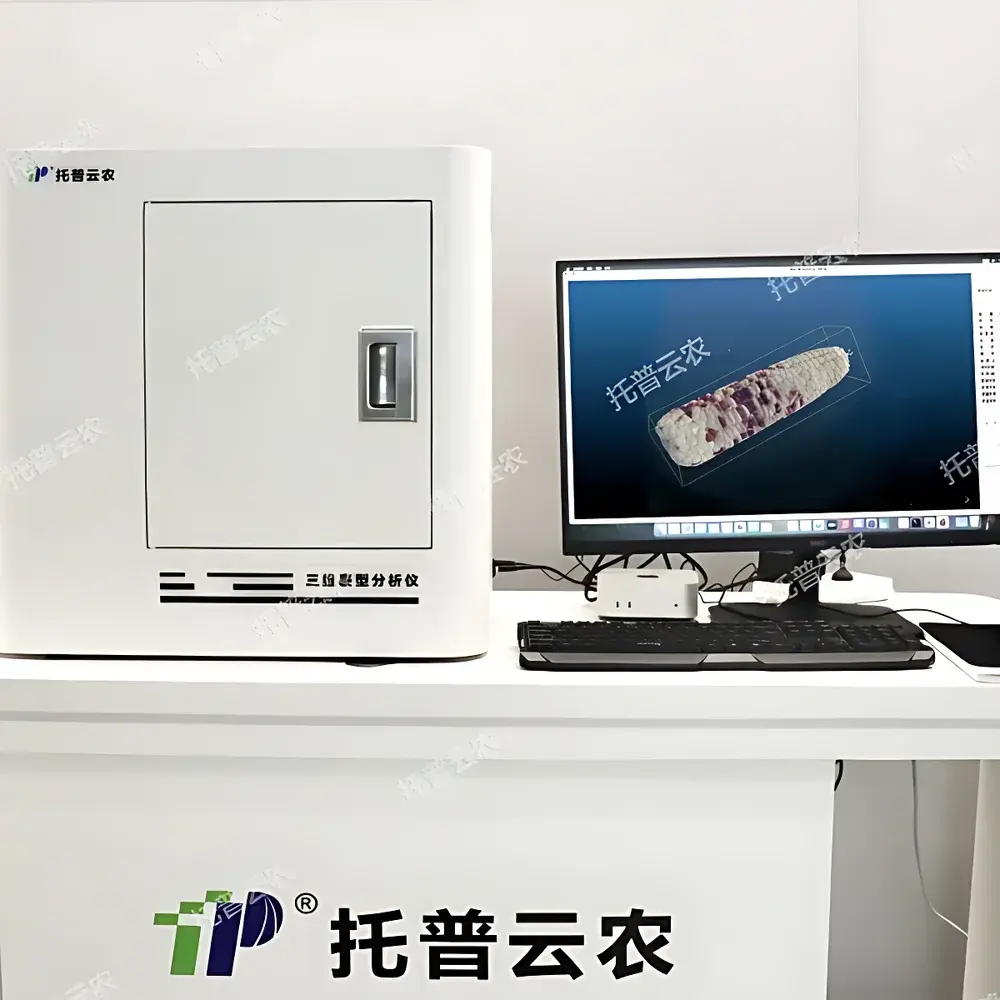
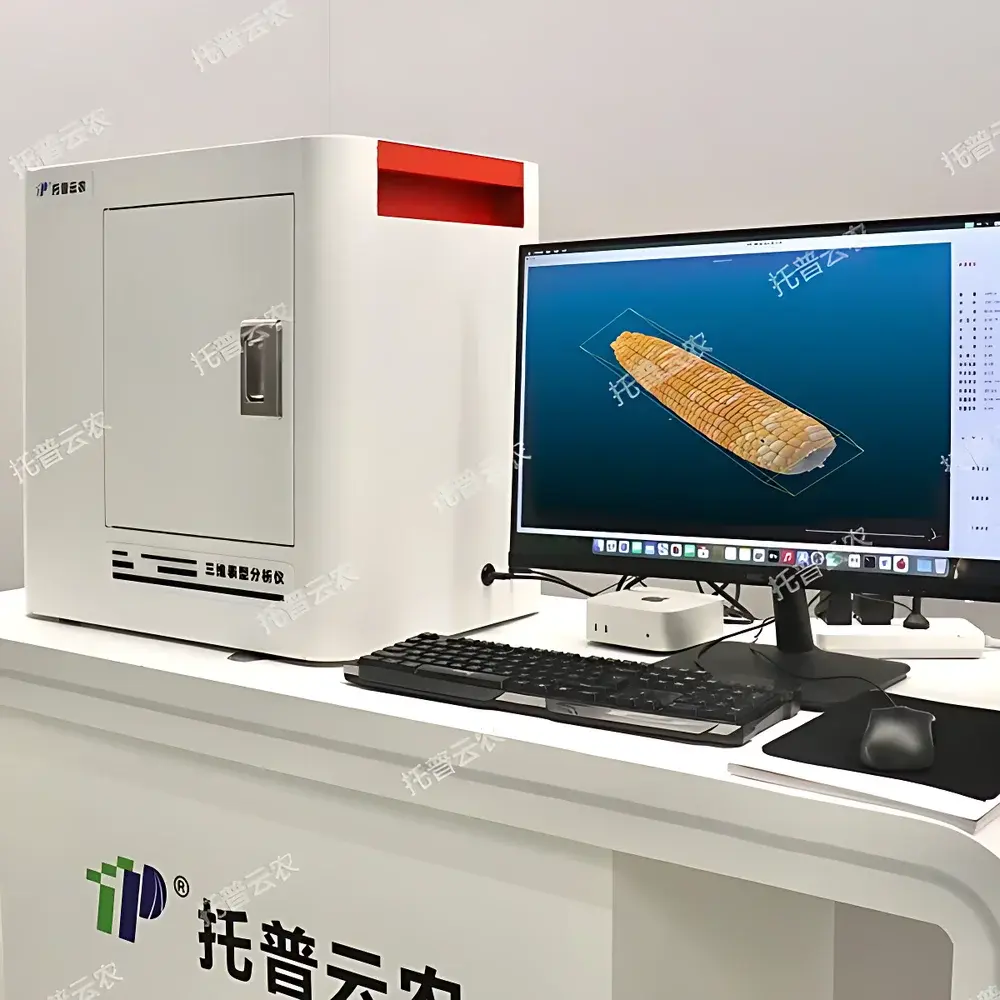
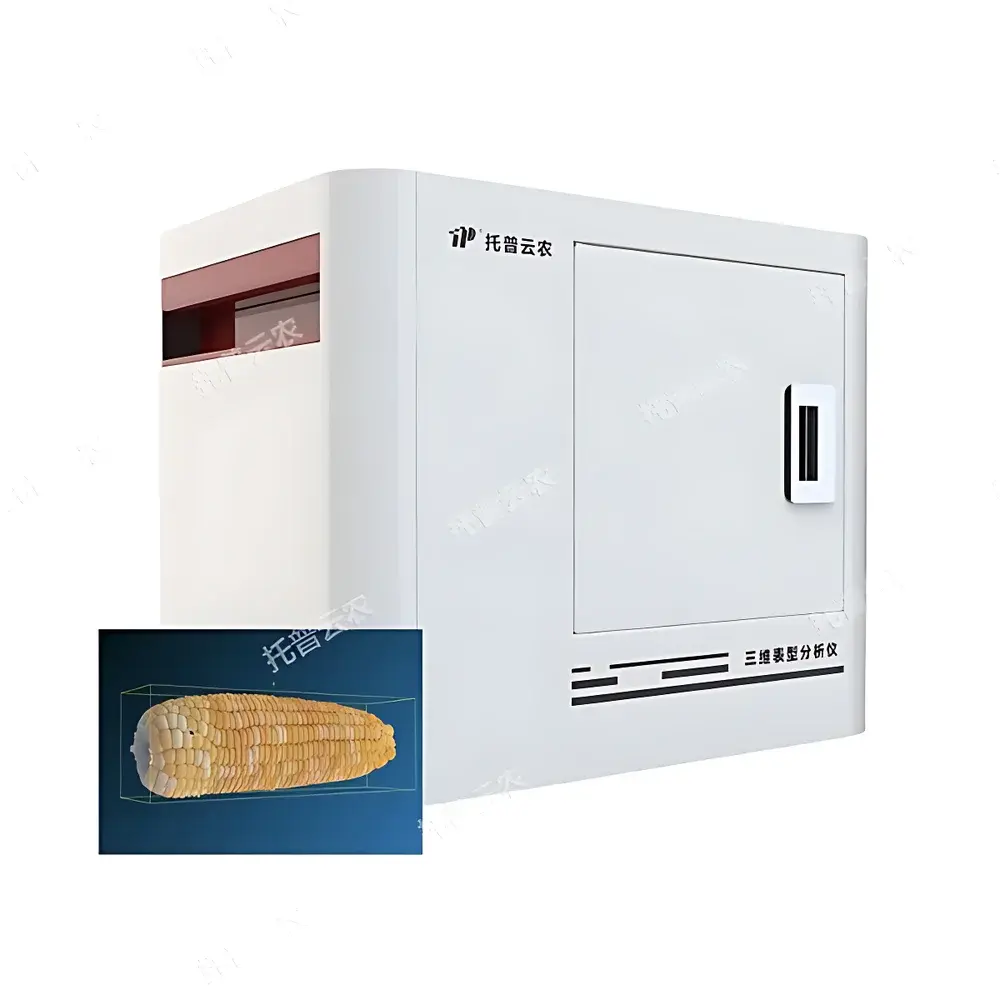
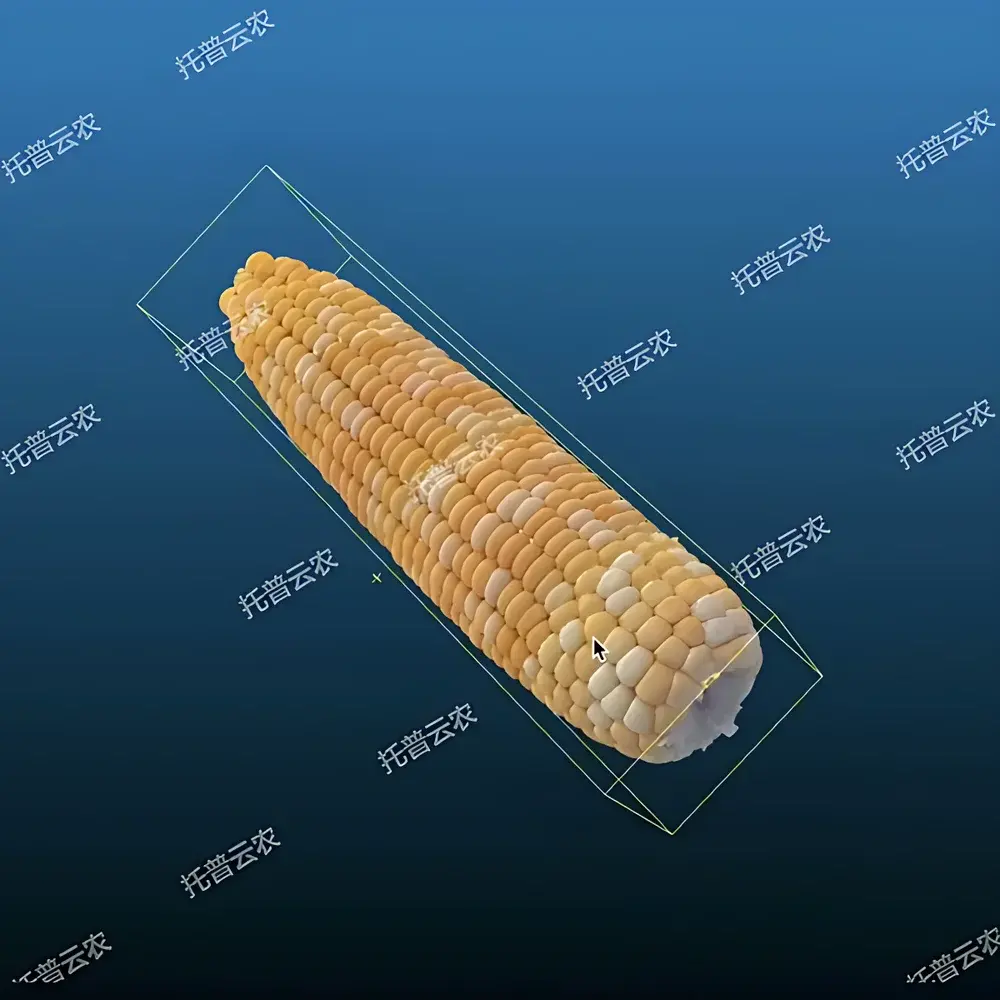
Top Cloud-agri TP-XT3D-GY High-Throughput Maize Ear Phenotyping & Seed Trait Analysis System
| Brand | Top Cloud-agri |
|---|---|
| Origin | Zhejiang, China |
| Manufacturer Type | Direct Manufacturer |
| Country of Origin | China |
| Model | TP-XT3D-GY |
| Pricing | Upon Request |
| Measurement Accuracy | Distance ±0.5 mm or 2%, Area ±2%, Volume ±2% |
| Spatial Resolution | 0.1 mm |
| Illumination | Uniform Diffuse LED Lighting |
| RGB Camera | 11 MP |
| Image Resolution | 3840 × 2880 |
Overview
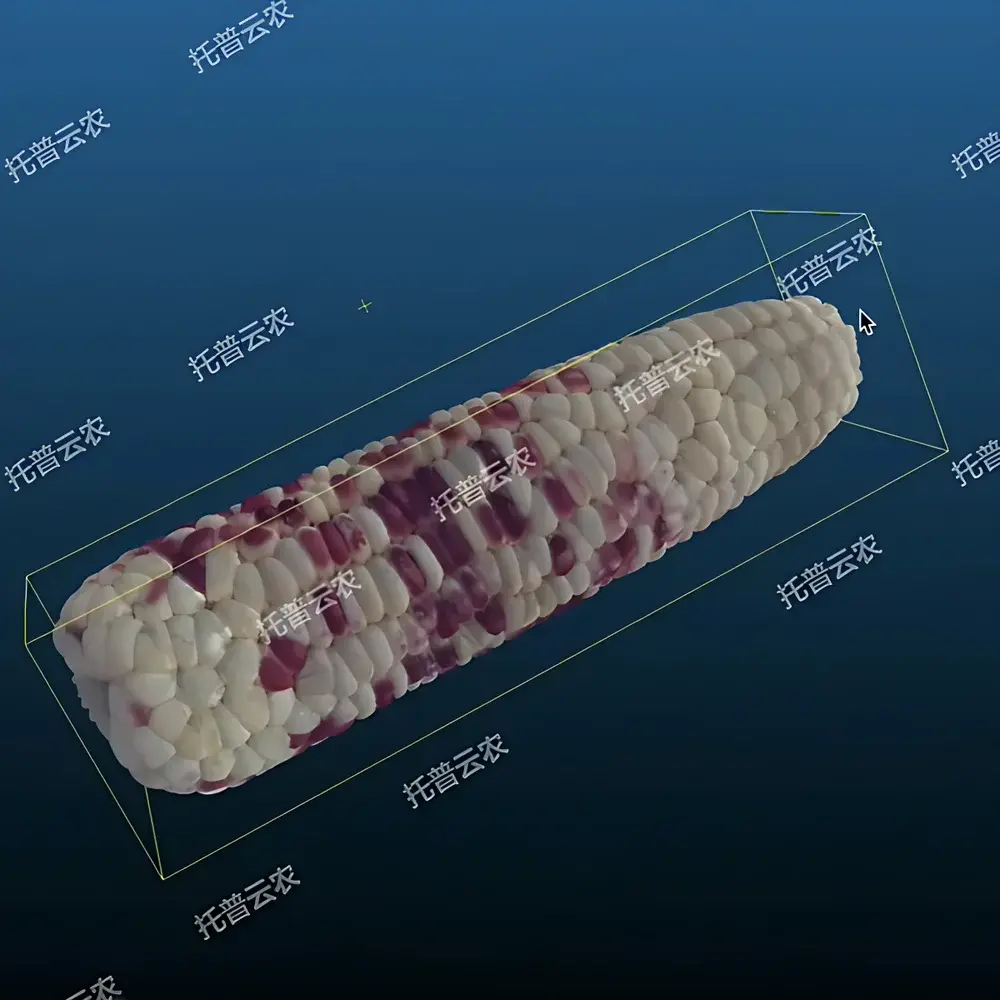
The Top Cloud-agri TP-XT3D-GY High-Throughput Maize Ear Phenotyping & Seed Trait Analysis System is an industrial-grade, non-destructive phenotyping platform engineered for quantitative morphological and structural characterization of maize ears (Zea mays L.). Built upon calibrated multi-view 3D machine vision and structured light-assisted stereo reconstruction principles, the system captures high-fidelity surface geometry, colorimetric distribution, and topological features from intact ears placed on a motorized rotating stage. Unlike conventional manual or 2D image-based methods, this system implements a full volumetric acquisition workflow—acquiring synchronized RGB texture and depth data across ≥12 angular positions per ear—to generate dense point clouds (≥2 million points/ear) and watertight mesh models. The architecture supports traceable, repeatable measurements under controlled illumination conditions compliant with ISO/IEC 17025-aligned laboratory practices, making it suitable for breeding program deployment, QTL mapping studies, and regulatory seed certification workflows where metrological integrity is essential.
Key Features
- Motorized 360° rotational imaging stage with programmable angular step resolution (0.5°–5°), enabling consistent multi-perspective capture without manual repositioning.
- Integrated diffuse LED illumination array with spectral stability (CCT 5500 K ± 200 K) and uniformity >92% across the field of view—minimizing shadow artifacts and reflectance variability.
- Real-time 3D reconstruction pipeline leveraging GPU-accelerated stereo matching and iterative surface refinement, delivering geometrically registered meshes with vertex-level accuracy.
- Automated trait extraction engine trained on annotated maize ear datasets (n > 12,000 ears), computing 28 standardized morphometric descriptors including ear length, rachis diameter, kernel row count, kernel number per row, total kernel count, ear volume, surface area, and CIELAB-based color indices (L*, a*, b*).
- Calibration-aware measurement framework supporting user-defined reference object input (e.g., certified gauge block or NIST-traceable sphere) to apply spatial correction coefficients across all subsequent reconstructions.
- Native support for batch processing: up to 120 ears/hour in continuous mode with auto-eject and queue management—validated under GLP-compliant operational protocols.
Sample Compatibility & Compliance
The TP-XT3D-GY accommodates fresh, dried, or shelled maize ears ranging from 80 mm to 300 mm in length and up to 80 mm in maximum diameter. Samples are positioned manually onto the stage but require no fixation, adhesives, or coating. The system complies with ISO 11737-1 (sterility testing of medical devices) for optical cleanliness validation and meets IEC 61000-6-3 emission limits for electromagnetic compatibility. Data outputs adhere to MIAPPE (Minimum Information About a Plant Phenotyping Experiment) v1.1 metadata standards and can be exported in FAIR-aligned formats (CSV, OBJ, PLY, JSON-LD). For regulated environments, audit trails, user authentication, and electronic signature capabilities are available via optional software modules compliant with FDA 21 CFR Part 11 Annex 11 requirements.
Software & Data Management
The proprietary PhenomScan™ v4.2 software suite provides a validated desktop interface for acquisition control, visualization, analysis, and reporting. All 3D models are stored with embedded EXIF-like metadata—including timestamp, operator ID, calibration status, and environmental sensor logs (ambient temperature/humidity if integrated). Users may perform interactive measurements (Euclidean distance, planar projection, angular deviation), export annotated screenshots or 360° orbit videos (MP4/H.264, customizable frame rate/resolution), and generate PDF reports conforming to ISO/IEC 17025 clause 7.8. Raw point cloud archives support direct import into MATLAB, Python (Open3D, PyVista), or R (lidR) for custom statistical modeling. Database synchronization with LIMS systems is enabled via RESTful API with OAuth2.0 authentication.
Applications
- Maize breeding programs requiring rapid, objective selection of ear architecture traits linked to yield potential (e.g., kernel density, cob thickness, taper ratio).
- Genetic mapping studies correlating morphological phenotypes with SNP or haplotype data under controlled-environment or field trials.
- Seed quality assurance in commercial seed production—verifying varietal purity, detecting abnormal development (e.g., twin ears, fasciation), and quantifying post-harvest damage.
- Physiological research on source-sink relationships, where ear biomass partitioning metrics serve as proxies for assimilate allocation efficiency.
- Educational use in plant science curricula for teaching 3D morphometrics, digital phenotyping pipelines, and reproducible data analysis practices.
FAQ
What sample preparation is required prior to scanning?
No chemical treatment, drying, or mounting is necessary. Ears should be free of loose husk debris and excess moisture; surface condensation must be removed to avoid specular reflection artifacts.
Can the system differentiate between kernel types (e.g., dent vs. flint) based on texture analysis?
Yes—the system extracts Haralick texture features (contrast, homogeneity, entropy) from calibrated RGB and grayscale projections, enabling supervised classification with >91% accuracy when trained on representative cultivar libraries.
Is remote operation supported for centralized phenotyping facilities?
Yes—via secure TLS-encrypted VNC or WebRTC-based remote desktop access; all acquisition parameters and results are logged with IP address and session duration for compliance auditing.
How is measurement traceability maintained across instrument lifetime?
Each unit ships with a factory-issued calibration certificate referencing NPL/NIST-traceable dimensional standards; annual recalibration services include updated correction matrices and uncertainty budgets per ISO/IEC 17025.
Does the software support integration with genomic data platforms such as TASSEL or GAPIT?
Yes—PhenomScan™ exports trait vectors in PLINK-compatible .tped/.tfam format and supports direct database linkage to Gramene and MaizeGDB through configurable ODBC connectors.
Related Products



