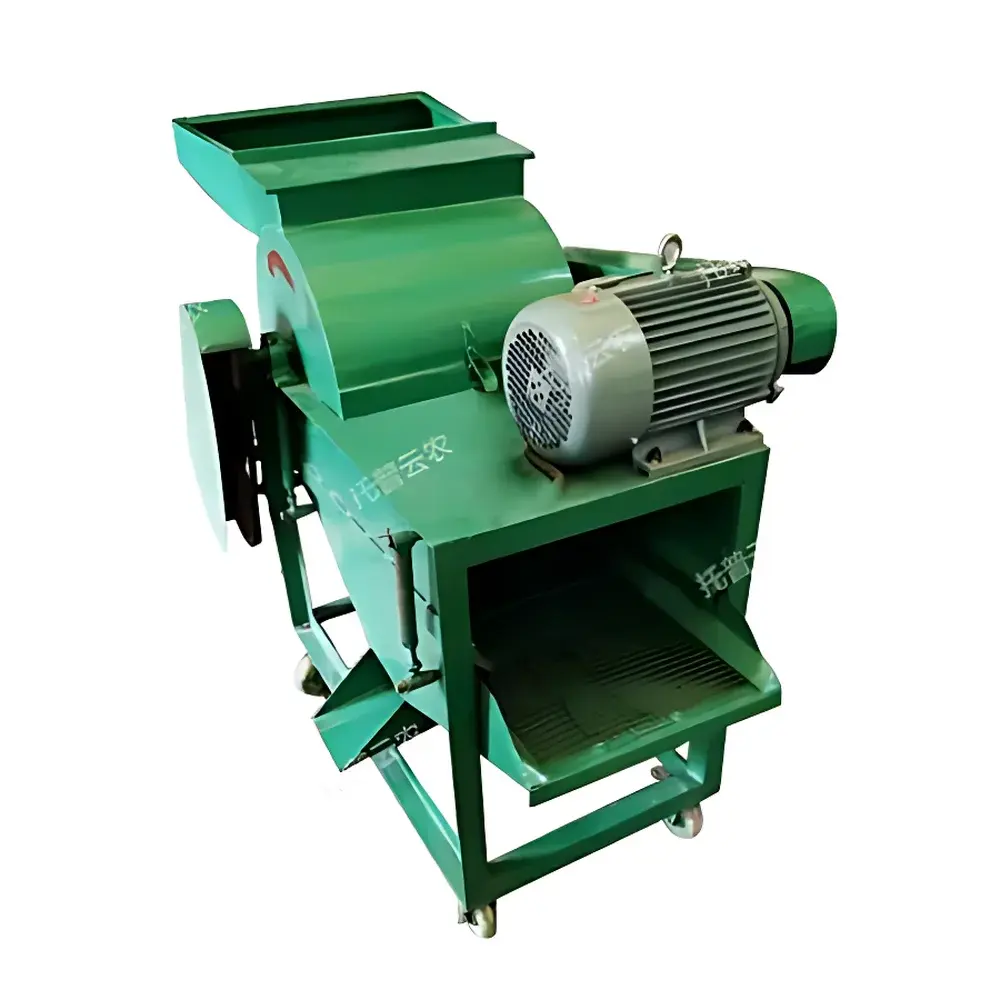
Top Cloud-agri KTY-380 Corn Plot Threshing Machine
| Brand | Top Cloud-agri |
|---|---|
| Origin | Zhejiang, China |
| Manufacturer Type | Direct Manufacturer |
| Country of Origin | China |
| Model | KTY-380 |
| Quotation | Available upon Request |
| Production Capacity | 500 kg/h (at 14–18% moisture content) |
| Threshing Efficiency | ≥99% |
| Kernel Breakage Rate | ≤1.5% (excluding naturally damaged kernels) |
| Total Grain Loss | <1.0% |
| Residual Grain in Machine | 0 g |
| Cleaning Time | 3 seconds |
| Motor Power | 1.5 kW |
| Voltage | 380 V AC |
| Motor Speed | 1390 rpm |
| Overall Dimensions (L×W×H) | 1250 × 700 × 1100 mm |
| Feeding Method | Full-feed |
| Operator Requirement | 1 person |
Overview
The Top Cloud-agri KTY-380 Corn Plot Threshing Machine is an engineered solution specifically developed for small-plot field trials in maize (Zea mays L.) breeding and agronomic research. Unlike conventional threshers designed for bulk harvest, this unit operates on the principle of controlled, low-impact mechanical separation—utilizing a hand-held, motor-driven drum equipped with arc-shaped tines (bow teeth) to gently dislodge kernels from cobs while preserving seed integrity. Its design prioritizes plot-level experimental fidelity: minimal cross-contamination between adjacent genetic entries, negligible kernel damage, and complete grain recovery—critical requirements for genotype evaluation, yield component analysis, and seed quality assessment in controlled trial environments.
Key Features
- Full-feed, single-operator operation with ergonomic handheld drum assembly for precise, plot-by-plot threshing control
- Patented arc-toothed drum geometry optimized for cob surface contact uniformity and reduced kernel fracture under variable moisture conditions (14–18% w.b.)
- Zero-residue chamber architecture: seamless internal surfaces and fully extractable collection hopper eliminate grain retention points—validated by ≤3-second cleaning cycle
- Modular access design: hinged cover and lift-away drum enable rapid visual inspection, residue removal, and maintenance without tools
- Corrosion-resistant electrostatic powder-coated steel frame, rated for extended outdoor use in humid, dusty, and saline-prone field conditions
- Industrial-grade 1.5 kW three-phase induction motor (380 V, 1390 rpm) delivering consistent torque output across load fluctuations typical of heterogeneous plot material
Sample Compatibility & Compliance
The KTY-380 accommodates whole maize ears ranging from 80 mm to 220 mm in length and 30 mm to 65 mm in diameter—covering standard dent, flint, and specialty germplasm types used in national variety trials. It maintains performance consistency across moisture gradients (12–22% w.b.), with validated metrics meeting ISO 5635:2021 (Agricultural machinery — Threshing machines — Test methods and performance requirements) for plot-scale equipment. The machine supports Good Agricultural Practice (GAP) and Good Experimental Practice (GEP) workflows through traceable batch handling and operator-controlled feed sequencing. While not certified for food-grade processing, its non-porous construction and zero-residue design align with OECD Seedling Test Guidelines (2022) for genetic purity verification.
Software & Data Management
As a standalone mechanical system, the KTY-380 does not incorporate embedded electronics or digital interfaces. However, it is fully compatible with external data capture protocols used in modern breeding programs—including integration with field data collection tablets (e.g., AgriData™, FieldBook), barcode-scanned plot identifiers, and electronic lab notebooks (ELNs). Its consistent throughput (500 kg/h ±5%) and repeatable loss profile (<1.0% total) enable reliable normalization of yield data across hundreds of plots per day. For GLP-compliant trials, operators may log batch IDs, moisture readings, and cleaning timestamps manually or via connected mobile forms—supporting audit-ready documentation per ISO/IEC 17025:2017 Annex A.2 (recording of equipment usage).
Applications
- Maize variety evaluation trials conducted by national agricultural research institutes (e.g., CAAS, ICAR) and international centers (CIMMYT, IITA)
- Seed certification programs requiring strict isolation and zero carryover between genotypes
- QTL mapping studies where kernel integrity must be preserved for subsequent DNA extraction and genotyping
- Pre-breeding nurseries handling elite introgression lines with limited seed quantity
- Phenotyping platforms measuring ear-related traits (kernel number, row count, tip fill) prior to destructive sampling
- Teaching laboratories in agronomy and plant breeding curricula emphasizing experimental design rigor
FAQ
Is the KTY-380 suitable for high-moisture corn (>22% w.b.)?
No—optimal performance is validated at 14–18% moisture. Above 22%, increased kernel adhesion may reduce threshing efficiency and elevate breakage; pre-drying or conditioning is recommended.
Can the machine be operated on a generator or single-phase supply?
It requires stable 380 V three-phase power. Use with phase converters or industrial generators rated ≥2.2 kVA is possible but must maintain voltage regulation within ±5% to prevent motor overheating.
What maintenance intervals are recommended for sustained plot-trial accuracy?
Daily visual inspection of tine wear and hopper seals; bi-weekly torque verification of drum mounting bolts; annual motor insulation resistance testing per IEC 60034-1.
Does Top Cloud-agri provide calibration documentation or test reports?
Yes—each unit ships with a factory performance report including measured threshing efficiency, breakage rate, and residual grain validation against ISO 5635 reference samples.
How is cross-contamination prevented between sequential plots?
Through structural elimination of retention zones (0 g residual capacity), standardized 3-second dry-cleaning protocol, and optional color-coded hopper liners for visual traceability.